There is a traditional idiom called "Saiou ga Uma" (The Old Man and His Horse).
It means, "Happiness and misfortune in human life are unpredictable. Therefore, good fortune is not worth celebrating, and misfortune is not worth grieving over."
In the "Human Affairs" chapter of the "Huainanzi," there is the following fable.
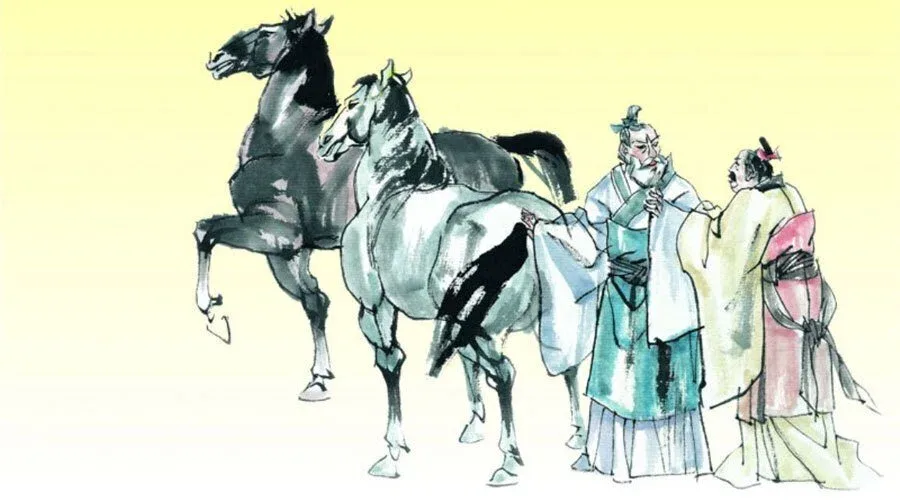
Long ago, near a fortress on the border, there lived an old man skilled in divination.
One day, the horse the old man kept ran away to the land of the Hu (a northern nomadic tribe).
Thinking the old man must be very sad, people came to comfort him, but the old man said calmly.
—This will surely turn into a blessing.
Then, a few months later, the runaway horse returned, bringing with it a fine steed from the Hu.
Thinking the old man must be very happy, people rushed to congratulate him, but the old man said calmly again.
—This might turn into a disaster.
When the fine steed arrived at the house, the old man's son became obsessed with riding, constantly switching between horses.
One day, the son accidentally fell from a horse and broke his thigh bone.
When everyone came to visit him out of concern, the old man said with composure,
"This will surely turn into a blessing."
No matter what happened, the old man never panicked or grieved, and lived his life as leisurely as ever.
A year later, the Hu army invaded in great numbers. Young men drew their bows to fight, and nine out of ten people near the border were killed in battle.
However, because the old man's son had a broken thigh and was physically disabled, he was exempted from military service, and both father and son were able to survive safely.
In human life, one never knows what is good fortune and what is misfortune.
The "Huainanzi" is a Taoist text. The passage about "Saiou ga Uma" speaks to the Taoist philosophy of "non-action" (wu wei), advising one to live naturally without forcing things.
In human life, fortune and misfortune, luck and disaster, are constantly shifting. A fortunate event can become the cause of misfortune, and a tragic event can become the catalyst for good fortune. Therefore, the main point of this fable is that it is wise to live by accepting things as they are, without getting carried away when successful or losing heart when failing.
In daily usage, this idiom is often used to comfort or encourage someone who has encountered bad luck or misfortune.
Incidentally, there is also the phrasing "Ningen Banji Saiou ga Uma." This is based on a poem by the Yuan dynasty monk Kaiji Genki,
which contains these lines.
The word "Ningen" in "Ningen Banji Saiou ga Uma" is generally read as "ningen" (human), but since it means "the human world" in classical Chinese, it should originally be read as "jinkan".
*This article is a revised version of the following post.