When people hear the word 'lawyer,' some may have images of them using difficult language, being intimidating, or having unclear fees.
I want to dispel those negative images of lawyers and be someone you can feel comfortable and secure consulting with.
In this article, I will talk about 'NDAs (Non-Disclosure Agreements)' for business owners, managers, and legal staff of small and medium-sized enterprises.NDAs (Non-Disclosure Agreements)I will avoid getting bogged down in detailed theory and instead provide practical knowledge that you can use in your daily work starting tomorrow.
✅ We are currently holdingfree legal seminarsonline.
Reusing templates is dangerous! The real reason why NDAs (Non-Disclosure Agreements) are essential in modern business
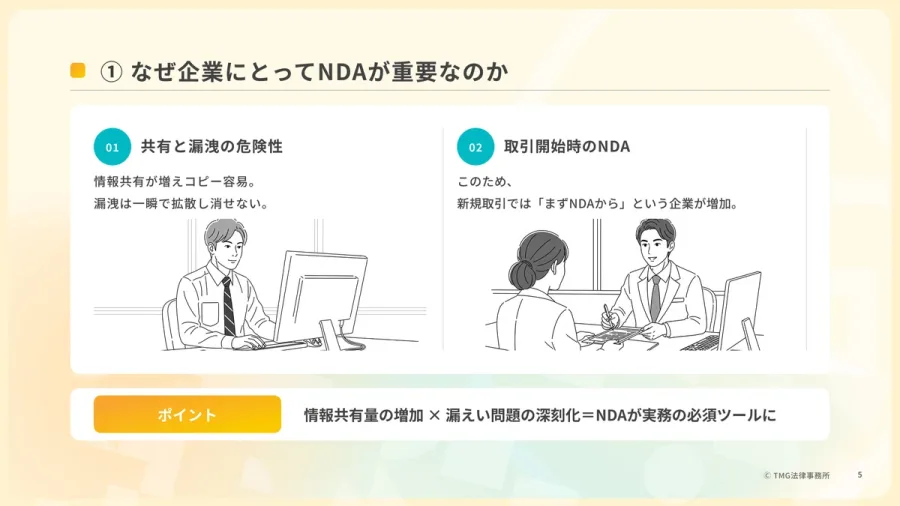
In recent years, data sharing has become easy through email, cloud storage, and messenger apps.
Because of this, if confidential business information is sent to the wrong person or exposed on the internet, it spreads in an instant, making it a difficult era to recover.
For this reason, more companies are presenting NDAs to urge caution in handling information.
Is your company reusing the same NDA template you used in the past? Reusing a template without understanding its contents can lead to the following types of trouble.
Management becomes difficultIf the scope of confidential information is too broad, the receiving party will not know what or how to manage it, which ultimately increases the risk of information leakage.
Conversely, if you decide to handle confidential information only as specified in advance, there is a risk of forgetting to communicate it, especially from the perspective of the party providing the information.
You need to think specifically about whether this transaction involves more information being received or provided, and whether there is a possibility that important information is included.
If the confidentiality period is too long, you must continue to hold the information even after the contract ends, which increases the burden of management.
Thinking 'It's safe because of the Unfair Competition Prevention Act' is a misunderstanding! The decisive difference between the law and an NDA (Non-Disclosure Agreement)
Regarding information leakage, there are also regulations by laws such asthe 'Unfair Competition Prevention Act'andthe 'Act on the Protection of Personal Information.'However, not all employees working in the field at companies are well-versed in these specialized laws.
An NDA is needed to complement the law as a'set of notes or a rulebook'to clearly communicate the rules between companies that 'I want you to protect this information' and to prevent trouble before it happens.
[Illustrated by Situation] 3 Transaction Cases Where Signing an NDA (Non-Disclosure Agreement) is Essential
NDAs are used in the preparation stage before entering into a full-scale contract.
Information exchange between companies (equal relationship)It is used for preliminary discussions before jointly creating a product by sharing each other's know-how and strengths.
Business Outsourcing/Subcontracting (Hierarchical Relationship)This is used when the party requesting work (the client) provides information to the party being requested (such as an agency) for tasks like system development or advertising production. If information is only being provided by the client, a one-way NDA (in the form of a written pledge) may be signed.
M&A and Business TransfersBasically, since the buyer views the seller's information, the buyer provides a one-way NDA to the seller. However, in cases like mergers where both parties disclose information to each other, a two-way NDA may be used.
Prevent Information Leaks Before They Happen! '3 Important Checkpoints' When Providing Your Company's Confidential Information to Others
When providing important information to another party, check the following points in the contract.
Feasibility of Sub-outsourcingWhen work is sub-outsourced to freelancers or external contractors for tasks like web production, check whether they are also required to sign an equivalent NDA to ensure information does not leak from there.
Identification of Confidential InformationBy indicating in advance that 'this is confidential information,' it becomes easier to draw the other party's attention to it.
Obligation to Return or Destroy Information if the Contract is Not ConcludedTo prevent the other party from starting a similar business or poaching employees after negotiations fall through in M&A or similar situations, rules for the return or destruction of information are essential. It is also effective to disclose information in stages, such as holding back information with high market value or high confidentiality until later.
[Taught by a Pro] 5 Clause Modification Techniques to Optimize NDA Templates for Your Company
It is important not to use templates as they are, but to fine-tune them according to the transaction.
Subject of Confidentiality ObligationsIf both parties are disclosing information, a 'two-way' type is reasonable; if only one party is providing something like blueprints, as in manufacturing outsourcing, a 'one-way' type is reasonable.
Definition of Confidential InformationThere is a 'limited type' where only specified items are considered confidential, and a 'non-limited type' where everything provided is considered confidential. It is recommended to specifically list items you want to protect, such as customer lists or recipes.
Scope of Third-Party DisclosureWhile it is standard to limit disclosure to internal staff (officers and employees), if necessary for business operations, you should revise the agreement to include parent companies, affiliates, professionals such as lawyers and tax accountants, and sub-contractors.
Contract DurationIt is common to set this for about 3 to 5 years from the date of information disclosure. If it is unreasonably long, it becomes a burden on the receiving party.
DamagesIn the event of a leak, the scope of damages is often too broad to calculate accurately, and identifying (proving) the leak route is difficult, so in reality, damage clauses are often not very useful.
However, if you want to prevent leaks as much as possible in advance, you need to include a clause that holds the other party liable for damages without limiting the scope or setting a cap.
The Real Work Starts After Signing! 'Building Internal Systems' and 'Managing External Contractors' to Prevent Information Leaks
Just because you signed a contract does not mean your information is automatically protected. 'Proactive prevention' to stop leaks before they happen is more important than anything else.
Thorough Awareness Among On-Site StaffCreate opportunities to educate staff by directly communicating rules, such as prohibiting the inclusion of sensitive information in social media posts.
Management of External ToolsWhen sharing via the cloud, limit access to authorized personnel, use passwords, and establish a system that keeps a record of who accessed the files.
Management of Sub-contractorsEnsure that you sign confidentiality agreements with every individual freelancer or sole proprietor.
It is important to maintain a stance of constantly questioning and confirming whether appropriate measures are being taken, not only within your own company but also with your business partners.
[Answered by a Lawyer] Is it difficult to claim damages for NDA violations? Common Q&A regarding Non-Disclosure Agreements
Q. I 'heard' that a business partner violated the NDA and leaked information. Can I claim damages?
A. Hearsay like 'I heard' does not count as evidence, and it is extremely difficult to identify who leaked the information. Furthermore, in court, you must clear strict requirements, such as proving that the information was 'managed as a secret,' 'useful,' and 'not publicly known.' Even if you win, proving the amount of damages is difficult, so the hurdle for compensation is very high.
Q. It seems that even with an NDA, you might not receive sufficient compensation if a leak occurs. Is there any point in signing an NDA at all?
A. Yes, you should use them in practice.
Having an NDA creates a warning and deterrent effect that 'if you violate this, you will be liable for damages,' which helps reduce accidental leaks. Also, in the unlikely event that a leak occurs and it goes to court, the fundamental question of what kind of NDA was signed becomes a premise for the argument. It is possible that the court might conclude, 'Was the information leaked in a transaction without even an NDA really an important secret?'
While an NDA alone is not a sufficient leak prevention measure, it is an essential step in your preliminary preparations.
How was that? An NDA is the first step toward reducing the risk of information leaks. Our firm is preparing to actively share information on X (formerly Twitter), YouTube, Instagram, and other platforms, so please be sure to follow us.
Additionally, those who complete our survey will receive benefits such as today's summary, Word data for the contract, and a checklist, so please take advantage of these.
If you have any concerns, please feel free to consult with us at any time.
Author and Supervisor of this Article
Koji Yoshida
Representative Lawyer, TMG Law Office (Member of the Osaka Bar Association, Registration No. 33866)
1999: Graduated from Kobe University, Faculty of Letters, Department of Philosophy (Sociology)
2004: Passed the (former) Bar Examination
2006: Registered as a lawyer (Osaka Bar Association)
2010: Established TMG Law Office
Since registering as a lawyer, I have been working at the forefront of corporate legal affairs for approximately 20 years. As a 'trusted advisor to management,' I focus on labor management, trouble prevention, and compliance measures for small and medium-sized enterprises.
I have a reputation for breaking down difficult legal terminology and proposing 'solutions' that are tailored to actual business operations.
Watch on-demand
This webinar is available to watch as a video. If you are in management and would like to deepen your understanding, please watch it on-demand.
Information on Individual Consultations
If you would like an individual consultation (first 30 minutes free) tailored to your company's situation based on the content of this article, please contact us here.
Information on Free Webinars
TMG Law Office holds seminars that accurately convey the problems that tend to occur in small and medium-sized enterprises, as well as how to deal with and avoid them.
Please start by attending our free seminar. We are the corporate lawyers here to strongly support you, the business owner or manager, in the medium to long term.
▼ This magazine is also recommended for those who read this article
#Business #CorporateLegalAffairs #NDA #NonDisclosureAgreement #Contract #InformationLeakage #SME #RiskManagement #TroublePrevention #HowToWriteContracts #Lawyer #BusinessOwner #CorporateNote #TMGLawOffice