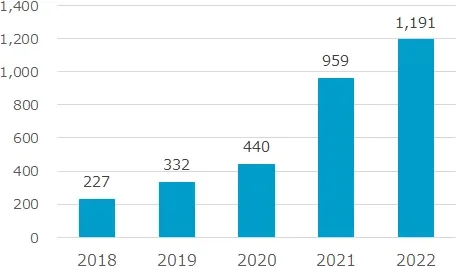
In 2025, the dating reality show (hereinafter referred to as "dating reality show") "Kyo, Suki ni Narimashita." (ABEMA) broke the record for the highest weekly viewership among all ABEMA original programs, and the total annual views for SNS-related videos exceeded 10 billion. Hirota Nagahama (Ohinasama), who appeared in the "Halon Chapter" broadcast in 2025, gained 1.58 million followers and has triggered the "Hirona-ure" (Hirona-sellout) phenomenon, where cosmetics sell out instantly every time she introduces them.
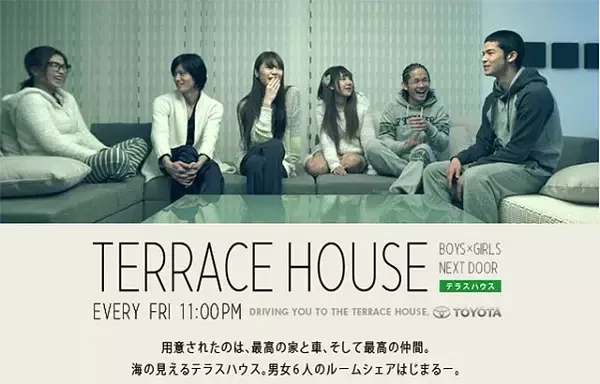
The "dating reality show," made famous by "Ainori" and "Terrace House," is no longer just "one popular genre of television program." Dating reality shows have become business devices that function as "talent manufacturing machines," "premium billing induction devices," and "advertising media for Gen Z."
This is the result of the nature of media and business models changing over approximately 20 years, and the presence of players who skillfully utilized them.
In this article, I have summarized how "Kyo-Suki" and ABEMA reached that pinnacle.
What is a "Dating Reality Show"?
A dating reality show is a genre of documentary-style programs that follow semi-amateur men and women as they engage in real romance within rules and environments set by the program. Because ordinary people who are not celebrities live and date in their natural state without a scripted plot, the tension of confessions and love triangles during the program is real, and the emotional immersion of the viewers can even exceed that of a drama. Furthermore, because romance is the main objective, "emotional moments" such as confessions and tears occur frequently in the work, are clipped for TikTok and X, and spread naturally.
For producers, the economic rationality is also extremely attractive. The performers are mainly ordinary people or semi-amateurs, so there is almost zero casting cost as there is no need for big-name actors or screenwriters. Since special effects and costumes are also minimal, production is possible at one-fifth to one-tenth the cost of a drama. Also, while romance immediately leads to scandals and loss of popularity for actors, dating reality shows have an "oshi-katsu" (supporting one's favorite) aspect where fans who have come to like the participants as a whole, such as "shipping couples," work hard to pay for and spread the content even if the romance succeeds.
In this way, dating reality shows are "content that can generate high engagement at a low cost."
ABEMA's Targeting of Teenage Girls and the Birth of Okami-kun
From here, I will explain ABEMA and "Kyo-Suki" while looking back a bit in time. In April 2016, ABEMA was launched as a joint venture between CyberAgent and TV Asahi. One of its main contents was "dating reality shows specialized for teenage girls." This strategy was influenced by the characteristics of ABEMA's viewers. Television targets the F1 demographic (women aged 20-34) that advertising sponsors aim for, and Amazon and Netflix also target the F1 demographic who can pay monthly fees. In contrast, about 40% of ABEMA's viewers, which is basically free, were young people in their teens and 20s. ABEMA, which was a latecomer at the time, produced programs mainly for teenagers, who tend to be ignored. Thus, in February 2017, about a year after its launch, the distribution of ABEMA's first original dating reality show, "Okami-kun ni wa Damasarenai" (I Won't Be Deceived by the Wolf), began.
At a time when dating reality shows with various concepts were springing up, the theme ABEMA chose for the program was "Werewolf Game x High School Romance." It featured about 10 men and women living together, with several "liars who will never fall in love (wolves)" hiding among them, and the reasoning and speculation of "who is the wolf?" became a hot topic on SNS.
The result was a huge hit. The final episode of the 4th series exceeded 1 million views within 5 minutes of the start of the broadcast, and recorded 38 million views in one season. It was said that "one in three junior and senior high school girls is watching it." However, Okami-kun has been effectively suspended since 2024. The reason is that because of the concept of romance and reasoning, the progression of the story is prone to similarity. Although it was broadcast for 8 years at a pace of 2 to 3 series per year, it became stereotyped, and it became impossible to continue mass-producing it.
ABEMA's Strategy of Pursuing Quantity and the Birth of "Kyo-Suki"
"Kyo, Suki ni Narimashita." (hereinafter "Kyo-Suki"), which started in October 2017 of the same year, was a dating reality show for teenage girls on ABEMA, just like Okami-kun, but its strategy was fundamentally the opposite.
While the concepts of dating reality shows were becoming more complex, "Kyo-Suki" adopted a strategy of mass-producing extremely simple stories of "high school students falling in love during a 2-night, 3-day school trip." At a time when most programs required participants for 1 month to 1 year, "Kyo-Suki" had a very short filming period and a short commitment period, making it easy to cast. The number of episodes per series was also short (about 5 episodes), and by changing the filming location and performers frequently, the atmosphere of the story changed weekly, ensuring that viewers would not get bored.
In 2024, 7 series were broadcast annually. Compared to the pace of 1 to 2 series per year for previous dating reality shows, this is a mass production system of a different order of magnitude.
◇
ABEMA further developed a "dating reality show portfolio strategy." There are currently about 30 ABEMA dating reality show titles. This is an overwhelming amount compared to Netflix (12 types) and Amazon Prime (5 types). By running multiple series in parallel with slightly different target demographics and ages, such as "Shuffle Island" and "Renai Drama na Koi ga Shitai," they established the impression that "when it comes to dating reality shows, it's ABEMA."
As a result, monthly viewership in 2024 reached 560 million (a significant increase year-on-year), and the number of premium members exceeded approximately 1.5 million. In 2025, ABEMA achieved profitability, turning a profit for the first time since its launch.
Why is "Kyo-Suki" the only show that can "mass-produce influencers"?
"Kyo-Suki" also has an overwhelming advantage over other programs in terms of the "quantity and reproducibility" of the talent it produces.
While other programs are lucky to produce one big hit per series (e.g., Meru Nukumi from "Wolf-kun," Miwako Kakei from "Terrace House"; other works peak at around 500,000 followers), "Kyo-Suki" consistently produces influencers every series, such as Hirona Nagahama (approx. 1.58 million total SNS followers), MON7A (approx. 2.8 million total SNS followers), Nozomi Tsuji's daughter Noa (approx. 3.6 million total SNS followers), and Risa Furusawa, Ayano Masuda, and Miyu Umeda from CUTIE STREET.
There are three reasons for this difference.
1. The "2 nights and 3 days" format ends by boosting the performer's brand value
Long-form documentaries like "The Bachelor" or "Terrace House" film participants over several months, so their "bad sides" and "failures" are also broadcast. While this increases empathy, it can also create haters or place restrictions on their influencer activities.
On the other hand, because "Kyo-Suki" lasts only 2 nights and 3 days, only the most beautiful moments of the participants—confessions, tears, and single-minded emotions—are captured and delivered to viewers, with almost no negative aspects depicted. In other words, "Kyo-Suki" is designed to "end with the participant's brand value boosted as a character," which is fundamentally different from the design of other programs where "the participant's true personality is conveyed, for better or worse."
Furthermore, participants who gain popularity upon their first appearance can reappear in other series as "continuing participants," showing a different side of themselves by interacting with new participants (Hirona Nagahama participated in three seasons: Mactan, Halong, and Summer Vacation 2025). I believe this is a sales method that only works because the work is short and has the lightness of "high schoolers' pure romance."
2. The existence of talent agencies with advertising functions
When discussing the "talent production function" of romance reality shows, one cannot ignore the relationship with talent agencies that coordinate by having their talent appear on "Kyo-Suki" to generate buzz or by scouting high schoolers who have broken out on the show.
Among them, seju, said to be the agency most closely linked with "Kyo-Suki," differs from typical agencies that only handle management. seju has an advertising marketing company (AnyMind Group) as its parent company. Therefore, it can acquire corporate advertisements itself and immediately assign its own influencers to them, allowing ads to be placed while the show is popular. As a result, the buzz for both the product and the talent themselves increases synergistically.
3. The infinite potential of high schoolers
Another factor is that the main participants of "Kyo-Suki" are limited to high school students. The main cast of shows like "The Bachelor" or "Terrace House" are in their 20s and 30s, and their character is born from the diversity of their original occupations and backgrounds. In contrast, the participants of "Kyo-Suki" are almost amateur high school students, so one could say they are in a state of "having no color" in a sense. For talent agencies, the younger the talent, the lower the operational cost, and since they have no fixed color, they can be sold in a wide range of directions after appearing on the show.
For example, there are cases such as three members of ASOBISYSTEM's idol project, CUTIE STREET, being "former Kyo-Suki participants," and MON7A, whose guitar performance on the show became a hot topic, debuting as a singer from Universal.
CUTIE STREET Ayano Masuda
Summary: Until romance reality shows become a "mass-producible IP business"
Finally, I would like to briefly look back at the romance reality market and the strategy of ABEMA, which handles "Kyo-Suki" within it.
The genre transitioned from the first generation, which emphasized variety elements that look good on TV like "Ainori," to the second generation, which emphasized documentaries like "Terrace House," and then reached the third generation following the cancellation of "Terrace House" and the rise of streaming platforms. The structure of romance reality shows has changed from producing one "masterpiece that everyone watches" to a system of mass-producing works for niche targets. It is thought that ABEMA was able to quickly plant many works for targets that existing players were not capturing. "Wolf-kun," which led the way in ABEMA production, established marketing methods for junior and senior high school girls, and "Kyo-Suki" simplified that and sublimated it into a "format that can be mass-produced almost infinitely."
Furthermore, the business model for romance reality shows of the past was simply "broadcast an interesting program, collect sponsor advertising fees, and that's it." However, "Kyo-Suki" has a self-sustaining ecosystem where cast members appear in advertisements through advertising agencies affiliated with their talent agencies. They increase their exposure and continue to promote the program while gaining further popularity as talents. Although "romance reality" was originally just a television program genre, it has established itself as a "scalable IP business." And ABEMA was the first to execute the optimal solution for this.
Currently, various reality content, including romance reality shows, is being produced as a means to create influencers. I am looking forward to seeing if even newer, revolutionary models will emerge in the future, and if anyone knows of any, I would love for you to tell me all about them!
Column: The Diversification of Reality Programs
Romance reality shows have evolved along with changes in media. I have summarized their history below. (The links are to where you can watch them now!)
First Generation (2000s): The era of variety-focused, ratings-obsessed televisionEra: Revenue was 100% from sponsor advertising. An era of television ratings supremacy.
-
Representative Works:
Ainori (Fuji TV, 1999–2009)
Koisuru Hanikami! (TBS, 2003–2009)
Mirai Nikki Series (Project within TBS's "Unnan no Hontoko!", 1999–2002)
Format: A variety-heavy structure where participants fall in love while overcoming rules, such as traveling in Ainori or celebrities going on dates in Koisuru Hanikami, set against large-scale location shoots lasting from several days to several months. It was a hybrid format that could be called a world first. The use of celebrities and overseas location shoots guaranteed the quality of the content.
Phenomenon: Program theme songs like Southern All Stars' "TSUNAMI" and Masaharu Fukuyama's "Sakurazaka" became double-million sellers, turning the "romance variety show x theme song" combination into a phenomenon. The movement to turn ordinary people into talents began in this generation.
Reason for Ending: Difficulty in recovering location shooting costs as television viewership declined due to the spread of the internet.
Second Generation (2010s): The era of documentaries emphasizing "authenticity" and the gateway to the fan economy
Era: An era where large-budget variety production became difficult. It was the time when YouTube and Instagram rose to prominence and the profession of "influencer" began to emerge.
-
Representative work:
Terrace House(Fuji TV, Netflix, 2012-2020)
Format: A documentary format where six young men and women chasing their dreams share a house, delivering their daily lives as they are without limiting the goal to romance. After being broadcast on Fuji TV for two years, it was revived as the first co-production with Netflix, which had just launched its service in Japan. A structure was also created where studio members added commentary like a secondary audio track.
Phenomenon: It gained popularity overseas through global distribution and was the only Japanese content selected for TIME magazine's "Best Shows of 2018." It produced cast members who expanded their careers through the program, such as Miwako Kakei and chay (singer-songwriter), creating the prototype for an "influencer gateway."
Reason for termination: It was cancelled in 2020 after a cast member passed away following cyberbullying. The issue of "long-term close coverage x SNS backlash" became apparent.
By the time the second generation ended due to the Terrace House incident, it was whispered that the romance reality genre itself might be over. However, in the 2020s, the romance reality market continues to expand.
The basic economic benefits of romance reality shows—low cost and high engagement—remained unchanged; rather, this was an era where viewers were looking for the next work after losing Terrace House.
On the other hand, the biggest lesson learned from the incident was the risk of "fixing members for a long period and showing their personalities as they are", and this decisively changed the design of the third generation. Media that symbolize such a third generation can be said to be ABEMA, as well as "Kyo-Suki".
Third Generation (2020s): The Warring States Period of Streaming Platforms and Diversification of Genres
Era: An era where Netflix, Amazon Prime, and ABEMA intensified competition for user acquisition in Japan, and the main battlefield for video media shifted from television to streaming. It was also an era where vertical short videos centered on TikTok and the culture of video clips spread.
-
Representative works:
The Bachelor Japan (Amazon Prime Video, 2017–)
Don't Be Fooled by the Wolf (ABEMA, 2017–)
Love Village (Netflix, 2023–)
The Boyfriend (Netflix, 2023–)
Love Jotou (Netflix, 2025–)
Format: Each platform is heavily investing in romance reality shows as exclusive content. Short-form programs lasting from one to several weeks that generate strong buzz have become the mainstream. The structure involves mass-producing edgy works with niche themes—such as werewolf games, matchmaking for those over 35, LGBTQ+ stories, and delinquent-themed shows—and turning them into series if they gain popularity.
Phenomenon: Established as a gateway to success for influencers. (Details below)
Reason for termination (N/A): Currently ongoing. However, with the increase in competition, the gap between programs that can continue and those that cannot is widening.
Also, reality shows in genres other than romance are now popular. I have summarized them in a list as well. Column: Diversifying Reality Shows
Business & Entrepreneurship
Reiwa no Tora CHANNEL (YouTube, 2018–present)
Nontitle (YouTube/U-NEXT, 2022–present)
REAL VALUE (YouTube, 2024–present)
Nightlife Industry
Ai no Hyena (ABEMA, 2023–present)
LAST CALL (YouTube, 2026–present)
Idol Auditions
PRODUCE 101 JAPAN (TBS/Lemino/Mnet, 2019–present)
iLiFE! New Member Audition Project (ABEMA/YouTube, 2026–present)
timelesz project -AUDITION- (Netflix, 2024)
BOYS PLANET / Girls Planet 999 (Mnet/Netflix, 2022–present)
Monaki Audition (YouTube, 2026–present)
Sports & Martial Arts
BreakingDown (YouTube/ABEMA, 2021-)
THE RAMPAGE Audition (YouTube, 2016-)