This is Mochizuki, the academic advisor. This year, we had our first summer vacation in three years without movement restrictions. How did everyone spend it? Unfortunately, I didn't go anywhere, and since I was busy with work, I spent my time weeding the vegetable garden and yard that had turned into a jungle, and pruning the garden trees.
Now, this is the first article update in three weeks. This time, we will look at "S-Allyl cysteine in garlic (Allium sativum): Formation, biofunction, and resistance to food processing for value-added product development" from the 2022 issue of 'Compr Rev Food Sci Food.' This review organizes information on "S-allyl cysteine," one of the components contained in Astanin, which is manufactured by Fuji Bio Farm.
S-Allyl cysteine (SAC) is an organosulfur compound that provides the characteristic aroma and physiological activity of garlic. In addition to SAC, organosulfur compounds in garlic include alliin (S-allyl cysteine sulfoxide), S-methyl cysteine (SMC), and S-ethyl cysteine.
Among garlic types, black garlic, which is aged raw garlic, contains the most SAC. The review introduces that while the S-allyl cysteine content in raw garlic is 19.0 to 1736.3 μg per gram, the content increases significantly in processed foods such as frozen/thawed garlic, pickled garlic, fermented garlic extract, and black garlic.
Recent research has also revealed that SAC content changes significantly depending on processing and manufacturing methods such as heating, ultrasound, freezing, fermentation, and high-pressure treatment, as well as variety and cultivation environment. Optimizing each process—production, processing, and storage—is very important information for developing products aimed at the health benefits of SAC.
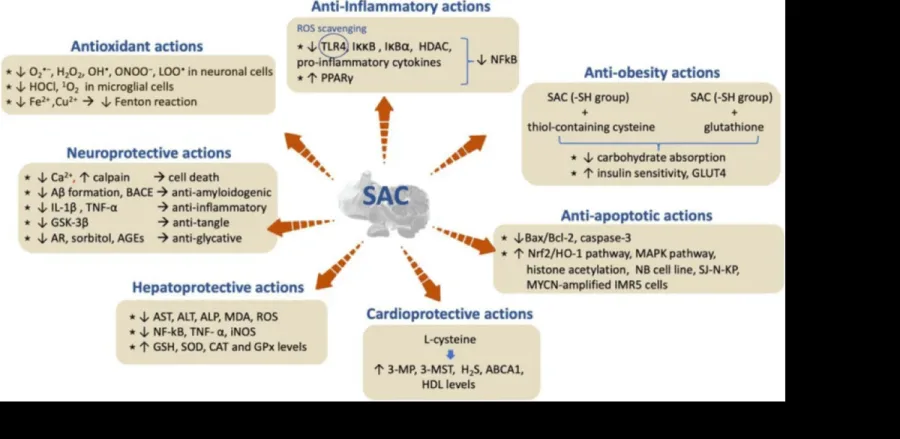
The Basis of Health Benefits is Antioxidant and Anti-inflammatory EffectsFrom here, we will look at the health benefits of SAC. In the review, functional properties such as antioxidant, anti-inflammatory, anti-obesity, hepatoprotective, cardioprotective, anti-apoptotic, and neuroprotective effects were organized with subheadings, citing previously reported papers. These are just some of the functionalities of SAC.
In this article, we will help you understand the basic pharmacological actions of SAC, such as its antioxidant and anti-inflammatory effects, and briefly introduce the contents of the cited papers regarding the protective effects on various organs based on those pharmacological actions.
● Antioxidant Effect
As introduced in previous articles, oxidative stress is involved in obesity, diabetes, cancer, and Alzheimer's disease. It has been suggested that SAC may be effective in preventing and improving various diseases. The involvement of SAC's antioxidant effect against reactive oxygen species is becoming clear.
SAC has a positive influence on the actions of superoxide anions, hydrogen peroxide, hydroxyl radicals, and peroxynitrite anions, which protect the living body from reactive oxygen species. It is also known to inhibit the production of pro-oxidant enzymes such as nicotinamide adenine dinucleotide phosphate, xanthine oxidase, nitric oxide synthase, and cyclooxygenase.
Incidentally, when we compared the scavenging effects against the above reactive oxygen species for garlic, black garlic, and sterilized garlic sprouts (GSP), which are the raw material for Astanin, the following results were obtained, showing that GSP can exert a more powerful antioxidant effect than black garlic against all reactive oxygen species.
● Anti-inflammatory Effect
Suppressing chronic inflammation is also essential for the prevention and improvement of various diseases. Several studies suggest that black garlic containing SAC can be an effective anti-inflammatory agent. It has been revealed that black garlic extract suppresses the production of nitric oxide and pro-inflammatory cytokines via signals involved in inflammatory responses, such as MAPK and NF-κB.
Details of the signaling pathways that suppress inflammatory responses are also becoming clear. The mechanisms of the anti-inflammatory effect of SAC in black garlic include the inhibition of TLR4 activation, the regulation of NF-κB signaling through TLR4 inhibition, and the inhibition of NF-κB nuclear translocation through increased expression of peroxisome proliferator-activated receptor γ.
● Cardiac/Neuroprotection and Anti-diabetic Effects
Padmanabhan & Prince (2006) reported that in myocardial infarction model rats, the activity of marker enzymes such as cardiac superoxide dismutase, catalase, glutathione peroxidase, and glutathione reductase, which had decreased, significantly increased with daily oral administration of SAC for 45 days. They reported that lipid peroxidation products decreased and antioxidant activity increased, thereby improving the antioxidant status and confirming the protective effect of SAC. Avula et al. (2014) similarly confirmed the cardioprotective effect of SAC in model rats.
Tsai et al. (2011) reported the neuroprotective effect of SAC in aging model mice treated with D-galactose (DG).
The aging model mice showed increased formation of Aβ1-40 and Aβ1-42 (which are types of amyloid plaques found in the brains of Alzheimer's patients) and increased mRNA expression of β-amyloid precursor protein (APP) and β-site APP cleaving enzyme 1 (BACE1). They stated that SAC intake significantly reduced Aβ1-40 and Aβ1-42, suppressed the expression of APP and BACE1, further reduced the formation of reactive oxygen species and protein carbonyls, and restored the antioxidant status of the brain.
Based on these findings, it is concluded that SAC may potentially inhibit the progression of neurodegenerative diseases such as Alzheimer's disease through anti-Aβ, anti-glycation, and antioxidant effects.
Lembede et al. (2018) examined the potential preventive effects of SAC in infant rats modeled after human newborns fed a high-fructose (FS) diet. Four-day-old male (n=32) and female (n=32) Wistar rats were randomly assigned and orally administered SAC daily for 15 days, and measurements were taken for blood glucose, triglycerides, cholesterol, plasma leptin, and insulin concentrations.
SAC significantly increased plasma insulin concentrations and the homeostasis model assessment for insulin resistance. Based on the results obtained in this study, the authors suggest that SAC could potentially be utilized as an anti-diabetic agent and insulin secretagogue.
Although the mechanisms of antioxidant and anti-inflammatory effects have become a technical and difficult topic, I hope you have understood that the protective effects of SAC on many organs through its antioxidant and anti-inflammatory properties have been researched and reported to date. The level of attention toward SAC is increasing year by year, and I believe many more studies related to SAC will be reported in the future. We intend to continuously conduct literature reviews and, based on the new findings obtained, connect them to product improvements and the development of new products.