1. Prologue: Listening to a New Breeze on the Tree-Lined Streets of Hanoi
Moist tropical light pours down through the gaps in the 'cai sau' (street trees) that line the old streets of Hanoi. The heavy humidity unique to this city dulls the high-frequency exhaust notes of motorbikes, while carrying the 'mid-range stickiness' of singing voices drifting from distant cafes to my eardrums with surprising clarity.
As a music anthropologist walking these streets, I am often struck by a strange sensation. It is a poignant sense of déjà vu, as if I am re-experiencing the 'history of Japanese music' that we left behind in the shadow of rapid economic growth, but with higher resolution.
Tracing the trajectory of Vietnamese pop music, or 'V-Pop,' is not merely an introduction to foreign pop songs. It is a time travel through another 'Japanese youth' reflected in a mirror, and an invitation to rediscover our own roots. This journey we are taking is also a story of going to find lost passion on the other side of the mirror.
2. Tracing Another 'Japanese Youth' Through Music
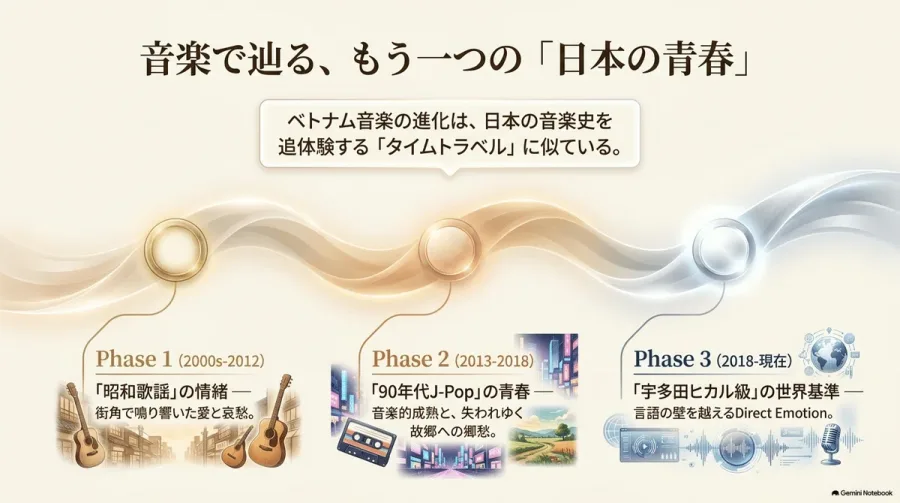
Looking at the evolution of V-Pop, we can see three dramatic phases that synchronize with social transformation. These are highly symbolic transitions that Japanese listeners can compare with fragments of their own memories.
Phase 1 (2000s-2012): The Emotion of 'Showa Kayo' Love and sorrow echoing on street corners. An era filled with indigenous vitality that shook people's raw emotions.
Phase 2 (2013-2018): The Youth of '90s J-Pop' Musical maturity and a nostalgia that makes one pause amidst rapid urbanization. A 'transitional period' attempting to shed the skin of traditional pop.
Phase 3 (2018-Present): Global Standards of the 'Hikaru Utada Level' A realm of 'Direct Emotion' that transcends the framework of Asia and invalidates even language barriers.
Now, let us first turn back the clock to that era of 'love and scenery,' which was rough around the edges but filled with enthusiasm.
3. Phase 1 (2000s-2012): The Era of 'Love and Scenery'
In the early 2000s, the streets of Vietnam were overflowing with chaotic scenes and music. At the time, it was called 'Nhạc trẻ' (music for young people), and in reality, it was centered on dramatic pop ballads heavily influenced by Chinese-style ballads and Korean drama OSTs.
Sound & Vibe: Programmed sounds from cheap synthesizers. However, what more than made up for that innocent intensity, which was the polar opposite of sophistication, was the singers' full-throttle vocal power.
Media: Music was consumed with physical intensity, not in record stores, but at street-corner bootleg CD stalls and as background music in cafes playing at volumes that could compete with the noise of motorbikes.
What is interesting from an anthropological perspective is that V-Pop of this era resonates at a deep level with the golden age of Japan's 'Showa Kayo.' The highly undulating melodies created by the complex 'tones' unique to the Vietnamese language structurally match the 'kobushi' (vocal trills) and 'sorrow' found in Japanese Enka and Kayo songs. This is simply because the sound of the words themselves contains the 'swaying' of emotion.
This passion, which was almost earthy, gave birth to the many stars who colored the street corners of that time.
4. Stars Who Colored the Street Corners of the Early 2010s
The stars who captured the hearts of the Vietnamese people at the time were truly icons of the era.
Tuấn Hưng: With a masculine, husky singing voice, he released the absolute karaoke staple song 'Tìm Lại Bầu Trời' to the world.
Cao Thái Sơn: The 'tragic prince' who tugs at heartstrings with drama-style music videos. 'Cầu Vồng Sau Mưa' became synonymous with the heartbreak of the youth at the time.
Khắc Việt: The king of male heartbreak songs. 'Yêu Lại Từ Đầu,' with its quintessential pop melody, was also a symbol of cafe music.
Lương Bích Hữu: A pure and earnest singing voice ('Em yêu anh') that evokes a 'budding of melody' that even Japanese listeners might find nostalgic.
Noo Phước Thịnh & Đông Nhi: Charismatic idols who garnered immense support from teens.
Mỹ Tâm: A national diva who has remained at the top since the 2000s. Her overwhelming aura and vocal prowess.
While their voices filled the streets, a simple question arises. Why were there so few 'rock bands' in this country compared to Japan or the West during the same period?
5. Column: Why are there so few 'rock bands' in Vietnam?
There are deep-seated structural factors behind why the band format struggled to become mainstream in the Vietnamese music scene.
Political and Historical Background: The influence of censorship under the socialist system. Solo singers who sang about safe and universal themes like 'love' and 'family affection' were more socially acceptable than rock, which carried anti-establishment and anarchic imagery.
Economic Conditions and Infrastructure: Acquiring expensive instruments and amplifier equipment was a significant financial burden, and there was a shortage of live music venues with proper acoustics. From a commercial perspective, 'one USB and one singer' was overwhelmingly cheaper and more efficient than maintaining a band.
Melody Supremacy: The soil of a deep karaoke culture. There is a national character that prefers 'beautiful and emotional melodies' that people can sing themselves and pour their feelings into, rather than intense beats or instrumental ensembles.
In recent years, indie pop-rock bands like Chillies and Ngọt have finally emerged, and with the spread of social media, they are beginning to blow a new wind. Even within these constraints, music is taking the next step toward more sophisticated expression.
. Phase 2 (2013-2018): Musical Maturity and 'Nostalgia for What Is Being Lost'
In the mid-2010s, V-Pop evolved from mere pop songs into an artistic deepening that explored its own roots. This was an important transitional period aimed at 'molting' from pop music into musicality.
Leading this period was one of the four great divas, Mỹ Linh. She elevated pop to R&B and jazz, dramatically raising the sound quality of the entire scene. Also, as rapid urbanization and economic development progressed, people sought acoustic sounds and introspective songs about their hometowns to fill the 'sense of loss' that had arisen within them. It was an era when music became a 'spiritual anchor' in a constantly changing daily life.
When listening to the music of this period, Japanese listeners are struck by a strange sense of nostalgia. It was a synchronicity with the brilliance that J-Pop once possessed.
7. Miraculous Synchronicity: Melodies that Overlap with the Memories of Japanese Listeners
The songs of Phase 2 overlap surprisingly vividly with specific musical experiences in Japan.
V-Pop, which had been nestled in nostalgia, eventually began to bare its fangs to the world with overwhelming intensity.
8. Phase 3 (2018-Present): 'Direct Emotion' that Shakes the World
Current V-Pop has already relegated the term 'developing' to the past.
Direct Emotion: Overwhelming vocal expression that effortlessly leaps over language barriers and directly shakes the listener's soul.
Fusion with Visual Art: Abundant capital and sophisticated creativity have come to fruition, making music videos with the quality of a feature film the standard.
Reaching Global Standards: An exquisite, old-yet-new pop sensibility that wraps traditional melodies in modern beats. It is ready to sweep the global streaming charts.
There is an artist who symbolizes this Phase 3 and who, as a Japanese person, I could not help but be shocked by.
9. The Rare Vocalist: The Impact of Hòa Minzy
The current pinnacle of V-Pop. That is Hòa Minzy. If one were to describe her, it is no exaggeration to say she is a talent of the 'Hikaru Utada class'.
Her talent is evident in her chameleon-like ability to freely handle everything from the heartbreaking epic ballad 'Không thể cùng nhau suốt kiếp' to 'Thị Mầu,' an avant-garde interpretation of traditional Vietnamese performing arts. Her appearance, which fuses a traditional demeanor with a modern sensibility, led to her winning the 'Vietnamese Popular Music Special Award' at the MUSIC AWARDS JAPAN 2026 and the global impact of the song 'Bạc Bling'.
Following the path she has blazed are even more uniquely talented individuals.
0. A Performance by Divas Who Solidify V-Pop
The current scene is evolving not as a single star, but as a 'diva movement' driven by a thick layer of talent.
In particular, Hoàng Thùy Linh has sublimated Vietnamese folklore and literature into extremely sophisticated dance music. The mega-hit 'See Tình' proves that their identity has transcended the borders of Asia and become a global common language. However, no matter how sophisticated the sound becomes, the 'source of the soul' that never changes flows beneath it.
11. Roots of the Soul: The Timeless Masterpiece 'Xuân này con không về'
Deeply etched into the Vietnamese identity is the slow, heartbreaking triplet rhythm known as 'Bolero' (Nhạc vàng = Yellow Music).
The sacred text of this genre is 'This Spring, I Won't Be Coming Home,' written in the 1960s. Originally a song about the loneliness of a young man on the front lines, it has become an anthem in modern times that speaks for the 'homesickness' of migrant workers and international students who cannot return home for Tet (Lunar New Year). The tears contained in this song are by no means a stranger's affair to us Japanese.
2. Earthiness and the Fundamental Beauty of Humanity: Resonance with Showa Kayo and Enka
There is a perfect resonance in the depths of emotion between Vietnamese music and Japanese Showa Kayo and Enka.
Because there is a reality of working hard, covered in mud and sweat, in harsh daily environments, a 'pure beauty' that longs for a distant hometown or mother dwells in the music. This perfectly matches the values of 'remitting money to family' and 'self-sacrifice' that the workers who supported Japan during its period of rapid economic growth entrusted to songs like 'Kitaguni no Haru' and 'Aa Ueno Eki'.
The earnest dignity of humanity that exists behind the light of modernization. That is the true nature of the beauty that connects the music of both countries as an elegy for the worker. Things that are passed down while changing their form with the times. Let's organize those transitions.
13. Integration Matrix: Looking Back at the Journey
The evolution of V-Pop to date and its links to Japanese music can be summarized as follows.
At the end of my journey, I would like to share what I felt in the winds of Hanoi.
14. Epilogue: Changing Sounds, Unchanging 'Love and Nostalgia'
The raw melodies once entrusted to 'slightly cheap synth sounds' have, over time, blossomed beautifully into a 'world-standard Direct Emotion' that transcends language barriers.
However, from an anthropological perspective, the essence of the 'indigenous love and nostalgia' flowing at its core has never been lost, no matter how sophisticated or digitized the sound becomes. It is that very 'earnest passion' that we have left behind somewhere in exchange for economic development.
I hope you will add the 'breeze of Vietnam' to your playlist. The melodies played by Vietnamese music will surely, powerfully, and gently awaken the 'other youth' sleeping deep within your heart.