I finally got to ride the Alishan Forest Railway I had been dreaming of. (December 31, 2024)
It was a highly satisfying train journey packed with highlights: the retro and compact train (narrow gauge), the first-time experience of switchbacks (three in total), the magnificent scenery, and the changing vegetation outside the window (tropical to subtropical to temperate). It was a stroke of luck that I happened to secure a seat near the front of the lead car, Car 4.
If I had to mention a difficulty, it was just that the conductor's (?) announcements were almost entirely in Chinese and I couldn't understand them. However, if you ask about things you don't understand in broken English or similar, they will answer properly, and in the first place, it was a problem with my own language skills, so it couldn't be helped.
Information about the railway's history as a line built for transporting cypress during the Japanese colonial era, its triple loops, and its narrow-gauge appeal can be found online and in books, so please take a look at those.
Here, I will record my personal experiences regarding matters for which there was little Japanese information online or in books.
Please note that this is based on the situation as of December 31, 2024, and includes personal opinions and impressions, so I would appreciate it if you read it only as a reference. I think it will be helpful for those traveling alone, those whose primary goal is simply to ride the train, and those who want to minimize financial costs.
First of all, I had a hard time getting the train ticket.
I think it is probably common to sign up for a tour, but that comes with unnecessary options like pick-up and drop-off from Taichung Station, costing over 20,000 yen. If you get just the ticket online, it only costs 750 TWD (3,600 yen) (600 TWD fare + 150 TWD mountain entry fee).
The ticket application process itself is on a dedicated website that even has a Japanese page, so there is absolutely no problem.
Tickets go on sale 15 days in advance (a bit earlier if it falls on a weekend), and it's a tricky system that I wish would open up a bit earlier. They are released at 7:00 AM Japan time, 15 days in advance, but for my personal schedule, I could go from 12/29 to 12/31, and when I accessed the site about 10-20 minutes late for each of those days, they were already sold out.
Relying on online information that tickets could be obtained right before the date, I didn't give up and tried several times, and on 12/28, I managed to get an uphill ticket for 12/31. After that, I accessed it several more times and it looked like I could get an uphill ticket for 12/30 and a downhill ticket for 12/31, but the hotels in Alishan were fully booked at the last minute, so I gave up. By the way, there are only two trains a day (one goes only as far as the intermediate Zhaoping Station), and a day trip round-trip between Chiayi and Alishan is impossible in terms of the schedule.
I foolishly speculate that the reason for the frequent last-minute cancellations is to hold tour slots until the very last moment, but I don't know for sure.
As a result, I took the train up and the bus back for a day trip. With this schedule, you arrive in Alishan around 15:00, and the last bus leaves at 17:10, so you can only stay for about 2 hours. By the way, being a timid person, I was very afraid of not being able to return due to unforeseen circumstances like train suspensions, so I headed back on the 15:40 bus. It takes about 10 minutes to walk from the train station to the bus stop, so I came back without really feeling like I had stayed at all
(But I was very satisfied because I got to ride the train )
Regarding the return bus, it seems you can make reservations (since there were 'reserved' and 'non-reserved' lanes), but I didn't know how to make one. There was no one in the reserved line, but the person at the end of the non-reserved line ended up having to stand on the bus, so if you really want to sit, you might want to make a reservation. I lined up about 20 minutes early and barely managed to get a seat, but only side-facing seats were left, and I got a little motion sick. Since it descends all at once from 2000m to almost sea level, it was quite a winding road. A young Japanese woman who got on midway and sat next to me had a bag ready and seemed to be having a very hard time.
By the way, it was route number 7322C, and it took about 2.5 hours from Alishan Station to Chiayi Station (the regular Chiayi Station, not the High Speed Rail station) (I think it was slightly delayed due to traffic). Depending on the time, there seemed to be buses to the High Speed Rail station (which also stop at the regular Chiayi Station midway), but since there are a reasonable number of buses from the regular Chiayi Station to the High Speed Rail Chiayi Station, I don't think you need to worry too much about it. By the way, if you are just heading to Kaohsiung, Tainan, or Taichung, considering the travel time to the High Speed Rail Chiayi Station, the time might not be that different even if you take a regular express train from the regular Chiayi Station.
The bus fare from Alishan to Chiayi Station was about 250 TWD (1200 yen). (I paid with an EasyCard (like Suica), so I couldn't grasp the exact bus fare.)
If you can't confirm your train reservation until the last minute, and you also need a hotel, I feel like a day trip without using a tour is realistic. I think there is also the option of taking a bus or taxi there and the train back. I don't know if there are taxis for the return trip, and it feels risky. I saw about two taxis parked in the parking lot, but I didn't know if they were cruising taxis or if someone had already booked them.
However, I thought later that if there were hotels that allowed cancellations until the last minute, it might have been a good idea to secure a hotel first.
By the way, the train reservation might have been fine because I was alone, but it might be even tougher if you need seats together for two or more people, so it might be better to just quietly sign up for a tour.
I was thinking of asking other passengers how they got their seats if there were any Japanese people on the train, but as far as I could see (and hear), there were no Japanese people. My Chinese is non-existent, my English is poor, and I'm socially awkward, so I couldn't ask anyone else.
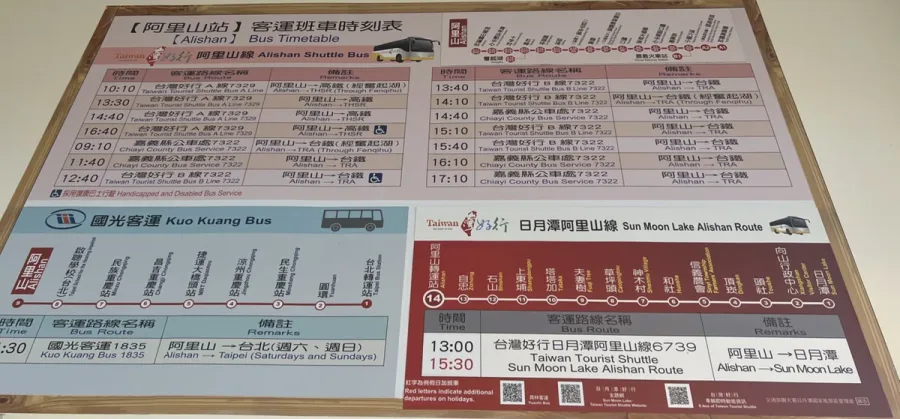
This is the bus stop timetable at Alishan.
Below is a Q&A regarding matters I had questions about before going.
Q: Is there in-train sales?
A: No. You might wonder, 'Does that mean I have to bring food and drink for the entire 5-hour journey?' Actually, the train stops at Fenqihu Station for about an hour midway, so you can get food and drinks there. I didn't know this until I went because of insufficient research.
The train departs Chiayi Station at 10:00, arrives at Fenqihu Station around 12:18, and departs that station at 13:21. There are many souvenir shops in Fenqihu, but there are also bento shops (with dining spaces) and a 7-Eleven (which has rice balls, bread, and of course, cup noodles), so you won't have trouble with food and drink. So, having drinks and snacks for a little over 2 hours is fine (though I think it's better to have plenty of water in case of train breakdowns, etc.).
The bento shops have 3 types of bentos for 170-190 TWD (about 800-900 yen), which is not that expensive.
The text in parentheses is from Google Translate. For reference.
I didn't know about this break midway, so I brought 5 hours' worth of food and didn't buy anything here, so I don't really know how it tastes.
As an aside, I also thought that this 1-hour break might also serve to prevent altitude sickness.
Q: Are there toilets on the train?
A: It wasn't written anywhere, so I was a little worried, but they are there, although they aren't very clean. I think they are in all 4 cars. There was one in Car 4, which I rode in, and as mentioned below, I couldn't move to other cars on the train.
Q: How many seats are there?
A: There are 4 passenger cars, and I think there are about 25 seats per car, for a total of about 100 seats.
Q: What is the seat configuration?
A: There are 3 seats in a row, consisting of a single seat and a pair of seats. By the way, my seat in Car 4 was marked '13'. From the front, '1' is the single seat on the right in the direction of travel, '2' and '4' are the pair of seats on the left, with '2' being the window seat and '4' being the aisle seat, and '3' was skipped. Similarly, '4n+1' is the single seat on the right, '4n+2' (window) and '4n+4' (aisle) are the pair of seats on the left, and '4n+3' is skipped. My '13' was the single seat on the right.
Please refer to the image below.
Q: Can you move to other cars on the train while it's running?
A: Probably not. When I went to the connection area while stopped at Fenqihu Station, a station attendant warned me. I think it's out of the question while the train is running. The connection area is exposed to the wind and has unstable footing, so I think it's for safety. I was lucky to be able to ride in the lead Car 4, so I could see the direction of travel through the driver's cabin.
Q: Can I bring a large carry-on bag?
A: There is a space for carry-on bags, so a large carry-on bag is fine. It's like the carry-on bag space on a Japanese limited express train, though there is a limit to some extent.
The luggage rack above the seat is narrow, and even my small carry-on bag that is allowed on airplanes didn't fit. It's easy to understand if you imagine the luggage rack of a Japanese highway bus. A point to note is that Car 4, which I rode in, did not have a carry-on bag space (probably because it's a control car, so there is less space), and I had to load my carry-on bag in Car 3, so I couldn't go get things from inside the carry-on bag while the train was running. The air conditioning on the train was too strong, and I think it would have been terrible if I didn't have a jacket.
Q: How is the air conditioning?
A: It works very well. Or rather, it was too cold (riding on 12/31). Quite a few passengers were closing the vents above their seats, so I don't think I was the only one who was cold. As mentioned above, it would have been terrible if I didn't have a jacket. I recommend bringing at least two items: one to wear and one to use as a blanket.
Q: What are the seat facilities?
A: There is no table. There is a small drink holder, but a 500ml plastic bottle is too big for the hole. I think some ingenuity is needed. A drink bag (the kind that carries paper cup drinks) and an S-hook I happened to have were useful. It might have been even better if I had a carabiner.
It looked like there was a reclining function, but it was narrow, so I didn't use it out of consideration for others. I am about 180cm tall and weigh about 75kg, but the backrest was slightly tilted to begin with, so I didn't feel that much pain.
Q: After booking a ticket online, how do I convert it to an electronic ticket?
A: When I looked online, it said something about converting to an electronic ticket, but I didn't really understand this. After getting the ticket online, I left it as is, and when I presented the details at the Chiayi Station counter on the day, a paper ticket was issued.
That's all for the Q&A.
Below, I have listed images of Chiayi Station, the view from the train window, Fenqihu Station (and its vicinity) along the way, and Alishan Station for reference.
#AlishanRailway