Introduction
You can read summaries of AI research papers here.
Hello! This is AI Nest Inc.
"AI agents write code for me, but they keep making the same mistakes..." Have you ever experienced this? In fact, even the latest AI agents suffer from a fundamental problem where they only come up with similar solutions when solving complex tasks.
The paper we are introducing today tackles this problem with a novel approach called "self-evolution." It is the idea of improving the AI agent's thought process (trajectory) through generational turnover, much like biological evolution.
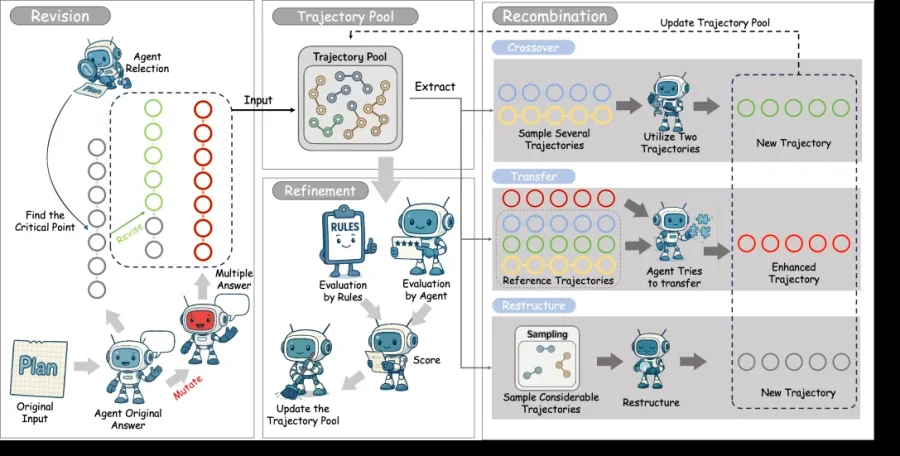
As shown in Figure 1, SE-Agent finds the optimal solution by evolving multiple "trajectories" (the process by which an agent solves a task). This is a mechanism that is truly like the biological evolutionary process.
Background: Why is this research necessary?
Current AI agents have a major limitation. It is the problem that when solving complex tasks, they can only generate similar solutions no matter how many times they try.
For example, let's consider a GitHub bug fixing task. Conventional agents often try to fix only the files where error messages appear, failing to notice the root cause in a different file. This is because probabilistic language models tend to be biased toward high-probability solution patterns.
Methods like Monte Carlo Tree Search (MCTS) have been tried, but they treat each trajectory independently and ignore the interdependencies and potential synergies between trajectories. In other words, they are not doing what humans naturally do: "learning from other attempts."
Proposed Method: What is the new approach?
The innovative point of SE-Agent is the introduction of a self-evolution mechanism at the trajectory level. By manipulating the trajectories themselves rather than just adjusting parameters, it has become possible to explore fundamentally different perspectives and solution approaches.
Look at the actual example in Figure 6. In fixing a bug in scikit-learn, the initial agent kept trying to fix the _validation.py file (because that's where the error appeared). However, after going through the SE-Agent's self-evolution process, it discovered the root cause in the multioutput.py file and solved the problem with a single-line fix.
Three Core OperationsSE-Agent evolves trajectories by repeating the following three operations:
1. Revision Self-reflect and improve individual trajectories. For example, it modifies the trajectory based on reflections such as "this step was redundant" or "I should have investigated deeper here."
2. Recombination Generate new trajectories by combining good parts from multiple trajectories. Like genetic cross-breeding, it multiplies the strengths of different trajectories.
3. Refinement Remove redundant parts and optimize for an efficient trajectory. Finally, select the trajectory that yields the highest reward.
Experiment and Evaluation: Is It Really Effective?
The research team conducted an evaluation using SWE-bench Verified, a benchmark for solving real-world GitHub issues. This is a highly challenging benchmark containing 500 actual bug-fixing tasks.
The results were surprising:
Claude-3.7-Sonnet: 40.6% → 61.2% (Pass@1)
GPT-4o: 22.4% → 40.4% (Pass@1)
DeepSeek-V3: 31.6% → 54.8% (Pass@1)
In other words, it has achieved a relative improvement of up to 55%. What is particularly noteworthy is that a significant performance improvement was consistently observed across all models.
Even more interesting is the Venn diagram in Figure 3. SE-Agent has solved 12 unique problems that could not be solved by other methods. This indicates that through trajectory self-evolution, it is possible to discover solutions that were unreachable by conventional approaches.
Practical Considerations: So, What Can This Be Used For?
The practicality of SE-Agent is extremely high:
1. Automation of Software Development It can be immediately applied to actual development tasks such as GitHub issue resolution, bug fixing, and code review. It can be integrated with a plug-and-play approach into existing frameworks like SWE-Agent and OpenHands.
2. Application to Complex Reasoning Tasks Beyond code generation, it can be applied to any task requiring multi-step reasoning, such as mathematical problem solving, strategic planning, and creative content generation.
3. Cost Efficiency As shown in Figure 4, SE-Agent reaches optimal performance with only 10 candidate trajectories. This means that high performance can be achieved while keeping API usage costs down.
Points to Note During Implementation:
Diversity of initial trajectories is important (using 5 different planning strategies)
Balance adjustment for each operation (Revision, Recombination, Refinement) is necessary
Adjust the number of evolution cycles according to task complexity
Summary
SE-Agent is a groundbreaking method that significantly improves the reasoning capabilities of AI agents. Through a self-evolution mechanism inspired by biological evolution, it has become possible to discover solutions that were previously unreachable with conventional methods.
In fact, the most interesting point of this research is the idea of "generating new generations of trajectories." By creating the next generation by learning from past trials rather than simply repeating them, it achieves "learning" in the true sense of the word.
Three key insights gained from this research:
Trajectory-level manipulation is key: By evolving the entire thought process rather than just adjusting parameters, fundamentally different solutions can be discovered.
Importance of mutual learning: Through interactions between trajectories rather than independent trials, it is possible to escape local optima and efficiently discover better solutions.
High practicality: It can be integrated into existing frameworks as plug-and-play, enabling immediate performance improvements.
Moving forward, it is expected that self-evolving agents like SE-Agent will contribute to solving more complex real-world problems. In particular, they hold the potential to become powerful partners that collaborate with human engineers in the automation of software development.
For those who want to organize the papers they have read to look back on later, or for those who want to share them with their team, the paper management service "Scacon" is also recommended. It is also highly compatible with organizing and accumulating research for those who write academic papers.