Have you ever seen sentences like these and felt that something was off?
I saw three fish in the tank.
There are ten sheep on the hill.
We saw several deer in the forest.
Even though they all refer to multiple living things, there is no -s at the end. Conversely, the following examples normally take an -s.
I saw five horses running across the field.
There were six cows in the barn.
We watched a group of elephants bathing in the river.
Where does this difference actually come from?
The reason 'fish' and 'sheep' have no plural form is a 'relic of Old English'
Actually, these are words that remain as plural forms that have not changed since Old English. Words like fish, sheep, and deer have been used with the same form for both singular and plural since the Old English era. Such nouns are called "irregular plurals" and are exceptions to how numbers are expressed in English.
However, even if you know this linguistic background, it is hard to remember when you actually need to use them. Therefore, a helpful perspective is "how humans have treated those animals".
Do animals treated in groups not have plural forms?
First of all, animals that gather in groups tend to have the same form for singular and plural.
fish (fish) → Move in schools, caught in groups → fish (same form for singular and plural)
sheep (sheep) → Grazed in flocks → sheep (same form for singular and plural)
deer (deer) → Seen in groups as targets for hunting → deer (same form for singular and plural)
We caught five fish, not one.
There are more than 30 sheep in the meadow.
Hunters spotted a few deer at dawn.
It is thought that these animals were often treated as a 'group' rather than as individuals, so there was no need to make them plural.
Why animals where individual identification is important take an '-s'
On the other hand, animals where 'individual differences are important' have changing plural forms. For example, like this:
horse → Used for riding or labor, each one has a specific role → horses
cow → Distinguished by use, such as beef cattle or dairy cows → cows
elephant → Huge and easy to count → elephants
My uncle owns three horses.
The farm has ten cows for dairy production.
We saw a herd of elephants in Africa.
How to use 'plural forms that distinguish types' such as 'fishes' and 'wines'
Furthermore, in more complicated situations, when talking about distinguishing 'types,' there is a rule that you make them plural, even for nouns that are usually treated as uncountable or as zero plural.
For example:
I like different wines from around the world.
European cheeses are very diverse.
The coffee shop serves a variety of coffees.
This also applies to animals. For example, the plural form is used when expressing 'types of fish' like fishes.
Example sentence:This aquarium is home to many different fishes. (There are various types of fish in this aquarium.)
The researcher studied five species of tropical fishes. (The researcher studied five species of tropical fish.)
However, it is not the case that this applies to all zero-plural animals. For example, expressions like sheeps and deers are generally considered grammatically incorrect. Even when you want to refer to different species, these animals are not pluralized, and are instead expressed as follows:
different breeds of sheep (various breeds of sheep)
various types of deer (various types of deer)
Why don't 'sheep' and 'deer' become 'sheeps' or 'deers'?
So why don't 'sheep' and 'deer' have plural forms?
It is believed that the distance between humans and the animals plays a role in the background.
Sheep and deer have long been managed and hunted in large herds, so there is a strong tendency to treat them as a 'group' or 'total quantity' rather than identifying them one by one. On the other hand, cows and horses have specific roles for each individual, are closer to humans, and have required individual distinction.
It is thought that this 'closeness or distance from humans' influences how they are treated in language.
Getting used to irregular English plurals is key
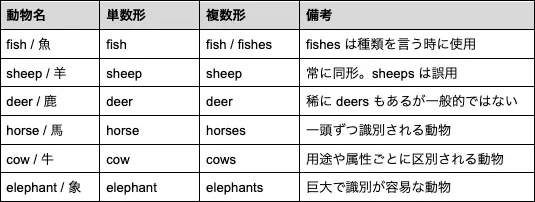
Finally, here is a summary.
As you can see, although there are certain patterns, they cannot be completely reduced to rules. While using etymology and the relationship with humans as clues, the shortest path is ultimately to 'get used to the ones you use most often'.
Below are the singular and plural forms of representative animals.
Learn zero-plural English expressions by using them in conversation
Now, while it is very important to learn these fine details as knowledge, you definitely need practice to use them effectively in actual conversation.
In Brighture's conversation classes, these fine grammatical points are designed to be learned naturally through conversation. The best way to learn is to actually speak them and memorize them as a sense. Please use them more and more in class and turn these 'tricky points' of English into your own weapons.
Please feel free to book a free trial lesson from this page!