Snails are creatures we often catch a glimpse of in gardens or parks after the rain.
Many of you likely have memories of holding one in your palm when you were a child.
While they are such familiar creatures, if asked, "How long do they live?", it is surprisingly difficult to answer.
In fact, the lifespan of a snail varies surprisingly widely depending on the species, ranging from one year to over 35 years.
It is also not widely known that you can significantly extend their lifespan by optimizing their living environment.
In this article, we will explain what a snail's lifespan is in an easy-to-understand way, while introducing the differences by species and concrete methods to help them live longer.
Actually from 1 to 35 years! Snail lifespans vary surprisingly by species
A snail's lifespan refers to the total number of years from hatching until death.
The key point is to count from the moment they are born from the egg, rather than "how many years they live after becoming an adult snail."
If you grasp this basic concept, you can understand the lifespan data for each species more accurately.
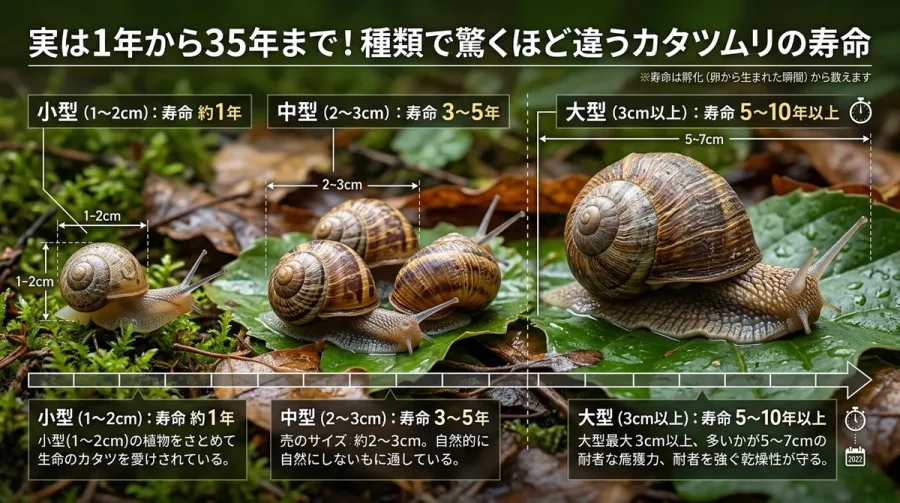
Shell size is a guide to lifespanIn fact, a snail's lifespan is deeply related to the size of its shell. As a rough guide, it can be organized as follows:
Small (shell about 1-2 cm): Lifespan is about 1 year
Medium (shell about 2-3 cm): Lifespan is 3-5 years
Large (shell 3 cm or more): Lifespan is 5-10 years or more
Species with larger and sturdier shells tend to live longer. The reason is that a thick shell protects against attacks from predators and is structured to be resistant to dryness. The shell plays a role like "armor" that protects the snail's life.
Comparing lifespans by major speciesWhen looking at the lifespans of specific species, the magnitude of the difference is surprising.
Bradybaena pellucida: about 1 year (a representative small species)
Bradybaena similaris: about 2 years
Euhadra quaesita: 3–5 years
Giant African Snail: About 10 years (large invasive species)
Cornu aspersum: 10–20 years, with the longest record being an incredible 35 years
The 35-year figure for the Cornu aspersum is a lifespan that completely overturns the common image of snails.
This is a 35-fold difference compared to the Bradybaena similaris often seen in local parks.
Lifespan can also change depending on the rearing environmentIn terms of how to manage a snail's lifespan—that is, how long you can keep it alive—the rearing environment holds the key.
There is a record of a Bradybaena similaris, which usually lives for about a year, living for about 2 years and 9 months due to proper indoor management.
Providing calcium and ensuring an appropriate environment for dormancy are considered to lead to longevity.
As such, the lifespan of a snail varies widely from 1 to 35 years depending on the species, and cannot be discussed in a single generalization.
Precisely because they are familiar creatures, learning about their diversity may spark a deeper interest in them.
Can lifespan more than double depending on how you keep them? The impact of the environment on survival years
A snail's lifespan changes significantly not only based on the species but also on the environment in which it is raised.
It is known that even for the same species of snail, there is a noticeable difference in survival years depending on whether they are left to nature outdoors or carefully managed indoors.
A real-life example where indoor rearing more than doubled the lifespanAs a surprising case, there is a report that a Bradybaena similaris, which usually lives for about a year, lived for about 2 years and 9 months (August 2021 to September 2023) under indoor management.
This is more than double the standard lifespan.
From this case, the following three factors are considered particularly important for extending a snail's lifespan.
Calcium supplementation: A nutrient essential for the maintenance and growth of the shell; if deficient, the shell becomes thin and the risk of death increases.
Ensuring proper dormancy: Allowing them to properly hibernate or enter a state of suspended animation during dry periods (epiphragm: a thin membrane covering the shell opening) prevents the depletion of physical strength.
Gradual environmental transition between indoors and outdoors: Protect them indoors during the juvenile stage and move them outdoors after they become adults to minimize stress from environmental changes.
For snails, dryness and sudden temperature changes can be fatal.
Because their bodies are mostly made of water, they rapidly lose physical strength in low-humidity environments.
Particular caution is needed regarding direct sunlight in summer and dryness caused by heating in winter.
Aiming for an ideal humidity of about 60-80% and a temperature around 15-25°C will help keep them stable.
Key points for setting up a breeding environmentA snail's lifespan is greatly influenced by the efforts of the keeper. Here are the specific setup points summarized:
Breeding case: Choose a container with a ventilated lid that can maintain humidity while preventing stuffiness.
Placement: Place it in a location with stable room temperature that is not exposed to direct sunlight.
Substrate: Spreading a few centimeters of leaf mold or potting soil makes it easier to maintain appropriate humidity.
The accumulation of small efforts significantly affects the number of years a snail survives.
Please use this as an opportunity to review your breeding environment.
3 practical points you can start today to help them live longer
Now that you understand what a snail's lifespan is and how it differs by species and environment, we will introduce specific methods to apply to your actual care.
By continuing proper care, there is a possibility that you can significantly extend their lifespan.
1. Do not neglect diet and calcium supplementationSnail shells require calcium to continue growing.
If calcium is insufficient, the shell becomes thin and more susceptible to external damage.
As for supplementation methods, limestone pebbles placed inside the case or crushing and feeding additive-free pet food (for dogs/cats) are easy and recommended methods.
Suitable staple vegetables and fruits include cabbage, lettuce, cucumber, and apples.
Remember to wash them thoroughly before feeding, as there may be residual pesticides.
2. Understand Hibernation and Estivation CorrectlyWhen snails sense dryness or low temperatures, they form an epiphragm (a thin membrane) over the shell opening and enter a state of suspended animation.
This is an instinctive defensive reaction to protect themselves from predators and dryness.
Trying to force a snail in this state to wake up causes significant stress and can shorten its lifespan.
During hibernation, it is best to keep them in a quiet place and only lightly mist them to maintain humidity.
Waiting for them to wake up at their own natural rhythm is very important for extending a snail's lifespan.
3. Keep Juveniles Indoors, Move to Outdoors Once MatureNewly hatched juveniles are very delicate and vulnerable to predators like birds and insects, as well as dryness, so it is recommended to protect and raise them indoors at first.
Once their shells have hardened to a certain degree, a gradual approach to acclimating them to an outdoor environment is effective.
Being mindful of a seasonal care schedule is also an effective way to extend a snail's lifespan.
Spring (March–May): Activity begins. Increase food intake and keep the case humidity high.
Summer (June–August): Beware of high temperatures. Avoid direct sunlight and move to a well-ventilated area.
Autumn (September–November): Preparation for hibernation. Do not panic if food intake decreases; just watch over them.
Winter (December–February): Hibernation period. Once you confirm the epiphragm, leave them undisturbed and only prevent them from drying out.
Maintaining this seasonal rhythm is a major key to long-term care.
Things to Know Before You Keep One! How to Choose a Species and the Pros and Cons
When you decide you want to keep a snail, the first thing you might worry about is which species to choose.
Size, personality, and the lifespan of the snail vary greatly depending on the species.
Choosing a species that fits your lifestyle is the first step to enjoying long-term care.
Two species recommended for beginnersFor those new to keeping snails, the following two species are particularly popular.
Characteristics of the Bradybaena similaris (Usukawa-maimai)
Found all over Japan and easy to obtain
The shell is thin and lightweight, and they are active, making them easy to observe
With a short lifespan of about one year, they are relatively easy to start with
Characteristics of the Euhadra peliomphala (Misuji-maimai)
Slightly larger with beautiful shell patterns, making them rewarding to observe
With a long lifespan of 3 to 5 years, you can enjoy a long-term relationship with them
They move slowly and are easy to handle, making them suitable for keeping with children
For those who want to take on a more serious challenge in snail keeping, the following species are also options.
Characteristics of the Giant African Snail (Achatina fulica)
A large species that can exceed 10 cm in body length
With a long lifespan of about 10 years, it is easy to form a deep attachment
Note, however, that they are designated as an 'Invasive Alien Species,' and keeping or transferring them without permission is prohibited by law
Characteristics of the Apple Snail (Helix pomatia)
With a record of living up to 35 years, this is a species where you can fully experience the longevity of snails
They are extremely rare and difficult to obtain, and maintaining their environment requires a high level of skill
The greatest appeal of keeping snails lies in nature observation and educational value.
For example, it is not uncommon to hear stories of elementary school children who, by recording the growth of a shell with a ruler, gained the realization that "living things change little by little every day."
The ability to experience the preciousness of life in a slow and steady way is a charm not found in other pets.
Disadvantages and precautions of keeping themOn the other hand, there are risks that are often overlooked.
If they are kept outdoors or escape, they can cause serious damage to home gardens.
In fact, there have been reports of over 70 snails gathering in a 30cm square garden, and cases where vegetables were devoured overnight.
Also, keeping specific invasive species like the Giant African Snail without permission can lead to legal issues, so be sure to check the species and the law before you start keeping them.
Summary
The lifespan of a snail varies greatly depending on the species and the environment in which it is kept.
While some species live for about 1 to 3 years in the wild, some individuals can live for over 10 years with proper ongoing care.
Creating a proper environment is the most important point for helping them live a long life.
Just by being mindful of three things—humidity and temperature control, a balanced diet, and maintaining a clean enclosure—you can make a big difference in their lifespan.
When it comes to snail lifespan, a method to keep in mind is "not to neglect daily observation."
Noticing small changes is the first step in health management.
Also, from the perspective of how to approach snail lifespan, choosing a species with long-term care in mind will lead to a deeper attachment.
Whether you are about to welcome a snail or are already keeping one, please try at least one thing you can practice starting today.
Small, consistent efforts should help extend the time you have with your precious snail.
Frequently Asked Questions
Q: How many years do snails live?
A: The lifespan of a snail varies greatly depending on the species; some live for about a year, while others can live for over 35 years.
Common Japanese land snail species typically live for about 3 to 5 years on average.
Since providing a proper environment can sometimes extend their lifespan, choosing the right species and providing daily care is important.
Q: What should I be careful about to help my snail live a long life?
A: There are three main points to consider for helping them live longer.
① Regularly provide food containing calcium (such as eggshells or komatsuna)
② Keep them in a clean enclosure while maintaining appropriate humidity
③ Avoid extreme temperature changes.
There are even reports of cases where practicing these methods daily has more than doubled their lifespan.
Q: Which species do you recommend for a first-time snail owner?
A: For beginners, I recommend the "Euhadra quaesita" (Hidari-maki-maimai) or "Euhadra peliomphala" (Misuji-maimai), as they are relatively easy to obtain in Japan and are quite hardy.
These species have high adaptability to their environment and are less difficult to keep.
On the other hand, some long-lived exotic species can be more complex to manage.
The most reasonable approach is to start with a familiar local species and try other types once you are accustomed to keeping them.
References and Citations
[1] kotsumu.com — https://kotsumu.com/13%E5%88%86%E3%81%A7%E8%AA%AD%E3%82%81%E3%82%8B%EF%BC%81%E3%82%AB%E3%82%BF%E3%83%84%E3%83%A0%E3%83%AA%E3%81%AE%E5%AF%BF%E5%91%BD%E3%81%A8%E9%95%B7%E7%94%9F%E3%81%8D%E3%81%AE%E3%82%B3%E3%83%84%E3%81%AE/
[2] kotsumu.com — https://kotsumu.com/13%E5%88%86%E3%81%A7%E8%AA%AD%E3%82%81%E3%82%8B%EF%BC%81%E3%82%AB%E3%82%BF%E3%83%84%E3%83%A0%E3%83%AA%E3%81%AE%E5%AF%BF%E5%91%BD%E3%81%A8%E9%95%B7%E7%94%9F%E3%81%8D%E3%81%AE%E3%82%B3%E3%83%84%E3%81%AE/
[3] kotsumu.com — https://kotsumu.com/13%E5%88%86%E3%81%A7%E8%AA%AD%E3%82%81%E3%82%8B%EF%BC%81%E3%82%AB%E3%82%BF%E3%83%84%E3%83%A0%E3%83%AA%E3%81%AE%E5%AF%BF%E5%91%BD%E3%81%A8%E9%95%B7%E7%94%9F%E3%81%8D%E3%81%AE%E3%82%B3%E3%83%84%E3%81%AE/
[4] kotsumu.com — https://kotsumu.com/13%E5%88%86%E3%81%A7%E8%AA%AD%E3%82%81%E3%82%8B%EF%BC%81%E3%82%AB%E3%82%BF%E3%83%84%E3%83%A0%E3%83%AA%E3%81%AE%E5%AF%BF%E5%91%BD%E3%81%A8%E9%95%B7%E7%94%9F%E3%81%8D%E3%81%AE%E3%82%B3%E3%83%84%E3%81%AE/
[5] kotsumu.com — https://kotsumu.com/13%E5%88%86%E3%81%A7%E8%AA%AD%E3%82%81%E3%82%8B%EF%BC%81%E3%82%AB%E3%82%BF%E3%83%84%E3%83%A0%E3%83%AA%E3%81%AE%E5%AF%BF%E5%91%BD%E3%81%A8%E9%95%B7%E7%94%9F%E3%81%8D%E3%81%AE%E3%82%B3%E3%83%84%E3%81%AE/