*Travel in January 2026
Check out the outbound trip on YouTube! This article covers the return trip!
Please watch the outbound trip on YouTube! I traveled from Aboshi to Mikawa-Tahara on local trains.
The outbound trip was a local train endurance test from Aboshi to Mikawa-Tahara. After that, I stayed at the luxury hotel Dormy Inn in Toyohashi, and for the return trip, I will luxuriously return to Himeji by private railway limited express.
I will spend money wherever I can, splurging and sticking to cross-seats!
Toyohashi (10:02) - Meitetsu Nagoya (10:52) Rapid Limited Express bound for Shin-Unuma
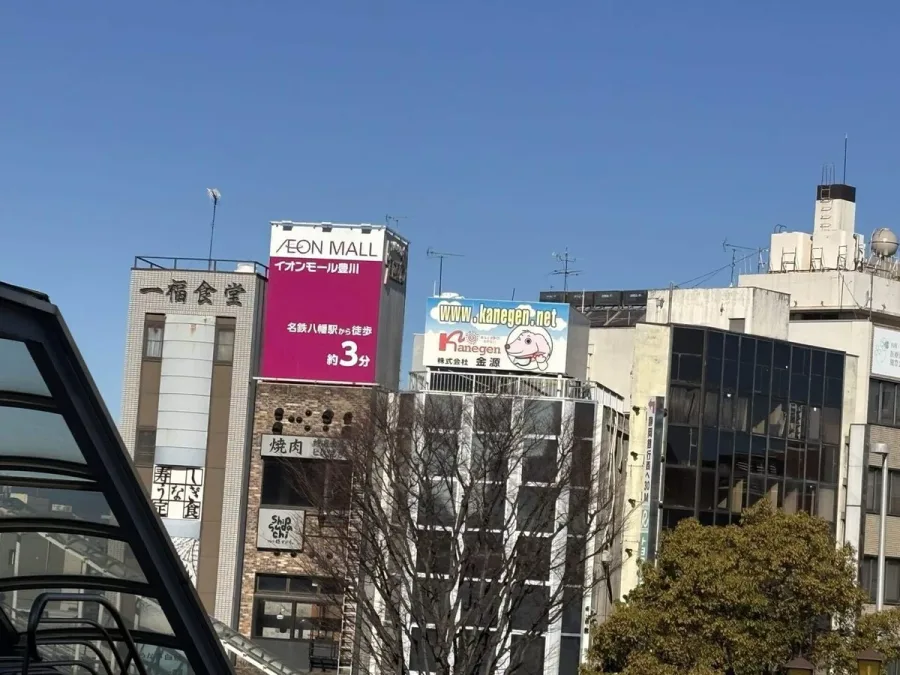
Prohibiting JR and sticking to private railways, the eastern base for limited express trains is Toyohashi Station. At Toyohashi Station, there was a sign for Aeon Mall. I have seen many signs for cars, but this might be the first time I have seen a sign emphasizing pedestrian access from the station.
The reason such signs exist might be because the Tokai region is an Aeon kingdom.
First, I will ride the Meitetsu Panorama Super.
Of course, since I am paying extra, I will ride in the Special Car. For this purpose, I became an internet reservation member.
The μ-ticket fee is an incredibly cheap 300 yen with the off-peak ticketless fare.
The observation car is coupled on the Toyohashi side, so it is a rear view, but the view of the Maiki rail yard and the elevated tracks at Chiryu is high and clear.
However, I wonder how long the elevated construction in Awaji and Chiryu will continue...
I have arrived at Meitetsu Nagoya. I will get off from the special car platform. Having a slide for transporting newspapers is also a feature of Nagoya Station.
Kintetsu Nagoya (11:10) - Ise-Nakagawa (12:09) Limited Express bound for Kashikojima
From Nagoya, it is the familiar Kintetsu.
I ride the Kintetsu Limited Express several times a year, so I am a ticketless member.
However, I often ride the Meihan Ko (non-stop) Limited Express in the morning and evening, and I don't recall ever riding a train that skips Yamato-Yagi, so I would like to try it once.
And, the train I am riding this time is not the Hinotori on the right, but the Ise-Shima Liner on the left.
This Hinotori skips Yamato-Yagi, but if I go all the way to Namba, there are no limited express trains going west from there, so unfortunately I cannot ride it.
Instead, I will travel in a Deluxe Car. Kintetsu Limited Express feels expensive compared to Meitetsu, but it is very cheap compared to JR.
From Nagoya to Nakagawa, the deluxe fee is only 210 yen added to the limited express fee.
Ise-Nakagawa (12:10) - Yamato-Yagi (13:01) Limited Express bound for Osaka-Namba
At Ise-Nakagawa, the next limited express train was already stopped. With a one-minute transfer, it departs before the limited express going to Kashikojima, and the connection is so good that the transfer time is very tight.
Arrived at Yamato-Yagi. About half of the passengers in the car I was in got off. The front was a 22000 series ACE and the back was an old Sunny Car. I
hit the jackpot by riding in a car with power outlets. I ride Kintetsu Limited Express quite often, but as far as I can remember,
I have never ridden the 22600 series Ace yet.
Yamato-Yagi (13:11) - Kintetsu-Tanbabashi (13:52) Limited Express bound for Kyoto
From Yamato-Yagi, I will head toward Kyoto. While it may seem like there are many trains since a limited express arrives every 15 minutes, the schedule is actually irregular with two trains per hour. I suspect this is due to the reduction in Osaka Line limited express services and connection adjustments.
This is likely due to the reduction of Osaka Line limited express services and connection adjustments.
The train that arrived was a Vista Car. I am riding in a single-level car.
The train and seats have been refurbished, but there are no power outlets, and the headrest covers featuring the Kintetsu limited express train design are still in use.
After crossing the Uji River on the Yodogawa Bridge, it is soon Tanbabashi Station.
The Yodogawa Bridge is known as the longest simple truss bridge in Japan with a span of 164 meters and no intermediate piers.
Also, since the Uji River is the main stream of the Yodo River, it is not unnatural for the bridge to be named Yodogawa.
This is a bridge often featured on YouTube and the like when the Kintetsu Kyoto Line is mentioned, and while everyone else takes great photos of it, mine feels a bit lackluster.
Kintetsu-Tanbabashi arrival.
I noticed when looking back at the photos that above the ticket gate, a design of the character 'Tan' inside a circle is depicted. This is the end of my long journey on Kintetsu.
Tanbabashi (14:03) - Gion-Shijo (14:12) Limited Express bound for Demachiyanagi
There was a surreal advertisement in the connecting passage saying Premium Car full of Maiko. (It is Kyoto, after all) I think this is a photo that captures the Osaka vibe.
I had a little time, so I looked outside the station building.
In front of the station, there is only a hall and a convenience store, and it is so quiet that you wouldn't think it's a limited express stop.
I have never gotten off here, but it seems the area around Momoyamagoryo-mae and Fushimi-Momoyama to the south is more of a commercial hub.
I enter the Keihan Tanbabashi Station ticket gate and board the next limited express.
In this series of travels, this is the shortest ride at less than 10 minutes, but I am of course riding the Premium Car. If a train allows for an upgrade, I will pay for it.
For this reason, I became a Keihan ticketless member.
In the blink of an eye, I arrived at Gion-Shijo Station. Information about the Premium Car is displayed in a huge size.
I feel like I haven't seen these large information display boards much lately.
The number of connected cars varies depending on the train model.
Kyoto-Kawaramachi (14:30) - Osaka-Umeda (15:12) Limited Express bound for Osaka-Umeda
Once you cross the Kamo River from Gion-Shijo Station, it is immediately Hankyu Kawaramachi Station. In the photo, you can see something like a station building in the back to the left.
The Kyoto area is overflowing with tourists lately, but the traffic on Shijo Bridge was light on this day.
I usually only cross the bridge, but since I had some time, I went down from the bridge and looked along the river.
The area under Shijo Bridge looks like the photo.
I go underground again and enter the Hankyu ticket gate.
I am boarding from Kyoto-Kawaramachi onthe paid seating 'PRiVACE', of course.
Keihan hasmany touristssuch as families, but my impression is that Hankyu hasrelatively more people in suits and daily commuters. It seems Hankyu's PRiVACE also took inspiration from Keihan's Premium Car, but
I prefer the comfort and view of the seats on Keihan.
After riding for about 40 minutes andcrossing the Yodo River, it is finally Umeda. It feels like traveling from Kyoto along the Yodo River to Osaka.
Arrived at Osaka-Umeda Station. The train I rode this timeseems to have been a new Hankyu model.
Hankyu's Umeda station has a sense of gravitas and is quite eye-catching.It can be called a model for a bustling city that starts from the station.
Osaka-Umeda (15:30) - Sanyo-Himeji (17:10) Direct Limited Express bound for Sanyo-Himeji
From Umeda, it is Hanshin Electric Railway.I took a photo because I was surprised to see a Sanyo trainoperating as a Limited Express bound for Suma-ura Koen. I will let this train pass.
Hanshin Electric Railway, the parent company of the Tigers, wasstill displaying championship posters everywhere. Spring training camp will start in just another month.
While doing that, the direct limited express I am taking arrived.Since it is marked in red, it is the one with fewer stopsin Kobe city.
There are reports that Hanshin and Hankyu are considering paid seating for the Kobe area as well. However, since there is currentlyno paid seating service on regular trains, I will ride a train with cross-seats.
The train I boarded hascross-seats only in the two middle cars out of six. This time, I chose the Hanshin route because
the ratio of cross-seats on the Hankyu Kobe Line is low. Also, the
train that passed by was a long-seat car, so I intended to let it pass if that one came.
Crossing the Yodo River again, I leave Osaka behind. In the distance, I can see the Rokko mountains, and I feel how close the mountains are in the Kansai region. Strictly speaking, the prefectural border is the Samondono River, a branch of the Kanzaki River.
From Nishidai Station, it changes from Hanshin to Sanyo. I head west while looking at the scenic landscapes of Kobe and Akashi. I find myself
taking more photos than on the Kintetsu section I am used to. Up to Akashi, the train
runs slowly, weaving through the sea, hills, and buildings. It loses to theJR
Special Rapid in terms of speed, but compared to Rapid or Local trains, the timedoes not change much.
Perhaps focusing on regional transport, the train I rode, in addition to standard stops, alsostops additionally at Takinochaya, which has James Mountain, atArai, which has factories, and atShirahamanomiya, which is developing with factories and housing.stops additionally
I came from the Aboshi direction on the outbound trip, but since there are no limited express trains on the Aboshi Line, I am heading toward Himeji.
Once the support pillars used for the monorail to Mt. Tegara come into view, Sanyo Himeji Station is just around the corner.
Arrived at Sanyo Himeji Station!
Because they operate through-service with a railway company that owns a baseball team, there are also Hanshin-wrapped trains.
Even though it is just a wrap, the presence of Manager Kyuji Fujikawa is overwhelming.
The red-painted cars of the through-service partner that owns a baseball team were lined up. A local train of their own company is also parked quietly in the corner.
A mysterious spinning vision. It introduces the Sanyo line area.
Looking at it this way, Himeji Station seems much more urban than many prefectural capitals.
In Western Japan, the areas in front of hub city stations are surprisingly prosperous, and walking around the city is fun.
On the other hand, the Tokai region that I passed through at the beginning of this article, with the exception of places like Yokkaichi, often has areas in front of stations that are not very prosperous despite the number of passengers. Commercial clusters are located along main roads.
So, this was a super!? comfortable Tokai-Kansai private railway cross-country trip where I paid for cross-seats whenever I could.