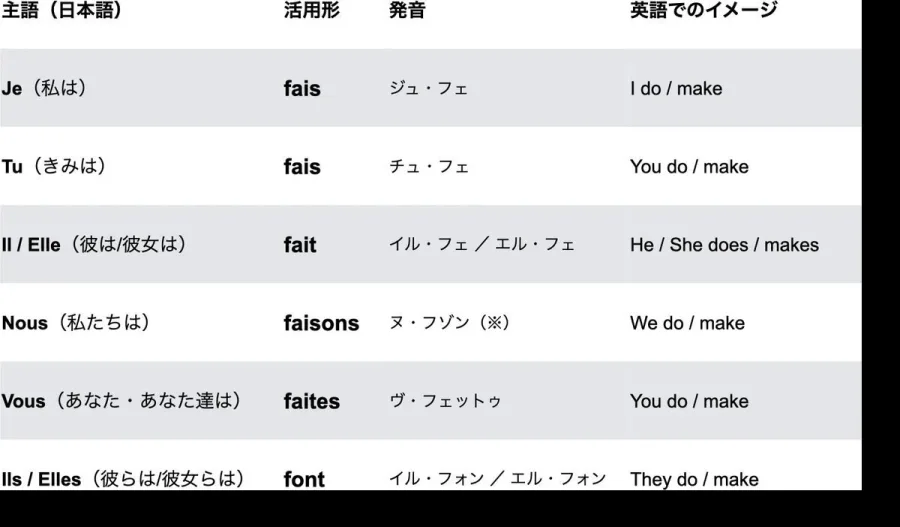
We will explain the most important French verb “faire” (pronounced 'fair').
“do” or “make” corresponds to it, and it is a versatile verb used in every situation, from daily life to proverbs. Since it conjugates irregularly, let's first focus on the present tense forms that appeared in the proverb this time.
1. Conjugation in the Indicative Present (Changes based on the subject)
In French, the form of the verb changes entirely depending on the subject (who).
Note: You might be tempted to read “Nous faisons” as “faisons” based on the spelling, but the rule is to pronounce it as “fuzon”.
Usage in the proverb: In the sentence earlier, because the subject “small streams (Les petits ruisseaux)” corresponds to the third-person plural (they), font (pronounced 'fon') was used.
2. Three representative meanings and usages of faire
① “To make” or “to do”
It is used to create specific things or to perform actions.
Faire un gâteau. (to make a cake)
Faire homework. / Faire les devoirs. (to do homework)
② Expressing weather (impersonal construction)
When saying “The weather is ~ today” in French, use Il (a dummy subject with no meaning) and the verb faire.
Il fait beau. (The weather is nice)
Il fait froid. (It is cold)
③ “To make someone do something (causative verb)”
By following it with the infinitive form of a verb, you can create expressions for commands or requests to “make someone do something.”
Faire travailler... (to make work)