We have entered an era where watermarks are being added to AI-generated text.
In August 2026, Anthropic announced that it would embed 'machine-readable markers' into text generated by Claude. The background for this is the EU AI Act, but the scope is not limited to the EU; it applies to all text generated around the world. New models released on or after August 2, 2026, will support this from day one, and it is planned to be gradually expanded to older models after a transition period.
Upon reading the announcement, this was the first question that came to mind: Where do you hide a watermark in a simple string of text?
If it were an image watermark, I could imagine it somehow. But text is just a sequence of characters that can be taken anywhere if you copy and paste it. You cannot change the font or the color. Yet, Anthropic claims that 'the watermark moves with the text even if you copy and paste it' and that 'it is invisible to the human reader.' Is that really true?
When I looked into it, I found the concept behind this technology to be truly fascinating, so I will explain the mechanism from scratch.
It works for images. What about text?
First, let's start with image watermarks.
Digital images are collections of pixels, and if you change the brightness of a single pixel ever so slightly, the human eye cannot distinguish it at all. By stacking a large number of these 'imperceptible changes,' information is embedded. This is the basis of digital watermarking for images. Since pixels are continuous numerical values, there is plenty of room to wiggle them.
Text does not have this room.
Writing is a sequence of discrete components called words (or more accurately, tokens). There is no such operation as changing 'Tokyo' just a little bit. If you replace it with another word, the meaning changes. At first glance, it seems impossible. That is why watermarking text has been considered significantly more difficult than watermarking images.
So, where is it embedded? The answer was in an unexpected place.
The hint lies in the LLM's 'lottery'
LLMs do not write text all at once.
They choose 'what word comes next' one by one and connect them. Moreover, the way they choose is a probabilistic lottery, so even if you ask the same question, you may not get the same answer every time. The model assigns a probability to each candidate. After that, it's a draw. Imagine something like 60% for 'sunny' and 30% for 'clear'.
What is important here is that 'situations where either is fine' appear many times in a sentence.
The words following 'Today's weather was cold and—' could be 'gloomy' or 'gray,' and both would be natural. Choosing either one does not change the quality of the text. This 'indifference' is the hiding place for the watermark.
In a long piece of text, there are hundreds of opportunities for this freedom of choice without changing the meaning. By adding a very slight 'habit' to each of these choices based on a secret rule, you can create a watermark. You cannot tell anything by looking at a single choice, but when you aggregate the data across the entire text, a bias that is statistically impossible in human writing emerges. This is the basic idea of digital text watermarking.
Strategy 1: Favoring certain words
The first to formalize this idea was the KGW method, announced by Kirchenbauer et al. in 2023. It was presented at the top machine learning conference, ICML, and became the starting point for this field.
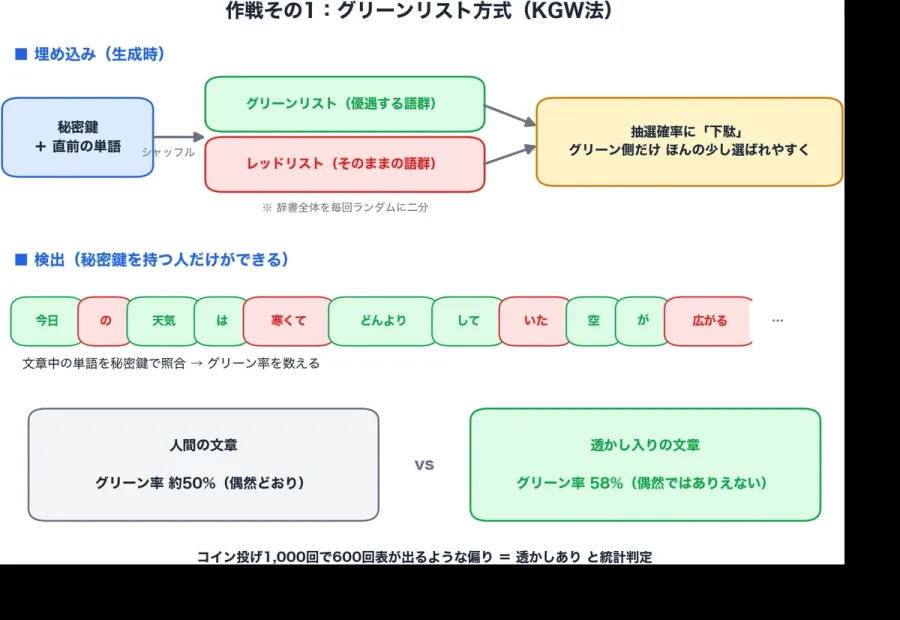
The method is simple. Using a secret key, all words in the dictionary are randomly divided into two groups: a 'green list' and a 'red list.' Then, every time text is generated, the selection probability is slightly boosted so that words on the green list are slightly more likely to be chosen.
By the way, this list is not fixed. It is reshuffled every time using the preceding word as a seed, so a 'one-time green list' is used for each position in the text. This is a measure to prevent the list from being guessed based on word biases, which could happen if a fixed list were used.
The detection side simply follows the same shuffle using a secret key, checks the words in the text one by one, and counts the 'green rate'.
For example, if you divide the list in half, the green rate of text written by a human will be roughly 50%. However, in watermarked text, this becomes 55% or 60%. To use a coin-toss analogy, it is like flipping a coin 1000 times and getting heads 600 times. It is clearly strange. You can statistically determine that a bias that would almost never occur by chance equals the presence of a watermark.
You can detect it with just the secret key, without even touching the model itself. It is a well-crafted mechanism.
However, there was a weakness: it distorts the lottery probability itself.
Because it gives an advantage to words that would otherwise be less likely to be chosen, the quality of the generated text can slightly decrease, and in situations where the answer is almost fixed—such as code or proper nouns—this forced favoritism can be particularly detrimental. It is a trade-off between quality and detection power. The KGW method was a system that carried this burden.
Strategy No. 2: Swapping the Random Numbers
That is where a method called 'distortion-free' came in. Its origins date back to a 2022 proposal by computer scientist Scott Aaronson, who was at OpenAI at the time.
In a nutshell, the idea is to not tamper with the probabilities, but only swap the random numbers used for the draw.
LLM lotteries require random numbers, but this method secretly replaces the 'true random' numbers with 'pseudo-random numbers calculated from a secret key and the preceding few words.' That is all. Since the probability of each word being chosen mathematically matches that of a model without a watermark, there is theoretically zero quality degradation.
On the other hand, the detector can reproduce the 'random numbers that should have been used at that time' from the secret key. By comparing the text with the random number sequence, if there is a series of overly perfect matches, it means there is a watermark.
Anthropic's official blog has a good analogy for this idea: Monopoly.
Suppose you use the 'sequence of digits in pi' as the dice rolls instead of actual dice. Starting from around the millionth decimal place, each player takes turns using the next digit as their 'roll,' but the play experience and the game results are no different from using dice. However, if you check all the moves against pi later, you can see that 'this game was using pi.' This game, so to speak, is watermarked.
Keep the fair lottery as is, but make the contents of the lottery verifiable after the fact. The essence of the distortion-free method boils down to this.
SynthID-Text adopted by Claude
The method that refined this distortion-free approach to a product level is SynthID-Text, which Google DeepMind announced in Nature in 2024, and it had already reached real-world operation in Gemini by the time of the paper.
Then, in August 2026, Anthropic revealed on its official blog that 'Claude's watermark is a type of SynthID-Text.'
The core of SynthID-Text is a mechanism called Tournament sampling. When deciding the next word, it first draws multiple candidate words. Then, it makes the candidates compete against each other using scores derived from a secret key, and the surviving word is adopted. It is, so to speak, a word tournament.
Since the winning words have a tendency to 'have higher secret key scores,' when you average the watermarked text as a whole, only the scores become unnaturally high. Detection targets this. Moreover, if the competition is set up in a one-on-one format, it has been proven that the word appearance probability matches the original model, so the distortion-free property is properly maintained.
What is persuasive is the scale of the actual operational data.
The Nature paper includes an experiment comparing the presence and absence of watermarks across approximately 20 million production traffic requests for Gemini, and the difference in user 'good/bad' ratings was 0.01–0.02%, which is not a statistically significant difference. The impact on generation speed was also a 0.57% increase. This is essentially within the margin of error. Anthropic also states in internal tests that 'no impact on content, creativity, or readability was observed.'
What watermarks can and cannot do
Reading this far, it may seem like a panacea. However, there are clear limitations. This is a point that Anthropic itself explains carefully in its official documentation.
What can be detected is only that 'it is highly likely that Claude was involved.'
The essence of a watermark is a statistical bias, so the answer is always just a likelihood (plausibility), and it is impossible to distinguish whether 'Claude wrote it from scratch' or 'Claude heavily edited human text.' Even if a human writes the text, if they have Claude translate it, Claude chooses all the words, so a watermark is inserted. Conversely, if a human heavily rewrites Claude's text or paraphrases it with another tool, the watermark will fade and disappear. Since the true nature of a watermark is a bias residing in 'surface-level word choice,' if the words are completely replaced, the bias is washed away along with them.
Note that the mechanism is fundamentally different from the 'AI text checkers' already in the world. Most existing checkers infer 'AI-ness' from statistical characteristics of writing style, so they are inherently prone to false positives. Watermark detection is a verification process using a secret key, so it is far more reliable for those who hold the key. On the other hand, a third party without the key has no way to detect it and will have to rely on the detection API that Anthropic plans to provide.
Situations where watermarks are less effective are also structurally determined by the mechanism.
・Short text. There are few opportunities for selection, and there is not enough signal to collect statistics.
・Factual descriptions. Borrowing an example from the official blog, after 'Newton's main work is the Principia—,' the next word is 'Mathematica'—there is only one choice. Watermarks cannot be inserted where there is no freedom of choice.
・Code. It is explicitly stated that watermarks are not applied to places where the correct answer is unique (though they may be inserted in comments, etc.).
・Proofreading and editing. Since most of the words are human-generated, there is nothing for the watermark to ride on.
In other words, watermark detection is not 'proof that it was written by AI'. Anthropic repeatedly emphasizes this point on its official blog. They are likely wary of a situation where detection results are taken out of context in schools and workplaces.
Furthermore, the privacy design is clear. Neither the watermark nor the key contains information that identifies the user, organization, or chat. All that can be known is 'whether or not Claude was involved'—that one point alone. Incidentally, what is attached to files such as images is C2PA, a system separate from watermarks. It is an industry-standard metadata (provenance proof) also used by camera manufacturers and photo editing software, and it is a mechanism that does not alter the contents of the file at all.
Conclusion
Embedding quirks into the 'arbitrary choices' of text. However, since the probability is not distorted and only the source of the random numbers is swapped to be derived from a secret key, quality does not drop in theory or in actual measurement. Detection is a statistical verification, and all that can be known is the likelihood of involvement—.
It is not a definitive way to see through 'whether it was written by AI,' but a label that quietly indicates 'whether AI was involved.' Just by knowing this sense of distance, you can avoid being swayed by the news of detection tools that will likely increase in the future.
The detection API is said to be 'coming soon,' but on the other hand, resistance to attacks that erase watermarks through paraphrasing is still in its infancy, and this is the main battlefield for research in this field. The cat-and-mouse game between those who embed and those who erase is actually just beginning. As a writer on note, I hope that the misunderstanding that 'watermark = AI certification' does not spread, and I intend to check the actual behavior once the detection API is released.
Reference links・How Claude's text watermarking works (Anthropic Official Blog)
・How Claude marks AI-generated content (Anthropic Support)
・Scalable watermarking for identifying large language model outputs (SynthID-Text, Nature 2024)
・A Watermark for Large Language Models (KGW Method, ICML 2023)