Hello. This is Zukosha.
Thank you for visiting the official Zukosha Note.
In this new "Learning About Our Work" series, we will introduce the work Zukosha does every day, along with the technologies, concepts, and background behind it.
We hope that through work that is not usually visible, you will get to know Zukosha's work a little better.
There are many things in our work that become invisible from the ground once completed. What we are introducing this time is one of them.
Tokachi is well known as one of Japan's leading large-scale field farming areas.
Using large tractors and drones, they rotate field crops such as wheat, sugar beets, potatoes, and beans.
And, with an eye on future climate change, research is underway at Obihiro University of Agriculture and Veterinary Medicine to see if rice cultivation can be added to this crop rotation system.
To conduct that research, we are currently developing a next-generation field on the university grounds where both rice and field crops can be planted.
In fiscal year 2026, the development of the fields used for that research and the facilities for supplying and discharging water is progressing.
Zukosha was responsible for everything from the geological survey to the design of this facility.
On the day of the site visit, the underdrain construction was supposed to be underway.
However, the construction was canceled due to the rain that fell from the previous night.
Although we could not see the underdrain construction, we walked around the site where water remained and asked about "what kind of mechanism is being built under the paddy field."
What is an "underdrain" under a paddy field?
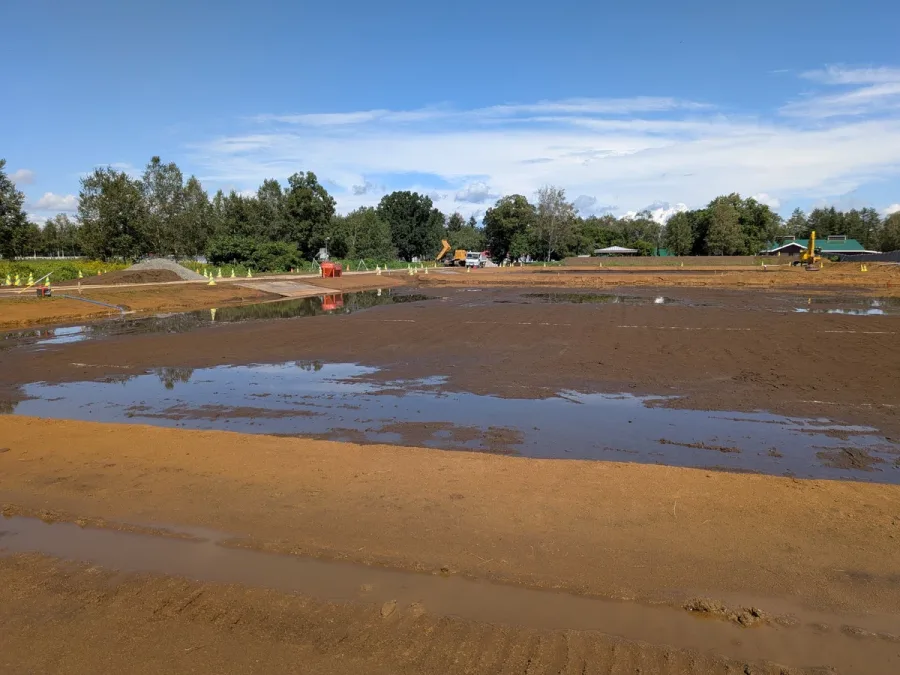
The first thing we were taught at the site was a facility called an "underdrain."
Underdrainage is a system that buries pipes under paddy fields and fields to discharge excess water accumulated in the soil.
If the groundwater level becomes too high due to rain or other factors, crops may suffer from moisture damage, or agricultural machinery may have difficulty entering the field.
Field crops such as wheat, sugar beets, potatoes, and beans, in particular, dislike waterlogging.
Therefore, we collect water into underdrain pipes buried in the ground and "discharge the water" outside the field to lower the groundwater level of the field.
At this site as well, underdrain pipes will be placed under the paddy field.
The materials used are perforated pipes, which have holes to take in water, and non-perforated pipes, which have no holes. By using each appropriately according to their role, we create pathways for water beneath the paddy field.
Draining water, adding water
An underdrain is a facility for discharging excess water.
However, the role of the underdrain pipes being installed this time is not limited to this.
Many field crops dislike waterlogged conditions, but rice cultivation requires a waterlogged state.
Instead of supplying the necessary water from the surface, we send it into the underdrain pipes, using the underdrain for "water supply" as well.
In other words,
when field crops become waterlogged, we drain water from underground.
When rice cultivation requires a waterlogged state, we add water from underground.
A single system is designed to fulfill both roles.
This type of system is called "sub-irrigation," which supplies and discharges water from underground through underdrains to adjust the groundwater level.
Even if a field looks like a single plot from the surface, a system is built underground that considers how to drain and deliver water.
Designing according to the field
Underdrain and sub-irrigation systems do not have to be built the same way everywhere. The necessary equipment changes depending on the soil conditions, water flow, and how the field is used.
This time, Zukosha was in charge of everything from geological surveys to design.
In the design phase, we consider factors such as the spacing of the underdrain pipes and the diameter of the pipes to be used, based on local conditions.
What is important is not simply draining water quickly.
While considering how the farmer will use the land, we ensure that water can be drained when necessary and delivered when needed.
"What kind of water flow is most convenient for that land?"
Working backward from that, we determine the shape of the facility.
The sub-irrigation system being installed this time supplies and discharges water from underground.
In other words, since water passes through the soil, it is important to understand its permeability. We determine the appropriate water volume by correctly investigating and analyzing these factors, but this also varies depending on the soil.
Before drawing up the blueprints, get to know the land and the agriculture that will take place there.
That, too, is an important part of the design work.
Creating fields where agricultural machinery can move easily
What we are considering in this design is not just the flow of water.
We have provided "turning farm roads" around the rice paddies so that agricultural machinery can work efficiently.
This is a system that allows agricultural machinery working in the field to move directly onto the farm road, turn around on the road, and move on to the next task.
By making it easier to enter and exit the rice paddies, there is no need to make large detours for every task, allowing farm work to proceed efficiently.
In design, it is not just about building the facilities themselves,
but also about how people and agricultural machinery will move there.
We determine the shape of the entire farmland while considering such actual usage scenarios.
Subsurface design that considers the flow of water, and surface design that considers the movement of agricultural machinery.
It is the combination of both that creates easy-to-use fields.
Work that becomes invisible once completed
The underdrain construction we were scheduled to see on this day was canceled due to rain.
However, while walking through the field where water remained and listening to the explanation, I felt something anew.
Draining water.
Adding water when necessary.
Thinking about shapes that make it easy for agricultural machinery to move.
At first glance, these may seem like separate things.
But in actual design, we assemble them into a single facility while considering the state of the soil, the flow of water, and even how that location will be used.
The underdrain introduced this time will also be hidden under the soil once construction is finished, and will not be seen in daily life.
Even so, it continues to function as a mechanism that regulates the flow of water and supports agricultural work in those unseen places.
There is design work like this even beneath the rice paddies we see every day without much thought.
This field trip was an opportunity to learn a little bit about that "invisible work."
And this year, the season for new rice has arrived again.
The rice that you eat every day.
One of the things that supports its production is this kind of underdrainage and field improvement. Along with the master skills of the producers, there are mechanisms that support agriculture in places that are usually invisible.
It might be nice to taste the new rice while thinking about that a little bit.