Wired earphones are returning to the fashion scene once again.
I have been feeling this more and more lately.
Until recently, wired earphones were often viewed as things that would be replaced by wireless ones, or as relics of the past in terms of convenience.
However, the current trend is a little different.
Wired earphones are not just a connection method; they are being re-evaluated as fashion items, including the cable visible around the neck, the accessory-like feel at the ears, and the look of a wire intentionally extending from a smartphone.
The Diesel Wired Earbuds I am covering this time are a product right in the middle of that trend.
These are not authentic IEMs that emerged from within the portable audio hobby.
They are wired earphones that lean heavily toward fashion, combining Diesel's brand image, a silver industrial exterior, chain and charm decorations, and a USB-C connection that plugs directly into a smartphone.
To be honest, I didn't have high expectations for the sound quality at first.
However, looking at the official stock, they seem to sell out as soon as they come in, and they are apparently a hot topic on social media.
If the younger generation is picking up wired earphones again as fashion items, as someone in the portable audio world, I can't help but have some expectations.
Wired earphones are not "old things," but are spreading as "things you choose to wear.".
If that leads even a little bit toward the idea that it's interesting to choose not just the look but also the sound, that is a very welcome trend.
So this time, I decided to measure these Diesel Wired Earbuds and listen to them seriously, just like I do with my usual earphone reviews, rather than treating them as fashion items.
To conclude, these are not wired earphones for seriously enjoying music.
However, it would be a shame to dismiss them as just products for show.
There are aspects that work for casually listening to modern pop music, and I think they are a very accessible entry point for picking up wired earphones as fashion.
What are Diesel Wired Earbuds?
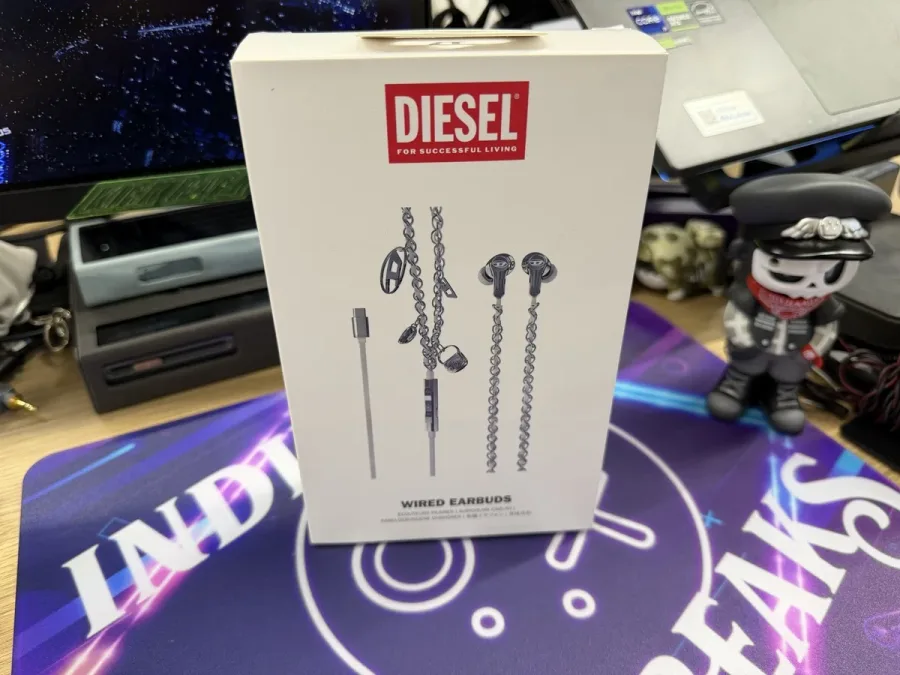
Diesel Wired Earbuds are wired earphones with a USB-C connection developed by Diesel.
Since they use a USB-C connection rather than a 3.5mm plug, they can be plugged directly into iPhones from the iPhone 15 onwards, many Android smartphones, and devices that support USB-C audio.
In other words, they are not products premised on dedicated portable audio equipment or conversion adapters, but general-purpose earphones that you plug directly into your smartphone and use.
The exterior is quite bold.
With a silver earphone body and a chain that seems to wrap around the cable.
Furthermore, they come with Diesel-like charms, making the design premised on being shown off as an accessory rather than just an earphone.
Judging by the labeling on the back of the package, it is natural to view this product not as earphones developed directly by Diesel as an audio manufacturer, but as a product developed by Techstyle B.V. under the Diesel Consumer Electronics Accessories license, with manufacturing handled by Dongguan Moyo Technology Co., LTD. in China.
In short, these are not IEMs for portable audio enthusiasts.
They are general-purpose fashion-tech USB-C wired earphones that combine the design sensibility of a fashion brand, a licensing business, and OEM/ODM-style manufacturing.
I think this premise is quite important.
This is because if you evaluate these earphones as serious IEMs for portable audio, the results will be quite harsh.
On the other hand, if you look at them as a product for someone who wants to wear wired earphones as a fashion item and plug them directly into their smartphone to listen to modern pop music, the way you evaluate them changes a bit.
In this article, I would like to look at them from both perspectives.
Accessories, Appearance, and Fit: Accessories are minimal, but the earphones themselves have a huge impact.
The accessories are quite simple.
Three sizes of eartips and an instruction manual.
No case is included.
The packaging is the type where the unit and cable are intricately fixed to a paper backing, and it was a bit of a struggle to take them out while keeping the box in good condition.
This is a way of displaying them that is typical for accessory products, but as packaging for audio products where you frequently take the earphones in and out, it is a bit difficult to handle.
The appearance of the unit itself is quite good.
The look, which combines a silver housing, chains, and charms, is clearly different from ordinary earphones.
Even before considering sound quality, they have the design power to make you want to wear them.
However, the fit is quite unique.
Despite the name Diesel Wired Earbuds, they are not typical flat-head style earbuds.
At the same time, they are a bit different from the type where you insert the nozzle deep into the ear like a normal IEM.
The actual sensation is closer to recent TWS.
Rather than inserting them deep into the ear, they are the type that shallowly blocks the entrance of the ear.
When I looked closely at the shape of the nozzle, it looked similar to the shape of Bose QuietComfort series eartips.
So I tried Bose eartips, and they fit quite well.
Conversely, although the SednaEarfit Crystal for BOSE Earbuds could be attached to the nozzle side, I gave up because I couldn't get a good seal on the entrance side with my ears.
I think it depends on the shape of your ears, but if the genuine Diesel eartips don't fit, it might be worth trying Bose-style eartips.
The thing that concerns me most about the fit is not the weight of the earphone unit itself, but the weight of the cable side.
The unit itself is not that heavy.
I suspect it is made of a silver-plated plastic material.
However, the chains and charms attached to the cable are definitely made of metal, and they have a distinct weight.
There are times when they feel heavier than thick aftermarket cables, and since they are not over-ear, there is a sense of anxiety about them being pulled downwards.
The visual appeal itself also makes them difficult to wear.
They work as a fashion item.
However, when viewed as a tool for listening to music stably for long periods, they are a product that requires a bit of care when wearing.
Measurement: A very unique balance with low-frequency volume and a strong presence band.
First, as a premise, this measurement was conducted not as a standard flat-head type earbud, but as an earphone type that uses ear tips to seal the ear canal.
Although the Diesel Wired Earbuds are named 'Earbuds,' they do not have a structure that sits shallowly in the concha like typical inner-ear earbuds.
Because they are designed to be used with ear tips that seal the ear canal to some extent, I was able to insert them firmly into the ear canal using my usual ear tips during measurement.
Since I did not feel any particular sound leakage, I have determined that the measurement itself is valid with a proper seal.
Looking at the frequency response, first of all, the low end is well-represented.
It does not drop off significantly from around 20Hz to 100Hz, and the volume can be confirmed down to the sub-bass range.
However, it connects smoothly toward the mid-low range, centered around 100Hz, so rather than being an extreme sub-bass specialist, it appears to be a type thatadds thickness to the entire low-frequency range.
Therefore, it is expected that the presence of the low end will appear quite strong in the measurements.
The foundation of the kick and bassline is easy to feel, and as a general earphone for smartphones, I think it has a balance that is unlikely to feel lacking in the low end.
On the other hand, since the peak of the low end is not extremely biased toward the 20-40Hz side, rather than a deeply sinking sub-bass, there is a possibility that it will be heard more asthe weight of the rhythm or the push of the mid-bass.
The mid-range gradually drops from after 100Hz to around 1kHz.
Looking at this shape, it seems to be in a direction that provides low-frequency volume without excessively inflating the mid-low range that serves as the foundation for vocals.
Therefore, it does not seem to be the type where voices are buried too much in the low end.
However, since the 300Hz to 1kHz range is not heavily boosted, it is slightly different from a type that produces dense vocal or instrument body resonance, density, and warmth.
It appears to be a balance where there is low-frequency volume, but the thickness of the mid-range itself is somewhat organized.
The most distinctive feature is the strong lift from just before 2kHz to around 4kHz.
This band is the part related to how vocals come forward, the clarity of words, and the contours of guitars and snares.
Since the Diesel Wired Earbuds have a very solid output here, in terms of measurement, it appears to be a tuning thatmakes vocals and sound attacks easy to understand and brings them forward.
There is plenty of low end, and the presence band is also strong.
Looking at this combination, I think the goal of the sound is toachieve both low-frequency impact and vocal clarity.
On the other hand, this 2-4kHz lift is also a part where the contours of voices and instruments can easily become prominent depending on the song.
Therefore, in actual listening, I want to confirm whether it works as vocal clarity or if it comes out as sound hardness or harshness.
The high range shows several peaks after 5kHz.
In particular, there is a strong mountain around 8-10kHz, and a lift is also visible around 15kHz.
However, since this area is also a band that easily fluctuates depending on the measurement environment, insertion position, and compatibility with ear tips, I want to avoid concluding the quality of the high range based solely on numerical peaks.
In terms of measurement, it looks like a shape that tries to provide some degree of airiness and brightness rather than being a completely dark and rounded earphone.
However, it is not a type where the 5-8kHz area extends smoothly, and since itappears to be dropping in tendency, it is necessary to confirm in actual listening how naturally the fine textures of cymbals, claps, hi-hats, and guitars are produced.
Overall, the frequency response of the Diesel Wired Earbuds is quite unique.
The low end is solid in volume, and the 2-4kHz presence band is also strong.
On the other hand, the thickness of the mid-range is somewhat organized, and the high range drops sharply rather than extending smoothly, so it cannot be fully read from the measurement how much remains as sound.
As far as the measurement alone is concerned, it is close toa general-purpose tuning that makes low-frequency impact, vocal proximity, and sound contours easy to understand.
On the other hand, whether it is a type that carefully depicts the natural thickness of instruments, the breadth of the space, and the fine textures of the high range is a point I want to confirm through actual listening.
In particular, since this model has a different wearing structure than standard IEMs or flat-head type earbuds, there is a possibility that the low-frequency volume and the way the high range is heard can easily change depending on the actual wearing state.
While it can be read on the premise that a seal is achieved in measurement, I think it is a model where the choice of ear tips and the stability of the fit are also greatly related to sound quality in actual use.
From here on, I will verify those predictions with actual tracks.
First Impressions | Can they be used normally as fashion earbuds?
First, rather than a difficult sound quality evaluation, I will check if the low end, vocals, and overall groove can be enjoyed naturally when plugged into a smartphone and playing everyday music.
Charli XCX — “360”Listening for the first time, I felt the sound was better than I imagined.
The low end has a tight image and rings out firmly as the foundation of the song.
It is not a low end that sinks intensely, but it has the rhythmic support necessary to listen to this song.
The detail in the high range might be lacking.
However, the necessary vocals stand firmly in the center.
Charli XCX's voice also comes out with the sound I imagined.
This part is honestly good.
On the other hand, the clap sounds are pulled back a bit.
Rather than carefully depicting fine percussion sounds or spatial openness, it feels like a sound design that basically separates vocals and low end firmly to make them easy to hear.
At this point, my impression was that it is a sound design for mass-market earbuds that is easy for anyone to listen to.
The 1975 — “If You’re Too Shy (Let Me Know)”Band sounds leaning toward rock can also be played without any particular issues.
Vocals are firmly separated in the presence band.
The voice is not completely buried and is placed in the center.
However, there is no resolution that allows you to read the details of the vocals.
There are scenes where they are buried in the overall instrumental sound, and when the amount of information in the song increases, the limits start to show all at once.
The separation between the kick drum and the bass line is also weak.
If anything, the bass line is hard to hear.
In the saxophone solo part, the sound itself comes to the front, but the feeling of it escaping upward is not strong.
Sound coming to the front and sound escaping with air are different, and these earbuds are weak at the latter.
It might be tough for sound sources that require performances using live instruments, a sense of presence, and the production of details.
This was my first impression.
Low End | There is volume. But it is not a low end that sinks deep.
The low end is the part related to the weight of the kick drum and bass line, and the pleasure of the rhythm, and here I will check not only if it has impact, but also if it functions properly as the foundation of the song.
Dua Lipa — “Houdini”The kick and bassline are clearly separated, and the enjoyment of the low end is fully audible.
It functions well as the foundation of the track.
However, the necessary depth on the sub-bass side is not really felt.
The presence of the low end is confirmed through measurements.
So, it is not completely absent.
However, in actual listening, it feels quite weak.
There is not much of a sense of the low end vibrating.
If anything, the sensation of the kick drum heavily hitting the rhythm persists.
The bass is also expressed on the pitch side.
However, the low end is not of a quality where you can hear the texture.
In a song with such emphasized low end, you can finally feel the depth of the low frequencies.
Even so, the center of gravity is high.
Rather than sinking deep, the image is more of it ringing right by your ears.
Regarding the mid-bass, it is more than sufficient.
Since the pitch itself does not disappear, I think there is enough volume for the low end to feel pleasant from a general perspective.
In the section from around 2:10 that proceeds only with sub-bass-leaning vibrations, there is indeed depth.
However, the center of gravity does not fully drop.
In this song as well, while there is volume and impact in the low end, the sensation of the sub-bass sinking into your body is thin.
Low-end summaryIt is not that the low end is not coming out.
Rather, it has enough impact to feel similar to recent TWS with strong low ends.
One might even say it is close to the low-end boost feel of the Bose or Sony WH-1000XM5.
However, from a portable audio perspective, the sub-bass depth, vibration, texture, and bassline tracking are weak.
It rings enough to feel the bassline and kick drum in normal songs.
However, these are not earphones for enjoying the low end as the star of the music.
It is a mid-bass-centered type that produces easy-to-understand low-end momentum.
It is not a low end that sinks deep.
Mid-range | Surprisingly listenable if focused on vocals
The mid-range is the band that is the center of music, such as vocals, piano, and guitar, and here I check whether the voice sounds natural and whether it stands in the center without being buried by the accompaniment.
Olivia Rodrigo — “vampire”The piano's mid-range extends beautifully.
Olivia Rodrigo's voice also comes through to some extent, including the whisper-like nuances and the airy feel in the upper registers.
This is better than I expected.
As for the vocal projection, it's not so intense that it becomes harsh on the ears.
It doesn't have that obviously painful way of presenting presence that you hear in some TWS earbuds.
Even in the latter half where the number of instruments increases, the fact that the vocals don't drift from the center is a strength.
These earphones are at least conscious of keeping the voice in the middle.
However, the separation between instruments isn't that high.
There is a sense that the mid-range itself is a bit muddy.
If you listen primarily to vocals, it works.
However, it's difficult if you try to look closely at the accompaniment as well.
For a track as well-organized as this, the strengths of these earphones shine through.
The piano has a solid, granular quality.
Hikaru Utada's voice also comes through naturally.
Even after the bass kicks in halfway through, the sound doesn't get too congested, and you can feel a sense of clarity.
Of course, the vocal transparency isn't exceptional.
Even so, while supported by a groovy bassline, it captures the components of Hikaru Utada's voice firmly.
On the other hand, the upward reverberation inherent in this track and the natural extension of the chorus upwards are hard to achieve.
Overall, the sound itself is biased toward capturing the vocals.
These are not earphones that paint a broad picture of the entire recording.
They are the type that lets you listen to the atmosphere of the music with the voice as the focus.
The mid-range is better than I thought.
If you only look at the vocals, it's surprisingly listenable.
The voice doesn't drift from the center, and it works for listening to modern pop songs.
However, the ability to depict the space of the entire recording, overtones, and separation between instruments is weak.
While it manages a minimum level of presentation as 'earphones for listening to voices,' it is not a mid-range with expressive power.
High-range | Closer to omission than extension
For the high-range, regarding parts related to cymbals, claps, the fine texture of guitars, airiness, and extension, here I will checknot just whether the sound is bright, but whether the fine details are properly preserved.
Rina Sawayama — “This Hell”The first thing that catches the ear is the intense bass rhythm.
As a mid-bass-oriented track, the foundation is more than sufficient, and it has solid impact.
The low-end impact is easy to perceive in this song as well.
On the other hand, the high-frequency range is quite concerning.
The clap sounds are pushed back and are almost inaudible.
There is a sense that a significant amount of sound is missing.
It sounds similar to what you might hear from recent TWS earbuds.
If you are accustomed to wired earphones, I think the high-frequency output will be hard to find satisfying.
It is easy to listen to in the sense that it doesn't sound harsh.
However, rather than the high frequencies being well-tuned,it feels more like the information you want to hear is missingthan that.
Unfortunately, you cannot hear the details of the guitar.
The sound isn't clear enough to pick up the fine strumming, making it difficult to enjoy the texture of the guitar.
The electronic piano rhythm comes through without any particular issues.
The kick drum and bass sounds are also present.
However, other percussion instruments are only barely audible.
The vocal clarity is also weak.
You can pick up more musical detail than you would by just playing audio through a smartphone speaker in an open space.
However, if you are expecting the level of detail found in wired IEMs, it is a tough sell.
The high-frequency range is a clear weakness of these earbuds.
Rather than high frequencies rounded off to avoid harshness, it is more thatthe amount of information itself is insufficient.
Claps, hi-hats, fine guitar textures, and spatial openness are difficult to hear.
It is an easy-to-listen-to high-frequency range.
However, from an audiophile perspective, rather than being “easy to listen to,”it is closer to “the sounds you want to hear are omitted”.
Technicality | Works for modern pop, but struggles with complex sources
For technicality, I check how well vocals, bass, and instruments are separated when the number of sounds increases, andwhether it can keep up with the speed and fine rhythms of the song.
Jungle — “Keep Moving”The way the strings come through in the beginning feels surprisingly natural.
The bassline, chorus, and main vocals are well separated.
While there is a sense of the sound flowing as a single block, it plays well enough to enjoy as music.
In the outro, other sounds fade out, so you can hear the fine ticking of the hi-hats.
However, it is difficult to say whether you can hear the texture of each note being struck clearly, as the contours are too strong.
It sounds decent enough when the number of sounds is kept simple.
However, when multiple instruments are layered, it lacks the ability to separate the information in detail.
In this song, everything from the vocals to the power of the low end meshes in a good way.
It might be well-suited for modern pop and K-pop.
The clarity of the notes, which I didn't feel much in the previous songs, can be felt in this one.
I feel like I can keep up with each note in the light, fast-paced beat.
Since programmed sound sources have clear contours to begin with, it might be a strength.
The low end has momentum.
The vocals are natural.
It manages to convey the speed and sense of urgency of the beat.
Listening to this song, I think the Diesel Wired Earbuds work well enough as earphones for casually enjoying modern pop music.
Zutomayo — “Byoushin wo Kamu”I added one more song to see how it handles more complex J-Pop.
However, the bassline is still hard to follow.
Even though the mid-bass is strong, you cannot properly hear the movement of the bassline.
It can keep up with the clarity around the piano to some extent.
However, it doesn't capture the fine details of the sound.
It is sufficient for enjoying the vocals and the atmosphere of the sound.
However, in the chorus, even the piano becomes a bit muddy, making it difficult to hear.
In this song, the limitations of the Diesel Wired Earbuds were clearly revealed.
Technical SummaryThe Diesel Wired Earbuds surprisingly work well with modern pop and K-pop where the source material is well-organized.
I think they excel at tracks centered on programmed beats where the contours of the vocals and rhythm are clear from the start.
On the other hand, they struggle with live instruments, band sounds, fine percussion, tracking basslines, and soundstage expression.
These are not earphones to expect high resolution, separation, or spatial expression from.
However, for the purpose of casually listening to modern pop on a smartphone, the music does not fall apart.
In fact, depending on the song, it can be more enjoyable than you might imagine.
Overall Verdict | Not for audiophiles. But an interesting entry point for wired earphones.
The Diesel Wired Earbuds are not earphones for seriously savoring music.
I cannot recommend these to anyone looking for wired earphones for sound quality.
To ears accustomed to wired IEMs, they fall short in every aspect: high-frequency detail, bass depth, instrument texture, separation, and spatial imaging.
Honestly, after listening to these, I think even the wired earphones I have in the 2,000 to 3,000 yen range sound better.
However, it would be a bit of a waste to leave it at that.
The Diesel Wired Earbuds have a look that is one-of-a-kind.
The silver housing, the chain, the charm, the USB-C connection.
They have the power to be seen not just as music playback devices, but as accessories you wear.
And the sound isn't a complete failure, either.
While the bass is centered on the mid-bass, it has an impact similar to recent bass-heavy TWS.
Vocals stand in the center.
If you're just casually listening to modern pop or K-pop, there are songs you might enjoy more than you'd expect.
On the other hand, you shouldn't expect portable audio-level detail, bass depth, high-frequency extension, or instrument texture.
These earphones are not meant for deep, critical listening.
Still, what makes this product interesting isn't the sound quality, but the fact that it is bringing wired earphones back into the fashion space once again.
You want to wear wired earphones as a fashion item.
You want to enjoy the Diesel accessory vibe, including the cable.
You want to plug them directly into your smartphone and listen to modern pop casually.
For those kinds of casual users, the Diesel Wired Earbuds serve as an accessible entry point.
These are not earphones I can recommend to portable audio enthusiasts for sound quality.
I can say that clearly.
But, if these earphones lead to more people becoming interested in wired earphones,
and if even a few more people feel that it's interesting to choose based on sound as well as looks down the road,
I would very much welcome that trend itself.
The Diesel Wired Earbuds are not good-sounding earphones.
However, they were a quite interesting product that makes you feel that wired earphones are returning once again as something you 'wear'.