Can you explain how 7-Eleven makes money? They are in the neighborhood, open in the middle of the night, and their rice balls and coffee are consistently delicious. Despite being so familiar, almost no one can put into words the mechanism behind their earnings. Why have they been able to remain the industry leader for decades, even though their products are not exceptionally cheap? This article breaks down that one point.
1. 7-Eleven is not a "convenience store"
First, I want you to discard one assumption you likely hold. As long as you think of 7-Eleven as a "convenient retail store (a store that buys and sells on its own)," you will not be able to see its true strength.
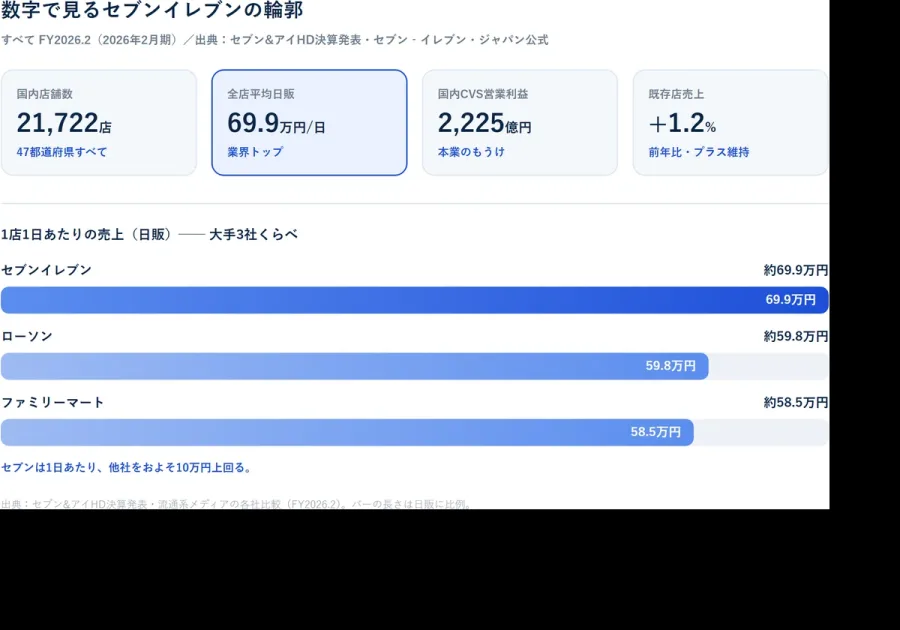
Let me state one fact. Out of 21,722 stores nationwide (FY2026.2), less than 1% are directly owned by the headquarters. Over 99% are stores owned by individuals or corporations that have joined the franchise. It is not the headquarters that opens the stores, hires staff, or carries the burden of unsold inventory.
So, what does the headquarters live on? Here, let's shift our perspective by one level. The 7-Eleven headquarters is not a "company that makes money by selling goods," but a "company that makes money by creating a system for stores to be profitable and having them use it." While it looks like a retail store, its essence is closer to an "OS (foundational system) for running retail." If each individual store is a smartphone app, the headquarters is the OS that supports them all from below.
Once you can make this one-line perspective shift, the meaning of the numbers in the financial results looks completely different. The entry point to this is the following three numbers.
2. The "mystery" of three numbers that is confusing if read literally
7-Eleven's financial results contain numbers that are confusing if read at face value (all are FY2026.2 = fiscal year ending February 2026). I won't give the answer yet. First, I want you to take away just the three "whys."
Mystery 1: Daily sales consistently exceed competitors by 100,000 yen.
The average amount one store sells in a day (daily sales) is approximately 699,000 yen. The industry's second-largest, Lawson, is about 598,000 yen, and the third-largest, FamilyMart, is about 585,000 yen. The size of convenience stores is similar everywhere. In boxes of the same size, why is it that only 7-Eleven can continue to sell 100,000 yen more every day?
Mystery 2: Despite owning almost no stores, they have an operating profit of approximately 222.5 billion yen in domestic convenience stores.
The headquarters owns over 99% of the stores. Inventory risk and labor costs are basically on the franchisee side. Yet, they generate an operating profit of approximately 222.5 billion yen from the domestic convenience store business alone. Where does the headquarters, which owns no stores, get this much profit?
Mystery 3: Despite the headline of "significant revenue decline," the core business is seeing profit growth.
The consolidated operating revenue for FY2026.2 was approximately 10.4 trillion yen, a decline of about 12.9% from the previous year. The headlines read "7-Eleven, significant revenue decline." However, the core domestic convenience store business saw a 1.2% increase in revenue in the same year. What on earth does this contradiction mean?
These three mysteries are not separate stories. They can all be explained by just one "mechanism." From here until Chapter 5, I will remain free as I break down that mechanism and provide the answers to the mysteries.
3. The Core - The headquarters receives a portion of the "profit," not the "sales"
This is the main point. First, let's clear up the biggest misunderstanding. The headquarters does not receive the sales that pass through the store's cash register. They receive a portion of the gross profit generated by the store every month by applying a rate (gross profit distribution method).
First, let's translate technical terms into everyday language. When an owner sells a product, the "source of profit" = gross profit (simply put, the margin) remains after subtracting the cost of goods from the selling price. The headquarters receives a portion of this gross profit every month as a "charge" = a usage fee for the system. Therefore, the headquarters' income is determined not by "how many products were sold," but by "how the gross profit earned by the franchise store is shared."
Let's follow the specifics. A 100-yen product is sold at a store. The purchase cost is roughly 70 yen. The remaining gross profit is 30 yen. This 30 yen is split between the store and the headquarters. The key point is that the headquarters does not receive "100 yen of sales," but rather uses the "30 yen of gross profit" as the base.
Why was this structure chosen? If it were designed to take a "percentage of sales," the store would have to pay the same rate to the headquarters even when selling items with almost no gross profit, such as cigarettes or utility bill payments, which could lead to the store losing money the more they sell. By using gross profit as the base, the headquarters only makes money when the store makes money. The headquarters and the store are in the same boat—this is the goal of the gross profit distribution system. That is precisely why the headquarters pours all its efforts into increasing the store's gross profit (developing high-margin private brands, logistics that maintain freshness, and POS systems that eliminate slow-moving items).
Here, I will also reveal the trick behind 7-Eleven's profit margin. The segment operating profit margin for the domestic convenience store business is approximately 24.3% (FY2026.2). A margin exceeding 24% in the retail industry is impossibly high. To reveal the secret, this is because it does not use "sales passing through the store register" as the denominator. The headquarters' operating revenue is made up of "gross profit multiplied by the charge rate + direct store revenue + fees," and the large chunk representing the cost of goods purchased by the stores is excluded from the denominator. If you try using the total chain-wide sales (approximately 5.3698 trillion yen) as the denominator, the same profit margin drops to about 4%. Neither is a lie. It is just a difference in how the denominator is taken. When discussing profit margins, always state the denominator as a set—this is the first rule of etiquette.
4. The Contents of the Charge Rate - Type A and Type C
So, how much does the headquarters take from the gross profit? The rates are divided by contract type. Type A (where the franchisee provides the land and building) is 43-45% of the gross profit. Type C (where the headquarters provides the land and building) uses a sliding scale, where the headquarters' share rate increases as the gross profit increases, rising in steps up to a maximum of 76%. The franchise fee for Type C is approximately 2.6 million yen, and a minimum total annual income of 20 million yen is guaranteed (FY2026.2, SEJ official).
It may look like "the headquarters takes as much as 76% in Type C," but this is not a difference in exploitation, but a difference in how risks are borne. In Type C, the headquarters provides both the land and the building. It is almost impossible for an individual leaving a corporate job to buy store land and build a building with their own funds, so the rate is higher because the headquarters shoulders that heavy initial investment. Type A has a lighter rate because the franchisee bears the initial burden themselves. Moreover, in exchange for the rate, the headquarters provides logistics networks, private brand development, POS, management guidance, and even covers a portion of waste and defective products. The charge is not "rent for the location," but a "system usage fee + risk-bearing fee."
What this sliding scale means is a structure where "the higher the store's daily sales, the larger the headquarters' share becomes in both rate and amount." 7-Eleven, which has the industry's top daily sales, has a thicker gross profit per store than Lawson or FamilyMart, which use the same system. A high rate is applied to a thick gross profit. The design is such that top daily sales are directly linked to top headquarters revenue.
5. The Two Pillars Supporting Profitability - Item-by-Item Management and Dominant Logistics You can read up to this point for free
If the charge is a "conversion device," then item-by-item management and dominant logistics are what protect the gross profit that serves as its base.
Item-by-item management is a method of using POS to grasp the best-selling and slow-moving items one by one to optimize ordering and shelf allocation. In the narrow sales floor of a convenience store, one shelf section is "prime real estate," and every time you place one slow-moving item, you lose space for one fast-selling item. Therefore, "what to remove" determines profit more than "what to place." Since 2023, AI ordering has been implemented, reducing ordering work by about 40% by predicting demand based on weather, day of the week, and past performance. However, the final decision remains with the owner. The multiplication of machine predictions and human local intuition suppresses both waste and stockouts simultaneously.
Dominant logistics is a mechanism for bundling deliveries by placing stores at high density. Freshness is life for rice balls and bento boxes, so they must be delivered multiple times a day. If stores are concentrated, one truck can cover many nearby stores at once. Furthermore, they implemented joint delivery, separating products into multiple temperature zones—20°C for rice, 5°C for chilled, -20°C for frozen, and room temperature—and loading products from multiple manufacturers onto a single truck. In the early days of the company, about 70 delivery vehicles were coming and going per store per day, but this was reduced to a level of about 9. That is a reduction of about 87%. If deliveries decrease, logistics costs go down, making it profitable to deliver fresh products frequently.
Because these two pillars protect the gross profit without letting it thin out, the operating profit the headquarters earns from one store is approximately 10.24 million yen per year (domestic CVS operating profit of 222.5 billion yen ÷ 21,722 stores), and the efficiency per tsubo is approximately 1.96 million yen/m² per year, establishing a low-asset, high-repetition profitability that does not require owning assets.
By now, the main body of the mechanism is visible. But there is still an unanswered question.
Why can't Lawson and FamilyMart, with the same gross profit distribution and the same capital strength, overtake 7-Eleven's daily sales even after more than a decade?
7-Eleven's moat can be "filled in one by one," but it cannot be filled as a whole. What is meshing with what?
And where is the only place this seemingly invincible mechanism becomes fragile?
From here on is the core of this article. I will fully deconstruct the answer to the question above—the blueprint of the 'chain of moats' that latecomers cannot catch up to even after a decade or more, and the only blind spot in this seemingly invincible mechanism.
There are two ways to read this.
1. Read only this article → 390 yen (one-time purchase)
In addition to the approximately 5,000-character main text, as a purchase bonus, you will receive a 10-page illustrated digest, as well as the complete 200-page illustrated book and a 10-minute explanatory video (instructions on how to receive them are at the end of the article).
2. Read the entire series → 980 yen/month membership (all-you-can-read)
Get unlimited access to all articles in the 'Business Model Deconstruction' series, which grows by one company at a time (each includes illustrations and bonuses). You'll get your money's worth just by reading three articles.
Click here for the all-you-can-read membership → https://note.com/tomochannel17/membership
If you prefer to read it as a standalone, please use the purchase button below.