This article provides a deeper explanation of the technical background and industry intentions based on the content of the short video above.
The performance race for AI semiconductors is no longer just about computing speed.
As GPU power consumption increases and multiple GPUs, CPUs, HBMs, and network devices are packed into a single rack at high density, the heat generated by the entire system is also surging.
No matter how high-performance a semiconductor is developed, if the generated heat cannot be removed, that performance cannot be maintained. This is because once a certain temperature is exceeded, the semiconductor slows down its operating speed to prevent failure.
Therefore, companies and research institutions around the world are advancing the development of new cooling methods.
The following four are cited as leading candidates.
Immersion cooling
Two-phase cooling
Photonic cooling
Microfluidic cooling
However, these four methods are not in a simple competitive relationship. Because the objects being cooled and the physical phenomena utilized differ, it is highly likely that multiple methods will be combined in the future.
In this article, we will organize the mechanisms, strengths, practical challenges, and latest trends of each to consider where AI semiconductor cooling is headed.
AI semiconductors stop due to heat before they reach their performance limits
What has supported the performance improvement of AI chips is the miniaturization and high-density integration of semiconductors.
By mounting more transistors and placing multiple arithmetic circuits and memory in close proximity, it has become possible to process large amounts of calculations in a short time.
However, high-density integration has a major side effect.
It is the generation of a large amount of heat from a small area.
NVIDIA's GB200 NVL72 is a rack-scale system that houses 72 Blackwell GPUs and 36 Grace CPUs in a single rack, and it is designed with liquid cooling as a prerequisite. In even higher-performance configurations, it is expected that the entire rack will handle power well exceeding 100kW.
Most of the power consumed by semiconductors and power supply units eventually turns into heat.
If a rack consumes 120kW, heat on a similar scale must be continuously transported outside. This is a domain that is difficult to handle just by sending cold air into the server room.
When the temperature inside a chip approaches its upper limit, the semiconductor reduces its operating frequency. This is called thermal throttling.
If thermal throttling occurs, even if you install expensive AI chips, you cannot maintain their original performance. If the high-temperature state continues for a long time, the deterioration of wiring, insulating films, and bonding parts will also accelerate.
In other words, cooling is not just energy-saving equipment.
It is a performance component that determines the chip's computational performance, stable operating rate, and lifespan.
The current mainstream is cold plate liquid cooling.
Before looking at the four next-generation methods, I would like to organize the current mainstream.
The direct-to-chip cold plate liquid cooling method is becoming widespread in high-performance AI servers.
This is a method where a metal cooling plate is attached to the top of a GPU or CPU, and cooling water is circulated inside it. The heat generated by the chip is transferred to the metal plate and carried away by the cooling water.
Because liquid can carry more heat than air, it is easier to obtain higher cooling capacity than conventional air cooling. Another strength is that it can maintain existing rack structures to a certain extent.
It is not necessary to submerge all components in liquid; it is also possible to configure a system where only high-heat components such as GPUs and CPUs are liquid-cooled, while memory, power supplies, and storage are air-cooled.
Therefore, it is thought that cold plate liquid cooling will become the center of AI data centers for the time being.
However, as the heat density of chips increases further, the metal, adhesive layers, and thermal interface materials between the cooling plate and the chip will reach their limits.
Even if you increase the cooling water, if the materials in front of it cannot conduct heat, the temperature inside the chip will not drop.
Therefore, methods that get even closer to the heat source are being sought.
Immersion cooling: Submerging the entire server in liquid.
Immersion cooling is a method in which the server's circuit boards and electronic components are completely submerged in a special liquid that hardly conducts electricity.
Since general water contains impurities and ions, it cannot be allowed to come into direct contact with operating electronic circuits. Therefore, insulating liquids such as mineral oil, synthetic hydrocarbons, ester-based liquids, and fluorine-based liquids are used.
Immersion cooling is broadly divided into single-phase and two-phase systems.
In the single-phase system, the liquid is circulated without boiling. It is a mechanism that sends the liquid that has received heat from the server to a heat exchanger, where the heat is transferred to the building's cooling water or similar.
Because the entire electronic component assembly is in contact with the liquid, it is easy to cool not only the GPU but also memory, power circuits, and network components all at once.
Because liquids can carry more heat than air, they are suitable for high-density server configurations. Since the number of fans inside the server can be reduced, it is also easier to suppress power consumption, noise, and the risk of fan failure.
In Japan, companies such as KDDI, Fujitsu, and Nidec have been advancing the development and demonstration of immersion cooling. Among data center operators, there is also a trend of securing piping and equipment space in advance in anticipation of future liquid cooling adoption.
On the other hand, the hurdles to adoption are not low.
When switching from conventional vertical racks to immersion tanks, it is necessary to reconsider everything from floor load capacity, piping, and maintenance access routes to transport equipment. Tanks filled with liquid are heavy, and when replacing a faulty circuit board, it must be lifted out of the liquid to perform the work.
There is also a possibility that resins, adhesives, cable coatings, and labels may deteriorate due to the liquid. Oxidation, contamination, insulation performance, replenishment, collection, and reuse of the liquid also become management targets.
While immersion cooling can be expected to have high energy-saving effects, it is a technology that changes not only the servers but also the way data centers are operated.
At present, rather than being universally adopted in all facilities, it is thought that adoption will proceed from data centers where equipment can be specially designed from the start and from high-density computing infrastructures.
Two-Phase Cooling: Removing Heat Through Liquid Boiling
Two-phase cooling utilizes the property that a large amount of heat is absorbed when a liquid changes into a gas.
When a substance changes from a liquid to a gas, heat is used not to raise the temperature, but to change its state. This heat is called latent heat.
A familiar example is boiling water.
When water reaches its boiling point, much of the added heat is used to turn the water into steam. In two-phase cooling, this phase change is used to cool the chips.
In two-phase immersion cooling, electronic components are submerged in an insulating liquid that boils at a low temperature.
When the liquid boils on the chip surface, the vapor moves to the top of the tank. When cooled by a condenser at the top, the vapor returns to a liquid state and falls back onto the electronic components.
Because a large amount of heat can be carried through phase change, it is easy to handle high heat flux.
Heat flux is a value indicating how much heat is generated from a certain area. Even with the same 1kW, cooling is more difficult when it is concentrated on a small chip than when it is generated from a wide area.
Two-phase cooling is a promising method for such localized high heat generation.
Companies like ZutaCore in Israel are deploying two-phase cold plate cooling. This is a method where the refrigerant is evaporated and condensed within a closed circuit near the chip, rather than submerging the entire server in liquid.
However, boiling does not mean it will cool unconditionally.
If the amount of heat increases too much, the chip surface may be covered with vapor, preventing the liquid from making contact. This limit is called the Critical Heat Flux, or CHF.
If the CHF is exceeded, the surface temperature that should be cooling can rise rapidly. Therefore, the bubble generation location, surface structure, flow rate, pressure, and condenser capacity must be appropriately controlled.
An even greater challenge is the refrigerant.
Two-phase cooling requires a liquid that is electrically non-conductive, non-flammable, boils at an appropriate temperature, and is unlikely to corrode electronic components.
Conventionally, fluorine-containing refrigerants were the leading candidates, but some may fall under the category of PFAS.
PFAS is a general term for organic fluorine compounds that are difficult to decompose in the environment. Concerns about their impact on the environment and health are growing, and discussions on regulations and usage restrictions are underway in various countries.
With 3M's withdrawal from PFAS manufacturing, the supply environment for conventional refrigerants has also changed.
Whether two-phase cooling becomes widespread will not be determined by cooling performance alone. A key turning point will be whether alternative refrigerants with low regulatory risk that can be stably procured over the long term can be established.
Related video: Two-phase direct-to-chip cooling short video
https://youtube.com/shorts/dFOjhoMComk
Photonic cooling: Moving heat with light
Photonic cooling is closer to a general term for technologies that use light to control heat.
It is not a single, unified data center cooling method like immersion cooling or cold plates. Currently, research is mainly progressing in two directions: optical refrigeration and radiative cooling.
In optical refrigeration, laser light is applied to a special material, causing it to emit light with higher energy than the incident light.
The atoms that make up the material vibrate due to heat. In quantum mechanics, this vibrational energy is called a phonon.
If the incident light absorbs the energy of the phonons and exits the material as light with higher energy, the heat inside the material decreases by that amount.
In other words, it carries heat out by loading it onto light.
In recent years, research has been advancing not only on materials doped with rare-earth elements but also on semiconductor materials such as gallium arsenide and heterostructures formed by stacking different two-dimensional materials.
The other direction is radiative cooling.
Objects emit infrared radiation according to their temperature. By forming fine structures or multilayer films on the surface, it is possible to efficiently emit infrared radiation of specific wavelengths.
While promising for applications such as dissipating heat from building roofs or equipment exteriors, the cooling capacity per unit area is often insufficient to directly cool AI packages that generate hundreds of watts to several kilowatts of heat.
Optical refrigeration also has its challenges.
One must evaluate factors including the power required to generate the laser, material purity, optical absorption loss, and luminous efficiency. Even if the material temperature can be lowered, if the entire system consumes more power, it is difficult to establish as the primary cooling method for data centers.
Therefore, photonic cooling is more likely to be used first in quantum devices, optical communication components, sensors, artificial satellites, and small hotspots inside chips.
At this point, it is more realistic to view it as a complementary technology for cooling areas that are difficult for conventional methods to reach, rather than a leading candidate to completely replace liquid cooling.
Related video:
Lasers cool chips! The impact of photonic cooling that dissipates heat with light
https://youtube.com/shorts/5HoQoHVIVqc
Microfluidic cooling: Creating channels inside the chip
Microfluidic cooling is the technology that gets closest to the heat source among the four methods.
With current cold plate liquid cooling, the heat generated inside the chip must pass through the back of the silicon, thermal interface materials, a metal lid, and a cooling plate before finally reaching the cooling water.
Each material and contact surface in this path hinders heat transfer.
This resistance to heat flow is called thermal resistance.
In microfluidic cooling, channels thinner than a human hair or micro-pillars are formed on the back of the chip or inside the package. Cooling liquid is flowed through them to remove heat directly from near the heat source.
The concept is not to make the cooling water itself extremely cold, but to shorten the distance between the heat source and the cooling water.
Microsoft has announced that in tests forming micro-channels on the back of silicon, they demonstrated up to three times the heat removal performance compared to conventional cold plates, reducing the temperature rise inside the chip by up to 65%.
Because cooling liquid is preferentially flowed to areas with high heat generation, channel shapes resembling leaf veins are also being considered.
TSMC has also reported test results incorporating a micro-pillar type Direct-to-Silicon cooling structure into CoWoS-R, an advanced packaging technology.
Micro-pillars are a structure where many tiny pillars are formed on the back of the silicon to increase the surface area in contact with the cooling liquid.
In the test, the potential to remove up to approximately 5.3 kW of heat was demonstrated for a large package equipped with multiple logic dies and HBM.
What is important here is that this does not mean 'a single GPU consumed 5.3 kW'.
It is a result showing a heat dissipation capacity of approximately 5.3 kW as a cooling structure for the entire large test package equipped with multiple semiconductors.
The reason microfluidic cooling is considered promising is that it can cool at the location closest to the heat source.
However, there are many challenges to its practical application.
Forming flow paths in silicon can potentially reduce the mechanical strength of the chip. Fine channels also risk becoming clogged with impurities contained in the coolant.
If a portion of the flow path becomes clogged, cooling will fail in specific areas, leading to localized temperature spikes.
Furthermore, while external cooling plates can be replaced, flow paths integrated into the chip cannot be easily swapped. A failure in the cooling mechanism could lead to the failure of the entire expensive semiconductor package.
For microfluidic cooling to see widespread adoption, it must prove not only its maximum cooling performance but also its reliability regarding channel clogging, leakage, seal longevity, water quality management, manufacturing yield, and repair methods.
Nevertheless, the trend of integrating cooling into the chip design itself is considered to be important for future AI semiconductors.
Related videos:
・Evolving liquid cooling! The AI cooling revolution that removes heat from within using microfluidic technology!
https://youtube.com/shorts/alRkTZBfcYA
・What is the future cooling technology developed by TSMC that cools chips directly with water?
https://youtube.com/shorts/alf1N4fOqi0
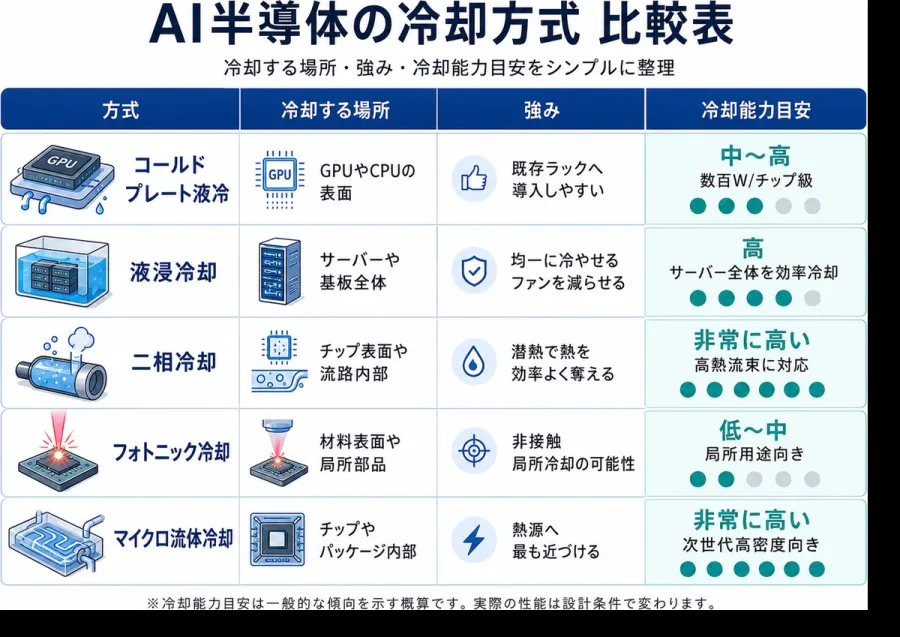
How do the four methods compare?
What this comparison reveals is that no single method will replace all others.
Immersion cooling is a technology for cooling the entire server, while microfluidic cooling is a technology for cooling the inside of the chip. The two are not just competing; they can also be combined.
Two-phase cooling can also be used not only in immersion tanks but also inside cold plates and micro-channels.
In the future, it is highly likely that we will see a multi-layered structure where the inside of the chip is cooled by microfluidics, the rack uses direct liquid cooling or immersion cooling, and the facility side utilizes hot water circulation and waste heat recovery.
Ultimately, which is the next favorite?
The short-term protagonist is direct-to-chip liquid cooling using cold plates.
It is easy to implement because it allows for a transition to liquid cooling for high-heat-generating GPUs and CPUs without significantly changing existing server or rack structures.
Immersion cooling will be a strong contender for data centers where dedicated facilities can be designed. While the effects of high-density integration and fan reduction are significant, it requires changing maintenance methods, so it is selective in its implementation.
Two-phase cooling has high heat removal capability. It is a strong option for immediate high-density requirements, but regulations, supply, and the price of refrigerants will determine its widespread adoption.
Photonic cooling is a promising area of research. However, rather than becoming the primary cooling method for AI data centers in the near future, it is expected to expand its applications starting from localized auxiliary cooling.
And the leading candidate for the medium to long term is microfluidic cooling.
The reason is that the physical fundamental of cooling lies in 'getting closer to the heat source.'
If the distance between the heat source and the coolant is shortened, the thermal resistance between them can be reduced. If the flow paths can be designed to match the heat generation distribution inside the chip, it is also possible to focus cooling specifically on hotspots.
However, microfluidic cooling is not necessarily the one that will be adopted the fastest.
The higher the performance of a method, the more difficult it can be to manufacture, inspect, maintain, and repair. The demonstrations by TSMC and Microsoft are at the stage of showing that the technology is physically viable, and whether it can be operated as a mass-produced product over a long period is a subject for future verification.
Therefore, the current outlook is as follows.
The current standard is cold plate liquid cooling. Immersion cooling is used in dedicated facilities. Two-phase cooling is used for applications requiring high cooling performance. And microfluidic cooling will become important for future large-scale AI packages.
It is highly likely that they will coexist based on application and time frame, rather than being unified into a single winner.
Summary
The performance race for AI semiconductors has entered a stage where it is not just about the number of operations, but also about how efficiently the generated heat can be removed.
Immersion cooling cools the entire server uniformly and can reduce the number of fans. However, it requires dedicated facilities, liquid management, and a maintenance system.
Two-phase cooling achieves high heat removal capability by utilizing the boiling and latent heat of the liquid. On the other hand, refrigerant regulation, supply, and control of the boiling state are challenges.
Photonic cooling is a research area that includes optical refrigeration and radiative cooling. At present, its potential as localized or auxiliary cooling is greater than as primary cooling.
Microfluidic cooling is the leading candidate for the medium to long term because it can get closest to the heat source. However, it is necessary to confirm issues such as flow path clogging, leakage, seals, manufacturing yield, and repairability.
Going forward, the following points are of particular interest.
The adoption speed of high-density AI racks exceeding 100kW
The performance limits of cold plate liquid cooling
PFAS regulations and the development of alternative refrigerants
Long-term reliability of micro-flow paths
Manufacturing yield of semiconductor packages including cooling structures
Waste heat recovery using high-temperature cooling water
Standardization of piping, connectors, and CDUs
In future AI semiconductors, it will become difficult to separate circuit design from cooling design.
It cannot be asserted that the company that masters heat will definitely win. However, it is certain that products that cannot control heat will not be able to demonstrate their full performance.
The future of AI depends not only on computing technology but also on the technology to safely transport that heat away.
Thank you for reading to the end.
If you felt this was even slightly helpful, liking or following would be a great encouragement for future updates.
I will continue to share information on technology and industry trends as clearly as possible.
References and Citations
NVIDIA 'GB200 NVL72'
https://www.nvidia.com/en-us/data-center/gb200-nvl72/
NVIDIA 'DGX GB200 User Guide'
https://docs.nvidia.com/dgx/dgxgb200-user-guide/hardware.html
Open Compute Project 'Immersion Cooling'
https://www.opencompute.org/community/immersion
Open Compute Project 'OCP Foundation and ASHRAE Form New Alliance'
https://www.opencompute.org/blog/open-compute-project-foundation-and-ashrae-form-new-alliance
Microsoft 'AI chips are getting hotter. A microfluidics breakthrough goes straight to the silicon'
https://news.microsoft.com/source/features/innovation/microfluidics-liquid-cooling-ai-chips/
Microsoft Japan 'AI chips are a "hot" topic'
https://news.microsoft.com/source/asia/2025/10/07/ai-chips-are-getting-hotter/?lang=ja
Nature Electronics 'Jet-enhanced manifold microchannels for cooling electronics up to a heat flux of 3,000 W cm−2'
https://doi.org/10.1038/s41928-025-01449-4
European Chemicals Agency 'Per- and polyfluoroalkyl substances'
https://echa.europa.eu/hot-topics/perfluoroalkyl-chemicals-pfas
Nature Reviews Physics 'Principles for demonstrating condensed phase optical refrigeration'
https://doi.org/10.1038/s42254-024-00804-2
Nature 'Optical cooling by interfacial charge transfer in 2D heterostructures'
https://doi.org/10.1038/s41586-026-10662-w
*Note: Performance values for each technology vary depending on conditions such as test equipment, cooling water temperature, flow rate, and heat generation area. Please be aware that different verification results cannot be simply compared side-by-side.
About NeoTechWorld Merchandise
We also create original merchandise featuring technology motifs.
If you are interested, please take a look.
▶ Click here for the merchandise list
Link:
#AI
#Semiconductor
#AISemiconductor
#DataCenter
#CoolingTechnology
#LiquidCooling
#ImmersionCooling
#TwoPhaseCooling
#PhotonicCooling
#Microfluidics
#TSMC
#NVIDIA
#NeoTechWorld