Everyone, thank you for your hard work on the Creative Awards!
The reader support period has ended, and normal operations begin this month.
So, for our first normal operation, I would like to do a 'Comparison of GPT-5.6 Sol and Claude Fable 5 from a note creator's perspective'.
Although it's a comparison, it won't be about text generation ability, but rather a discussion focused on analytical ability and response quirks✨
GPT-5.6 Sol vs Claude Fable 5 Comparison
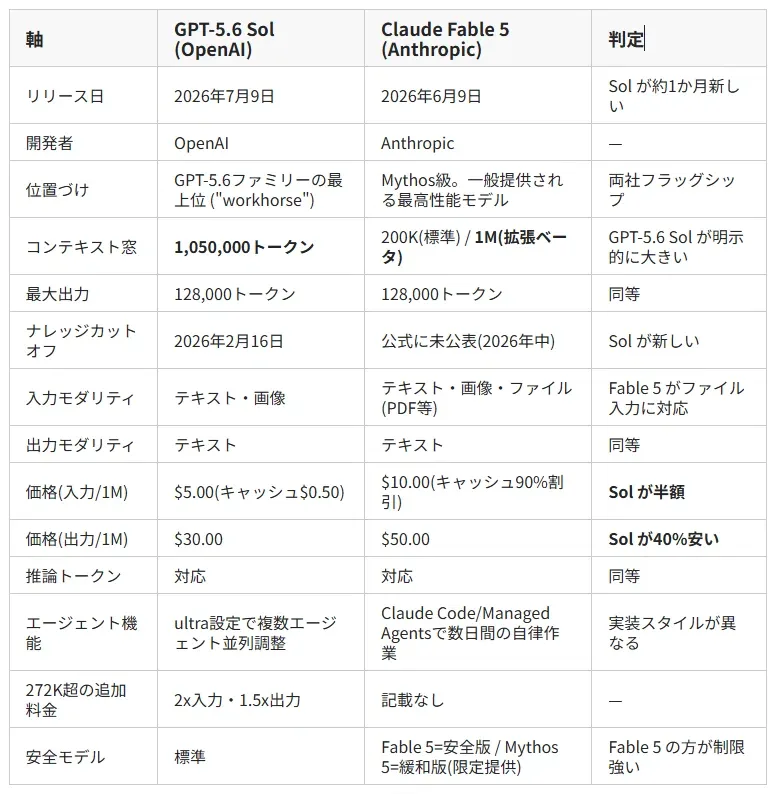
First, let's look at the comparison table for each axis.
But honestly, you don't really need to look at this closely (lol).
What's important is the difference when actually using them.
That said, please refer to it when you are curious.
Various difficult things are written, but to put it simply,
Claude Fable 5 if you want to provide materials and turn them into an article
GPT-5.6 Sol if you want to refine content while having a long dialogue
I think it's something like this.
The benchmarks look like this.
Comparison for note Creators
Finally, the main topic.
Let's compare them along the actual writing process!
Generating ideas is the biggest point of differentiation, so you should do it yourself.
I'd like to say that, but let's compare them just in case.
GPT-5.6 Sol's area of expertise
Decomposing themes and creating new points of discussion from contradictions, exceptions, and connections to other fields
Claude Fable 5's area of expertise
Expanding on experiences, emotions, scenes, and associations to suggest easy-to-write topics
When applied to NOTE article trends, it looks like this.
For Sol: Philosophy, social analysis, AI theory, side hustles, organizing business theory
For Fable: Daily essays, personal experiences, creative writing, reading material based on emotions
This is the process of deepening the ideas generated to create the raw material for an article.
For example, if you have a dialogue with the theme of 'failure', the following differences arise.
GPT-5.6 Sol
'Are failure and stagnation the same?' 'Isn't the state of being unable to gain failure actually dangerous?' It is easy to deepen the boundaries of concepts.
A type that updates conclusions while decomposing premises, contradictions, counterexamples, and other possibilities.
Claude Fable 5
'The scene of the day I failed', 'Experiences whose meaning changed later', 'Myself who couldn't forgive failure'. It is easy to develop in a direction that makes it possible to talk about experiences.
A type that maintains context and implications while deepening meaning by expanding associations.
Sol if you want to create new 'points of discussion', Fable if you want to increase new 'seeds for writing'
It's something like this.
This is the creation of the article's skeleton.
What Sol is good at is the design of 'what, why, and in what order to place things'.
Fable is good at adjusting 'how to make it flow so it reads naturally'.
As mentioned above, Sol is good at maintaining logical consistency, so it demonstrates strength in business theory that convinces readers with the order of chapters, and in the structure of analytical articles.
On the other hand, Fable is good at smoothing out emotional ups and downs and the connections between episodes, so it is suitable for essays and creative plots that emphasize the aftertaste.
However, you don't have to choose one or the other; it is also possible to use them together, such as designing the article structure with Sol first, and then softening the stiffness between paragraphs with Fable.
Writing the BodyI don't place much importance on writing the body.
For what it's worth, GPT-5.6 Sol tends to output stiff and organized text, while Claude Fable 5 tends to output soft and flowing text.
However, it's only used as a draft anyway, and if you leave this part to AI, it becomes difficult to differentiate yourself.
Let's polish ourselves, including establishing our own writing style.
Analysis of the Finished ArticleThe differences between the two models become very apparent in this process.
Sol breaks down the finished article as a 'collection of functions'.
What does the opening promise?
Are the sections in the middle necessary for the conclusion?
Are the claims and evidence connected?
Are there any paragraphs with the same function that overlap?
Where does the reader's perception flip?
What changes if a section is deleted or moved?
Fable reads the finished article integrally as 'a single flow'.
How does the narrative voice create distance from the reader?
How does the episode concretize the theme?
What meaning do repeated words or motifs have?
How do the reader's emotions shift?
What kind of lingering impression does the ending leave?
Sol runs the risk of processing even intentional ambiguity or lingering impressions as 'logical gaps'.
Conversely, Fable runs the risk of favorably interpreting mere logical leaps or redundancy as 'ambiguity,' 'lingering impressions,' or 'careful development'.
(Probably) A major advantage of GPT-5.6 Sol
Personally, what I thought was 'Sol is amazing' is that it can read information from screenshots of article lists and analyze those groups of articles.
For example, I take a screenshot of a list image that only summarizes my review articles.
Model: GPT-5.6 Sol
Thinking Level: Maximum
With this setting, I will make a request to Sol as follows.
Here is the response that came back.
GPT-5.6 Sol's ResponseTo conclude, what they have in common is not just a review, but a 'pattern of extracting one invention from one work and flipping the reader's perception'.
More accurately, it can be called a one-work-one-concept perception-shifting critique.
The basic structure is almost in the following form.
For example, the direction of the transformation can also be seen from the titles.
Eccentric reincarnation manga
→ 'Liberating the Goshuin-cho (stamp book) from the Goshuin-cho'Storyboard-style manga
→ 'Storyboards dancing at the fingertips'Spicy food challenge record
→ 'We, humanity, who are amazing and stupid'Work using a paper fortune (Amidakuji)
→ 'The invention of playing with the form itself'Dialogue-centered works
→ "Why do 'dialogue dramas' resonate?"
In other words, rather than reporting emotions like "it was interesting" or "it was moving," it articulates what the work is implicitly doing on behalf of the author and the reader.
The titles follow the same pattern
What is placed on the thumbnail is not the title of the work, but rather:
Expanding thought
Liberating from the Goshuin stamp book
Before discarding it as noise
Why it resonates
Playing with the format itself
These are the "propositions" extracted from the articles.
Moreover, concepts are turned into verbs: "expanding," "liberating," "dancing," "discarding," "resonating," and "playing." This is not a title that introduces the attributes of a work, but a title that foretells how one's perception will shift before and after reading.
Therefore, the core of each article is not the subject of the introduction itself, but rather:
Therefore, the core of each article is not the subject of the introduction itself, but rather:
This is the reward for reading.
There is also a common condition for the selected works
The genres are scattered: sci-fi, manga, essays, dialogue dramas, personal accounts, and experimental formats.
Nevertheless, the pattern holds because the selection criteria is not genre. These are likely the types of works being chosen:
It has one standout invention
Its value cannot be fully explained by existing genre names alone
It can create a reversal of "it looks like just X, but it's actually Y"
It has a structure that can be applied to other fields
Its appeal can be conveyed without summarizing the content in detail
In other words, it is not picking "highly polished works" in general, but works that have structural protrusions.
Review articles and meta-articles form a single system
Articles such as "What it's like to be on the receiving end of a review," "Why conversational dramas resonate," and "I want to write reviews that don't assume a return favor" are not analyses of individual works, but rather analyses of the act of writing reviews itself.
Therefore, these 11 pieces have a three-layer structure:
Individual articles = Demonstration of methods
Meta-articles = Principles and ethics of methods
The entire collection of articles = Redefining the format of the review
as described above.
In particular, the reason "not assuming a return favor" works is that these are not private messages to the author, but independent intellectual content that can be read by third parties.
The work is not just a topic, but at the same time, it is not the final destination of the article.
Using other people's works as a catalyst, new concepts are being generated.
What do you think?
GPT-5.6 Sol appears to recognize the title information of images, and after searching and analyzing them, outputs commonalities.
While analysis via image OCR + web search itself is not a particularly new feature, I was surprised by the high level of accuracy in the latest model.
Honestly, having my "own style" verbalized to this extent is almost scary (laughs).
But this seems to have many uses, doesn't it?
By looking through Sol's eyes, the consistency of my articles and the value they provide to readers have been brought into sharp relief.
I believe this will become a powerful tool for moving beyond self-indulgent creation and strategically leveraging my strengths once I recognize them.
In conclusion
AI is a mirror for finding 'another self'
While there are areas where Sol is superior, I don't think the conclusion ends with a discussion of which one, Sol or Fable, is the correct choice.
When you want to strengthen your logical framework, borrow Sol's sharp perspective; when you want to weave a story that touches the reader's heart, surrender yourself to Fable's gentle sensibility.
The very process of using them differently becomes an exercise in reaffirming what kind of writing you want to deliver.
The Creative Awards are over, and a new daily routine of writing begins.
While peering into the "mirror" of the latest AI, why not enjoy building up articles that only you can write?