Hello everyone.
Today in Tokyo, it is a humid day with warnings issued for lightning. The maximum temperature has exceeded 30 degrees Celsius, and there is a possibility of sudden rain or thunderstorms toward the evening.
Amidst this, major news has broken in the logistics industry. Yamato Holdings has announced the completion of its domestic freighter aircraft business. Today, I will interpret this decision while considering the history of the business and the industry.
■ Topic
Yamato Holdings announces completion of domestic freighter operations
'Flying Delivery Service' to end after 2.5 years
(Source: Yamato Holdings, 'Notice Regarding the Completion of Domestic Freighter Operations,' September 3, 2026)
Decision made by the Board of Directors
On September 3, Yamato Holdings announced that its Board of Directors had resolved to complete the operation of its domestic freighters. It also signed a memorandum of understanding with Japan Airlines (JAL) to terminate the contract regarding operations. The plan is to continue current operations until around June 2027, after which it will transition to alternative transportation methods, including the use of passenger aircraft belly cargo space.
The reasons for the decision cited in the release are that while labor shortages in trucking and rising costs due to high fuel prices continue, costs in air transport have also risen due to the weak yen and high fuel prices, and 'contrary to initial expectations, the price gap between truck transport and air transport has widened.' Although they have focused on improving fare efficiency, reviewing routes, and market development through high-value-added services, they determined that from the perspective of providing sustainable transport services, utilizing passenger aircraft belly space is more optimal than continuing freighter operations.
For regions where increased demand for semiconductors, automotive-related goods, and agricultural/marine products is expected, such as Kyushu (Kitakyushu Airport) and Hokkaido (New Chitose Airport), the company indicated a policy to maintain transport quality by focusing on passenger aircraft belly space. While the impact on consolidated earnings for the current fiscal year (ending March 2027) is expected to be 'minor,' the specific amount of the extraordinary loss associated with the completion of operations is 'currently under review.'
From a difficult start to increased flights and sales expansion
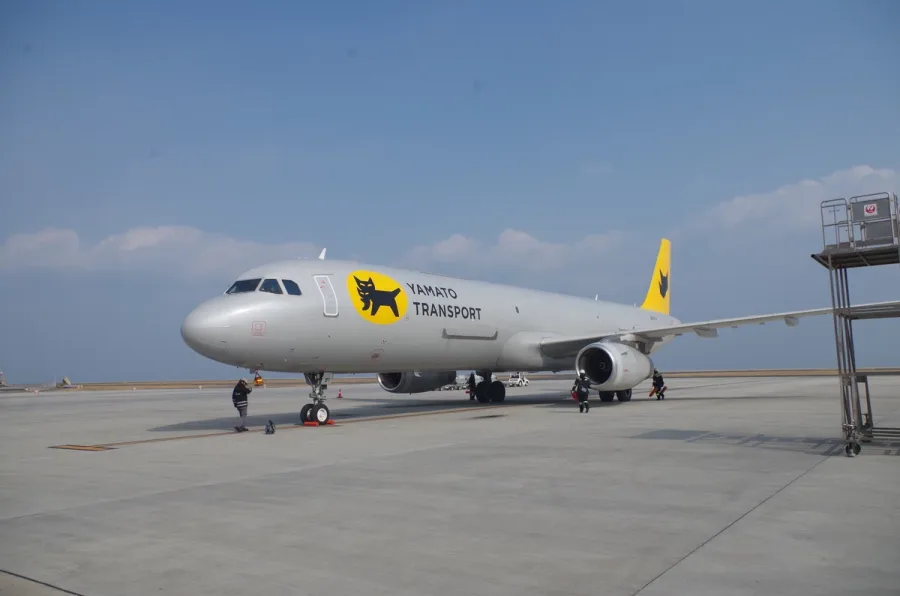
Yamato's freighter business started on April 11, 2024, using Airbus A321-200P2F aircraft, following considerations that began in 2019. It initially launched with a network connecting New Chitose, Kitakyushu, and Naha, centered on Narita, and flights departing from and arriving at Haneda were added on July 31 of the same year. The operation is handled by Spring Japan, an LCC of the JAL Group. It was launched as a countermeasure to the overtime work regulations for truck drivers, the so-called '2024 problem,' and the then-Director-General of the Logistics and Motor Transport Bureau of the Ministry of Land, Infrastructure, Transport and Tourism attended the inauguration ceremony.
However, the start was difficult. In the fiscal year ending March 2025, the freighter business recorded an operating loss of 14.3 billion yen on a consolidated basis. As of July 2024, a Yamato Transport representative revealed that the load factor was '60-70%' and stated, 'We want to improve profitability while gradually increasing the number of flights.' An insider confided, 'The contract terms with JAL were too heavy a cost burden to begin with.' In addition to low utilization rates, it is possible that the contract structure itself, which delegated operations to the JAL Group, was a burden on improving profitability.
However, subsequent sales efforts became visible in concrete forms. In October 2024, the Kitakyushu-New Chitose route was increased. In October 2025, they began an initiative to deliver live fish the next day from fishery operators in Tsushima City, Nagasaki Prefecture, to restaurants in Tokyo using uniquely developed cool containers. In March 2026, a new route was opened between Kansai International Airport and New Chitose, leading to cases such as the high-speed transport of fresh milk from Hokkaido to Osaka. Expanding into high-value-added areas like fresh produce, in addition to the initially anticipated cargo such as semiconductors and industrial products, can be said to have been a search for profitability rather than merely prolonging a deficit business.
The decision to end operations came just as this was happening. The company's explanation that 'the price gap widened due to rising air transport costs' indicates that the external environment for the business was tougher than expected, but because it was in the midst of steady route development and high-value-added efforts, some industry insiders are expressing surprise, saying, 'Isn't this decision too quick?'
Reading in the context of 'sanctuary-free review'
Regarding Yamato Holdings, the framework of its management itself has been moving significantly since the beginning of this year. The change of president to Toshiyuki Sakurai was announced in January 2026, and he took office in May. In the full-year financial results for the fiscal year ending March 2026, operating profit was 28.3 billion yen, up 99.2% from the previous year, but it fell 11.6 billion yen short of the initial forecast of 40 billion yen, and net profit remained at 13.6 billion yen, down 64% from the previous year.
The new Sakurai administration declared a 'sanctuary-free review' and announced the achievement of 40 billion yen in operating profit for the fiscal year ending March 2027, but the first quarter (April-June), which was the start, resulted in an operating loss of 4.8 billion yen, the fourth consecutive quarterly final deficit. The day after the financial results announcement, the stock price plunged nearly 7% from the previous day in the morning session, and market confidence is wavering.
Looking at the breakdown of the 11.6 billion yen shortfall from the initial forecast for the fiscal year ending March 2026, the cracks in management become more concrete. Despite a decline in the volume of parcel deliveries exceeding expectations during the peak season of the third quarter, the system could not be optimized immediately, and the downward rigidity of operating costs became apparent, which was a negative factor of 9.8 billion yen. Although the optimization of pricing itself produced a profit-increasing effect of 29.7 billion yen, it did not reach the targeted level, leaving a shortfall of 5.3 billion yen. While they achieved results exceeding expectations by 1.6 billion yen through reductions in indirect costs, one could view it as a year where they could not earn where they should have, and made ends meet by cutting where they could.
In parallel, they have been proceeding with asset compression through sale-and-leasebacks of real estate, including the headquarters building in Ginza. In the fiscal year ending March 2026, they liquidated a total of 20 projects, including large non-operating real estate, and sold assets with a book value of 23.7 billion yen for 41.1 billion yen. In the financial results briefing materials, real estate sales centered on non-operating assets were positioned as a pillar of 'B/S management,' and the one-time amortization of goodwill related to Nakano Shokai (13.4 billion yen) was also recorded as a result of 'strictly re-evaluating business plans under the new management.' The 'sanctuary-free review' has been backed up by numbers, not just slogans.
Yu Nomura, the CFO who leads this 'sanctuary-free review' from a financial perspective, served as CFO Executive Officer of Seiyu until just before joining Yamato Holdings in April 2025. Seiyu is a company in which KKR holds the majority of shares, and Nomura also appeared at the press conference for the sale of Seiyu to Trial Holdings in March 2025. After that, the person who led the practical side of the sale of Seiyu took the position of CFO at Yamato.
Incidentally, KKR is also a fund that is strengthening its presence in the logistics industry. It acquired Hitachi Transport System in 2023 and changed its name to 'LOGISTEED,' and in 2024, it also brought the peer Alps Logistics under its umbrella through a TOB.
According to those involved, former President Nagao seemed to have a cautious stance on the reduction or withdrawal of the freighter business. If that is true, this decision can be said to be inseparable from the change in management structure. It is a structure where the freighter business, which started as a medium- to long-term business concept, was placed on the chopping block at a time when the leadership of management changed.
Lessons from Sagawa's 'Galaxy Airlines'
There is a bitter precedent in the Japanese air cargo business. In 2005, Sagawa Express (now SG Holdings) established the cargo-specialized airline 'Galaxy Airlines.' Mitsui & Co., Japan Airlines, and Sumitomo Corporation also participated in the investment, and it began operations in October 2006 with two Airbus A300 aircraft.
However, costs exceeded expectations due to equipment issues and soaring fuel prices, leading to losses from the very first year of operation. A proposal to buy back a portion of the shares from shareholders met with backlash, and the service effectively came to an end just about two years after it began. There is a deep-seated view in the industry that despite having a delivery network, there was a lack of 'resolve to settle in and nurture' a business with such heavy fixed costs as aircraft operations until the very end.
A country where international integrators do not grow
There are structural reasons why 'integrators' (operators that handle everything from collection to transport and delivery) like FedEx, UPS, and DHL have not grown in Japan. The two major airlines, JAL and ANA, have long stuck to their roles as carriers that 'transport from airport to airport,' leaving collection and delivery to forwarders. For both companies, which have passenger businesses as their foundation, there was likely little necessity to take risks and expand into the upstream and downstream of cargo.
The history of Nippon Cargo Airlines (NCA) also reflects this structure. Established in 1978 with investment from shipping companies and All Nippon Airways, NCA flew its first flight in 1985 and has maintained a presence as Japan's only international cargo-specialized airline. However, in 2005, ANA sold its shares to Nippon Yusen Kaisha (NYK). NYK then agreed to sell them to ANA Holdings in March 2023, and in August 2025, NCA returned to the ANA Group for the first time in 20 years. The history of the management axis wavering every time the parent company changed can be said to be a manifestation of the fact that the resolve to seriously nurture a cargo-specialized business never took root anywhere in the industry.
Yamato's challenge attracted attention as a step toward becoming a 'Japanese-style integrator' precisely because of this history of failure. If they could combine air transport with the strengths of their last-mile network—approximately 2,900 sales offices and about 40,000 delivery vehicles nationwide—they should have been able to realize an end-to-end service without going through forwarders.
The flame is about to go out again...
This completion of operations is not a 'withdrawal' but a review of one form of business, and they are not abandoning air transport itself, as they will continue to utilize passenger flight belly space. However, in the sense that they are letting go of a system where they control dedicated aircraft themselves, it is undeniable that their progress toward becoming an integrator is taking a step backward.
The government has also supported these challenges through the development of 24-hour airports and the promotion of modal shifts. Environmental improvements such as strengthening functions at Kitakyushu Airport and New Chitose Airport, and expanding bonded warehouses, were surely intended with an eye toward the entire aviation modal shift, including the freighter business. I do not believe this decision can be fully explained by changes in the external environment such as the weak yen and high fuel prices alone. The question of whether it is acceptable for the leadership of international logistics to remain in the hands of foreign capital should exist beyond the management decisions of a single company like Yamato.
Was there no way to keep the flame of this challenge alive?
Perhaps the fixed costs of the freighter business were too heavy for Yamato to bear alone. However, is it really okay to completely cut off the sales efforts in high-value-added areas that have been built up so far, such as high-speed transport of live fish and long-distance transport of fresh milk?
Without being fixated on the framework of operating dedicated aircraft in-house, was there no way to keep the flame of this challenge alive by changing its form, such as through joint operations with other logistics companies or airlines, or a public-private scheme linked to national logistics policy? Someone in the industry needs to finally take over the 'resolve to settle in and nurture' that Sagawa and NCA failed to do.
Selling assets, adjusting short-term performance, and reviewing medium- to long-term businesses one by one. From the current Yamato, such steps are visible. While being chased by short-term capital market responses, perhaps medium- to long-term investments like the freighter business became the first target for 'sanctuary-free review.' Such a question arises from today's announcement.
That is all for today. Look forward to the next issue.