Imagine if you unfolded a map and found that the scale was slightly different in the northern regions compared to the southern regions. You might not notice it during casual use, but precise measurements would reveal that 'something is wrong.' A study has been published suggesting that a situation like this might be occurring on a cosmic scale.
This news, reported by Live Science on May 12, 2026, challenges the fundamental assumptions of modern cosmology.
What is the 'Wallpaper Assumption' in cosmology?
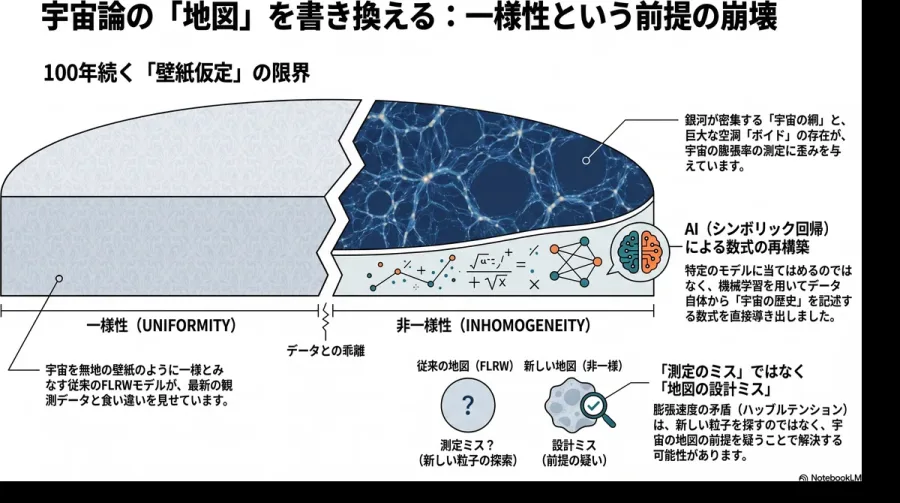
Modern cosmology is, in a sense, built upon one major assumption: 'If you look at the universe on a sufficiently large scale, it looks the same no matter which direction you look or where you look.'
This is called the FLRW cosmology (Friedmann-Lemaître-Robertson-Walker cosmology). This framework, constructed independently by several scientists in the 1920s, treats the entire universe as a 'homogeneous and isotropic space.' It is the assumption that, like plain wallpaper pasted all over a room, it looks the same no matter where you cut it.
This assumption has been a powerful model for nearly 100 years, supporting theories such as the Big Bang and the discovery of dark energy. However, this latest study is groundbreaking in that it attempts to directly detect the possibility of 'pattern misalignment' in that wallpaper using observational data.
The real universe is full of 'bumps'
The core of the problem lies in the fact that the real universe is much more complex than wallpaper.
Galaxies are not uniformly spread throughout the universe but form a spiderweb-like 'cosmic web.' It is a complex entanglement of filamentary regions where galaxy clusters are dense, and 'voids'—empty spaces hundreds of millions of light-years in diameter—where almost nothing exists.
A research team led by physicist Asta Heinesen at the Niels Bohr Institute in Copenhagen has developed a new verification method that takes these 'bumps' seriously.
They focused on two effects.
One is the Dyer-Roeder effect. Light reaching us from distant celestial bodies tends to pass through empty voids rather than areas where matter is dense. It is like a delivery service taking a back road to avoid a congested main highway; if we only measure the light that arrives this way, we might underestimate the actual amount of matter in the universe.
The other is cosmological backreaction. This is the idea that the growth of large-scale structures like galaxies and voids changes the average expansion rate of the universe itself. Imagine that the way a balloon expands changes because bumps are forming on its surface.
Using machine learning to 'excavate formulas from data'
Another notable aspect of this method is the introduction of a machine learning technique called symbolic regression.
Conventional approaches have been to 'assume this model is correct and adjust the parameters to fit the observations.' In contrast, symbolic regression is based on the reverse idea of 'finding the form of the formula itself from the data.' This approach, which attempts to reconstruct the history of the universe's expansion without preconceptions, is an important step in eliminating model dependency.
The research team applied this method by combining the Pantheon+ supernova observation catalog with data from DESI (Dark Energy Spectroscopic Instrument), which maps over 47 million galaxies in three dimensions. As a result, a 2–4σ deviation from the predictions of standard FLRW cosmology was observed.
In physics, a result can only be called a 'discovery' once it exceeds 5σ, so this result is still at the stage of a 'promising hint.' However, it is certainly a sign significant enough for researchers to describe it as a 'surprising violation.'
If it's true, how will cosmology change?
This discovery is important because, 'if it is real, it has the potential to invalidate most of the currently proposed solutions all at once.'
Cosmology currently faces a major mystery known as the 'Hubble tension.' This is the problem where measuring the expansion rate of the universe in the early universe versus the nearby universe results in a discrepancy of about 10%. To solve this, various ideas have been proposed, such as changes in dark energy, new types of elementary particles, and modified gravity theories. The hypothesis that 'the universe is rotating,' which we covered previously, is one of them.
However, this latest research suggests that as long as all these proposals are considered on the foundation of FLRW cosmology, they cannot provide a fundamental solution. It raises the possibility that 'the problem is not the discrepancy in the measured values, but the design of the map itself.'
When science doubts itself
In the era when the geocentric model was believed, scientists kept adding auxiliary mechanisms called 'epicycles' to explain the observed 'irregular movements of planets.' In the end, that model could not solve the problem, and a paradigm shift to the heliocentric model was necessary.
The results of this study are also at a preliminary stage at this point. The paper is still pre-peer review (a preprint), and verification using larger-scale observational data is essential. The research team also acknowledges that 'currently, observational data is limited, and further precise measurements are required.'
Even so, the fact that they have begun to question the possibility that 'the scale of the map we have used for 100 years might actually be slightly off' based on actual data is enough to make one feel that the frontier of cosmology has entered a new phase.
The attempt to understand the universe is quietly deepening, moving beyond just 'what shape the universe is' to the question of 'whether the premises of the maps we have been using were correct.'
Reference Articles
〇Physicists find evidence that the universe isn't perfectly uniform — potentially unraveling a 100-year-old model of cosmology (May 12, 2026)
〇Is the universe rotating? — A new hypothesis challenging the Hubble constant problem (April 18, 2025)
〇'About 30 theories' of the universe collapse — The greatest mystery in cosmology posed by 15 years of observation (December 17, 2025)
〇Supernovae evidence for foundational change to cosmological models (January 2025)
https://academic.oup.com/mnrasl/article/537/1/L55/7926647
〇Reconstructing a large-scale matter-density contrast profile to reconcile Pantheon+ supernovae with DESI DR2 BAO in an inhomogeneous universe (April 2026)