Yippie! (Chapter 1)
Hey! It's Yippie! Welcome to The New Order: Yippie! development diary. I'm Mangolith, Happy Warrior, and QuoProQuid, the leads of the American development team. Today, we'll talk about the future of America and what it brings to TNO and all of you players.
Development of the American rework patch "Yippie!" has been underway since late 2022. To design a larger rework plan than any other country in TNO without hindering what other teams needed, the team started with the trio who designed the heart. This rework will more than triple the current scale of American content, taking the first step toward bringing America into the scope of TNO2 with content up to January 1977! The patch began as an expansion of American content in TT3, adding Philip Hart as a new presidential candidate for 1968. Fans quickly noticed the improvement in quality in both gameplay and narrative compared to other American routes, which encouraged us to push further. The biggest motivation for us to work on this rework is that the current TNO American content lacks continuity between administrations (such as being able to easily "undo" previous administrations), lacks political change and cultural engagement, and there is a disconnect between what is happening in the world and what is happening in America.
In short, we want to create a powerful story that firmly positions America in the plight of the Cold War, highlighting change, intense characters, and deep engagement with history. We understand that many in the community love the current America. We wouldn't take the bold step of rebuilding these foundations if we weren't absolutely confident in the replacement. While the current TNO America has 12 regular candidates, 2 special candidates, and playable content up to 1973, Yippie will feature 30 regular candidates, over 10 special candidates, and playable content ending after January 20, 1977, culminating in the 1976 Bicentennial. Yes, TNO2 starts here. In this diary, we will detail America's prehistory and the American content leading up to the inauguration of the winner of the 1964 presidential election, which is most relevant to gameplay. We will cover the major events of each year, new mechanics, and the five next presidential candidates.
This development diary only covers the first three years of playable content, but the content from 1962 to 1977 is not a vague, fantastical promise, but is already designed and currently moving toward implementation. You will be able to get this patch next year.
Prehistory
The bright waves of flashbulbs pass by the side of President Franklin Roosevelt's pitch-black carriage like machine-gun bullets. The defenders of the "Court-Packing Plan" were killed by many hands. Republicans and Democrats alike returned to gloat over their victory. It was a hot, gloomy day, July 16, 1937. The First Family, on their way to the funeral of Representative Joseph Robinson of Arkansas, sat behind the galloping horses.
First Lady Eleanor Roosevelt must have asked her husband, "Are you okay, Franklin?" To which the President might have replied with feigned confidence, "Oh, I'm just worried about Mrs. Robinson." There was no need to worry that Robinson had taken Roosevelt's bill to the grave, or that a recession was looming. Failure after failure in Congress, and the many international conflicts occurring in Europe, Asia, and America, weighed heavily on his heart. Roosevelt didn't care about victory; he only saw defeat and could not escape the vicious cycle. From that July day on, everything for him turned to sand, washed away, and was never to be regained.
In the 1938 midterm elections, the illusion of Roosevelt's dominance in America vanished. Republicans and conservative Democrats defeated the Roosevelt coalition, seeking restraint and congressional governance. The "Roosevelt Behemoth," the New Deal, had reorganized America's administrative state, but it could not prevent the recession of 1937-38, nor could it hold the mechanisms and cartels that were milking the New Deal accountable. In the eyes of conservatives and the growing number of liberals, the once-accepted President Roosevelt appeared as a gangster running an administrative protection racket in the American economy. To break this trend and end the regulatory nightmare, the Republicans sought an expert to bring prominent criminals into the light.
While the Republicans searched for a standard-bearer for 1940, chaos continued in Roosevelt's White House. The President could have defied the precedent set by Washington and run for a third term, but his doubts remained constant and intense. He had watched President Wilson's ruin up close. How the Republican's vicious Congress had ruined his life's work and paved the way for today's Nazi regime. Having seen the results in 1920 and understanding that the failure had remained in the party until his own victory in 1932, Roosevelt decided it was best not to shake his already unstable position.
Thomas E. Dewey took office as Manhattan District Attorney in 1938, burning with desire and ambition to eradicate organized crime. Born in 1902, Dewey celebrated his 36th birthday and was about to enter his fifth year of prosecuting New York gangsters as his public reputation soared. Newspapers praised him one after another, and people shouted his name as he passed by. His brilliance was such that thousands of local voters wanted to elect this young warrior in the Attorney General race for their own region. Although Dewey was young, popular, and lacked a background as an administrator or leader, he had a surprising talent for consistently being himself without flattering others.
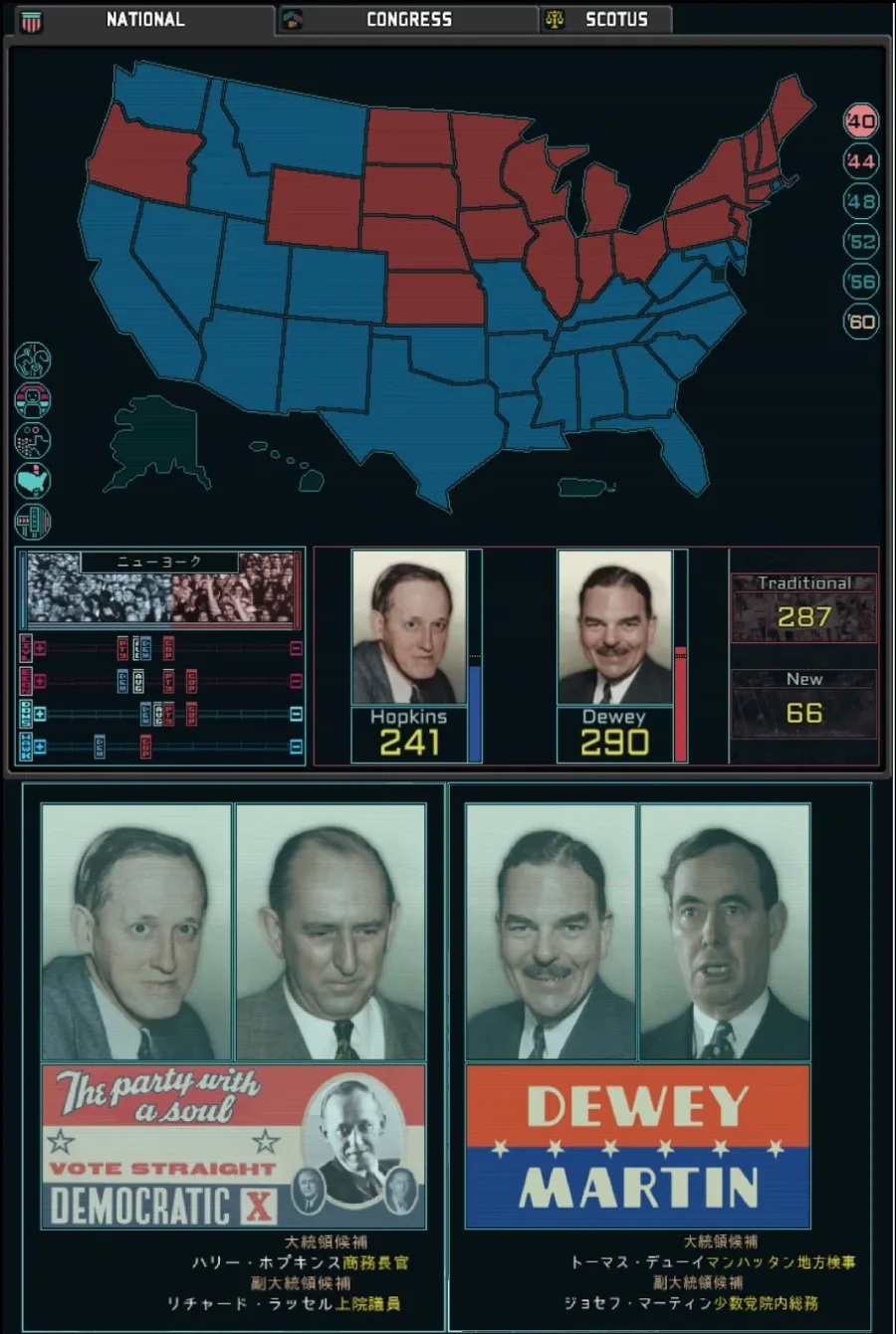
Suppressing the moderate Willkie and the conservative Robert Taft, and capturing the support of both, Dewey appealed for new ideas and a return to rational government at the vibrant Republican National Convention. In contrast, the Democratic convention looked almost mournful, nominating the sickly Harry Hopkins, Roosevelt's Secretary of Commerce and political agent, as their presidential candidate. As the 1940 presidential election unfolded, Dewey's lack of experience was replaced by public debate over Hopkins' health and allegations of corruption. The deal to lend weapons to war-weary democratic forces in Europe was deadlocked, and the confrontation with Japan was intensifying. The American people began to think that Dewey's election was a foregone conclusion. Dewey fought the President on the economy, the administrative state, and foreign policy, returning witty isolationist barbs every time Roosevelt made an interventionist gesture.
Ultimately, Roosevelt did not achieve his best results in foreign policy at the last minute, nor did he lead his chosen successor to victory, and the crises unfolding in Europe and Asia were left in the hands of 38-year-old President-elect Thomas Dewey.
After taking office, it became clear to Dewey and his administration that their election victory was not enough to reshape America and its overseas priorities. Conservatives welcomed Dewey's restraint of presidential power, but the administration failed to secure legislative support, and the party's policies achieved almost nothing. Partly due to the influence of Secretary of State John Foster Dulles, the young President lost the initiative in foreign policy due to this failure, significantly lowering his authority.
And on December 7, 1941, while peace negotiations in the Pacific were deadlocked, Japanese naval aircraft attacked Pearl Harbor in Hawaii, dealing a devastating blow. The Dewey administration initially set 1942 as a do-or-die year, focusing on the Works Progress Administration and Social Security, but because Roosevelt and Hull had previously failed in peace negotiations with the Empire of Japan, the country was changed forever. A few days later, America joined the Allies against the Tripartite Pact of Germany, Italy, and Japan, and another of Dewey's campaign promises went unfulfilled.
If President Roosevelt had been aiming for an unprecedented third term, the administration would have used his leadership and command to wake America from its slumber and immediately build a mobilization system. His personality, which had pushed through the New Deal in incredibly difficult circumstances a few years earlier, would have awakened again, giving America the opportunity for war-making that many postwar critics said Dewey lacked. But that did not happen. Paralyzed by the weight of his responsibilities and the now-insurmountable divisions in the executive branch, President Dewey struggled and decided to follow the loudest voice in the room.
Among the smoldering wrecks at Pearl Harbor was the USS Enterprise, the flagship of the U.S. Pacific Fleet. Later, the USS Lexington, Hornet, and Yorktown sank to the bottom of the sea. Soon, Japanese forces landed on Midway Atoll, directly threatening Hawaii, and America shifted its focus from the war in Europe to the war in the Pacific. At the strong urging of the Joint Chiefs and his advisors, President Dewey authorized General Douglas MacArthur to launch an offensive in East Papua to occupy the Dutch East Indies and reinvade Manila, as part of the "Pacific First" strategy formulated after MacArthur's withdrawal from the Japanese-occupied Philippines. This operation quickly bogged down, taking the rest of the war to slowly advance west, causing over 100,000 U.S. casualties in the process.
Due to the maneuvering of Robert Taft, an anti-communist and anti-Atlanticist, America provided no aid to the Soviet Union fighting Germany, and was ill-prepared for the Axis invasion of Britain in March 1943. Despite the British front retreating northward, the defense by General Dwight Eisenhower, a rising star in the media, provided hope for an eventual turnaround, in contrast to the incompetence of the Joint Chiefs and Dewey's foreign policy.
The war became a new opportunity for the Dewey administration to reorganize the domestic front. According to Republican power brokers, World War II was not a "war for democracy" as many Democrats advocated, but a reorganization of the world's balance of power, just like World War I and previous European wars. A legitimate reason to cut government spending, namely to fund war expenditures, now existed. The New Deal was starved, facilities were reorganized, state and federal hospitals were closed, and patients were either sterilized and released or quietly disappeared. Funds were returned to Dewey's wartime resource reserves. Despite these cuts, mobilization efforts did not begin in earnest until the Democrats gained a majority in the 1942 elections. From then on, the opposition-majority Congress played a major role in directing the war effort.
Union workers, the main support base for the Democrats, began fighting the administration after the Dewey administration approved government contracts that allowed for efficiency promotion and fixing, fueling wildcat strikes and radical actions against war industries. Soon, Democratic-affiliated unions strengthened their cooperation with socialist groups such as the Communist Party, rebuilding a mixed Popular Front coalition of Democratic liberals, which came under strict surveillance by J. Edgar Hoover's G-Men. Under government direction, the FBI targeted war-related spies, saboteurs, and ideological extremists, both real and imagined. This included union leaders, participants in the top-secret nuclear development project, the Manhattan Project, and Democratic-affiliated deputy secretaries, all of whom faced harassment, house searches, and periodic detention. Dewey also ordered the internment of Japanese-Americans, German-Americans, and Italian-Americans in inland facilities. This racial policy, which particularly targeted Japanese-Americans, instilled racial paranoia in the American climate. This was further exacerbated by wartime propaganda and election campaigns in the 1942 and 1944 elections, and did not subside even after the war. He freely utilized the FBI against "war saboteurs," overreacting to perceived threats within the U.S. and Latin America, and fostering "wartime terror" sentiment that increasingly hindered mobilization.
In this situation, the Democrats nominated Judge William O. Douglas as their 1944 presidential candidate. Douglas was a figure who aimed for the administration with a modern and bold liberal approach, with experience from the Roosevelt era. His popularity, combined with the support of vice-presidential candidate Tom Connally in the South, made his victory certain before election day. However, it was a close race, especially in the Midwestern states, and Dewey was re-elected. Despite the controversy, protests, and temporary shock over Douglas's defeat, the American people never changed horses in midstream, accepting Dewey's victory as necessary to obtain a fair peace. Still, the war situation continued to worsen.
By 1944, America had turned the tide of the war in the Pacific, slowly beginning an "island-hopping" campaign while prioritizing resources for General MacArthur's Papua operation. As early as 1942, voices opposing MacArthur's methods had begun to rise within the Army and the Cabinet, but they faced censorship from the top brass. Even as the general's star faded, high-ranking defenders continued to support him, despite the dissatisfaction of field commanders and the public. The development of a uranium-based nuclear bomb, which President Roosevelt had initiated in 1940, also faced great difficulties under the Dewey administration. Due to budget cuts and investigations based on suspicions of espionage and political extremism, many talented individuals were driven out of the project. J. Robert Oppenheimer, one of the few exceptions who remained, accurately predicted that America would not possess a combat-ready nuclear weapon until after 1946. The U.S. Marine Corps recaptured Midway in 1943 and occupied many of the Pacific islands that had been British or French territories by early 1944. However, this came at the cost of the collapse of the China-Burma front and the withdrawal of British India from the war against Japan (1944), which was rapidly becoming unstable.
The death of British Prime Minister Winston Churchill made matters worse. His successor, Lord Beaverbrook, increasingly supported a negotiated settlement with Germany. America's development of chemical weapons and intense bombing campaigns against cities in southern England further stimulated anti-war sentiment among the British public, and by late 1944, it was clear that the Allies could not retake Britain. In April 1945, Secretary of State John Foster Dulles, fearing that a pro-German British puppet regime would refuse to pay its massive war debts to America, authorized negotiators to meet with German representatives in neutral Sweden to formulate terms for an armistice. The War Department's unfavorable prediction that America could defeat Japan by 1949 further sapped morale, and since Japan was also surprisingly open to peace, Japanese agents were also called to Sweden. From there, a skillful diplomatic competition began, with America using the impending peace with Germany to counter Japan, eventually negotiating an agreement along the lines of the current occupation regime.
In June 1945, America formally concluded two armistice agreements with the Axis powers. The terms also applied to the remaining Allies, with Britain fulfilling its debts to America and its allies, and occupied territories maintained as of June 1, 1945, until a new order was designed in a future peace treaty. Dulles correctly recognized that Germany and Japan were already overextended and could not immediately pose a threat to American influence, but by compromising the public's concept of a "war for democracy" with a realistic division of the world, the entire political establishment was shaken. Through one despicable agreement, America compromised democracy, denied freedom and justice for all, and accepted rule by force. Thus, for the rest of the 20th century, America would be forever tainted by international fascism.
The concept of defeat, which was novel to American war history, proved difficult to handle. Some argued that the Dewey administration could have won at the time of the peace, but lacked the courage to continue sacrificing the lives and materials necessary for victory. This opinion has been particularly prominent since 1946, when the Manhattan Project became publicly known. Others thought that America's entry into the war itself was a mistake. Still others, even if indifferent to the handling of the war itself, lamented the poor execution and strategic decisions. The decision to scar the British countryside with Agent Orange, incendiary bombs, and powerful chemicals not only did little to stop the German advance, but also lost the support of the British people, making long-term war-making impossible. The inflexible choice to empower General Douglas MacArthur brought benefits on Papua, but at the expense of China, Burma, and India, and contributed to the permanent loss of credibility not only of MacArthur but of almost all military leaders during the war. Views on the war were diverse and sometimes conflicting, but everyone agreed that Thomas Dewey, his subordinate generals, and the Republican Party were responsible.
Dewey and his remaining cabinet, facing political annihilation in the coming election cycle, scrambled to save America's international prestige. The opportunity came with the rapidly collapsing Soviet Union. With the country in chaos, the President was given an opportunity to intervene and restore his and America's authority. However, unlike the American Expeditionary Force to Russia in 1919, the purpose of the Siberian intervention was to stabilize the chaotic Soviet remnant government led by former secret police chief Genrikh Yagoda. At the port of Magadan, Western forces stood shoulder-to-shoulder with Soviet communists to maintain order, prevent starvation, and facilitate the migration of thousands of bureaucrats and intellectuals fleeing their war-torn homeland. Through the Democratic Congress's "Operation Paperclip", their expertise contributed to the development of American science and technology. At the same time, the total war of the Allied forces remaining in Siberia strengthened their military ties, maintaining the Allies, who had been divided throughout the period of potential collapse.
However, in the end, Dewey's hopes in Siberia suffered the same setbacks as his other efforts. The intervention in Russia was insufficient to prevent a landslide for the Democrats in the 1946 midterm elections, nor was it the minor foreign adventure the President had envisioned. Yagoda's Soviet government proved impossible to maintain, and American involvement only increased. Allied involvement in the region remained at the level of several thousand ground troops, but because of the intractable conflict and persistent skirmishes with anti-government forces supported by Japan, the media dubbed this intervention the Siberian War. This created a point of contention between the internationalists, who were the majority in the establishment, and the smoldering faction of isolationists. This conflict would persist long after the end of the Dewey administration.
Due to the pressure of the overwhelming Democratic majority in both houses, the end of the Dewey administration became a lame duck among lame ducks. The President's executive power was limited to foreign affairs, his vetoes were ineffective, and since a total defeat in 1948 was considered a foregone conclusion, the President reluctantly became a symbol of the aggressive Democratic agenda. The White House and Congress agreed on some matters, such as support for the Soviet government in Siberia, but Dewey eventually became a junior partner in his own administration. This unhappy marriage culminated in the Long-Term Planning Act of 1947. This law pushed forward Roosevelt's New Deal policies and formally brought the federal government into national economic development through the Long-Term Planning Bureau under the Department of Commerce. Republican protests that this law infringed on private commerce were ignored by the overwhelming Democratic majority, just like Dewey's vetoes. The reality of the Great Depression and the war influenced American politics, and the era of the unregulated national economy came to an end.
If there is anything to mention about the last two years of the Dewey administration, it is the admission of Alaska and Hawaii as the 49th and 50th states, respectively. Alaska was a massive, frigid outpost at the edge of the continent, dominated by military bases, leftist Russian immigrants, and indigenous peoples. Hawaii, on the other hand, was a paradise island owned by corporations, and the two states played contrasting roles as Democratic and Republican strongholds, respectively. However, it was not without its problems. Hawaii, in particular, existed as the embodiment of the class and racial struggle between the white-dominated "Big Five" corporations and the multiracial unions seeking to overthrow their control over Hawaiian politics and business. Accusations and denials of communist and pro-Co-Prosperity Sphere sentiments among unions and Japanese-American union members fueled a pressure cooker of tension, but by the grace of God, that tension did not burst in the final months of the Dewey administration.
Whether or not the pundits understood it at the time, the uncontested 1948 presidential election became a turning point in American history, reshaping the two major parties from behind the scenes. Within the Republican Party, the Eastern establishment collectively passed on the nomination, choosing to conserve their strength until more favorable circumstances arrived. However, by abandoning the party's power center, these moderates left an opening for a figure with the anger and ambition to exploit the disgruntled Republican base, humiliated by Dewey's powerless second term. The party leadership was terrified that "Mr. Republican," Senator Robert Taft, rather than a docile sacrificial lamb, would overwhelm the few establishment forces with a hardline anti-interventionist, anti-New Deal, anti-Dewey platform, defending his own role in the Dewey administration's disastrous war effort. This event ended the dominance of moderates in the Republican Party, and active conservatives established themselves as a powerful force within the party.
In contrast to the lack of Republican candidates, the 1948 Democratic nomination race became the fiercest in history. Amidst the maneuvering and debate among countless candidates, Senators Claude Pepper and Strom Thurmond strove to aim for what many Democrats considered a fantasy. They wanted to nominate Allied Supreme Commander Dwight D. Eisenhower, the most popular person in America at the time, as the Democratic candidate. Even when the Pacific front collapsed, Eisenhower had brilliantly commanded the Allied forces in Europe. Ike, who had demonstrated leadership under pressure and achieved successive successes at the end of the war, had become a living legend to the American people. In fact, his most loyal supporters stated that if the Republicans hadn't been scared off by their principles, Ike would have won the war completely. It was thought that no one was more suitable to steer the nation in a new and uncertain world than a general who had fought the Axis powers and brought them to a halt. A draft movement was needed for the reluctant Eisenhower to participate in the election, but Democrats, not caring that he himself was not a Democrat, voted in droves, hoping that Eisenhower would be the next Roosevelt. Other candidates were soon swept aside, and Eisenhower began his charge toward victory over Taft starting in July 1948.
It became clear that the Eisenhower camp had no intention of getting involved with a hopeless candidate like Taft. Ike avoided current issues and made personal appeals. The Democratic candidate, who ran on a platform of basic competence and a vague change from Dewey's failures, gained a great advantage because Americans generally did not understand his actual political beliefs at all. Northerners saw the general as a flexible figure who could realize the lost potential of the New Deal and the controversial civil rights clause adopted at the Democratic convention (which Eisenhower himself did not comment on). Southerners saw him as a figure with moderate convictions who could play a role in preventing Northern liberals from destroying their way of life. Meanwhile, liberals were satisfied with the platform, even though their chosen candidate did not clarify his stance and accepted compromise as an easy solution. Even disgruntled internationalist Republicans saw Ike as a fighter against fascism abroad, in contrast to the isolationist Taft. Meanwhile, Eisenhower chose not to shatter any of his diverse supporters' dreams. He avoided political promises and even attacks on the highly unpopular Supreme Commander, sticking to vague platitudes about democracy, justice, and hope. Analysts predicted that the Republicans would be devastated in November, effectively ending their investigation. As a result, they missed the true value of Taft's campaign as Eisenhower crushed the Republicans. Taft sowed the seeds, set the table, and prepared the organizational spark for the next generation of radical activists.
Eisenhower's inauguration set a record for crowd size. Citizens from all over the country gathered in D.C., cheering as a war hero took office as President and restored Democratic control. For those dissatisfied with the war results and the collapse of the New Deal, and more broadly, for those seeking a presence to boost the lowered national morale, Eisenhower, much like George Washington, gave dignity and purpose to a nation plagued by humiliation and loss. With overwhelming support in Congress, the Supreme Court, and public opinion, Ike had the power to change the shape of America with a wave of his hand. In fact, many Democratic supporters dreamed that they could effectively erase the pain of failure through overwhelming power.
However, these dreams ignored the fact that Eisenhower had never promised or intended the kind of major reforms his enthusiastic supporters envisioned. On the contrary, liberals across the country watched in horror as the general took no action, only reversing Dewey's policies in limited circumstances, buying back the Tennessee Valley Authority's dams from the private sector, building highways, and generally not trying to expand the role of government.
The rare political authority was given to a person who lacked the will to use it, and as a result, the Democratic project stagnated while holding the world in its hands. Nevertheless, the Democratic project at the end of the Dewey administration dealt a significant blow to the excesses of capitalism. As a result, America was gifted a technocratic and corporatist economy that shifted its direction toward the private economy while maintaining much of its wartime economic mobilization. The era of the "Great Depression" had passed, and the Democrats used planning to keep the ship running through the storm.
Eisenhower showed little interest in domestic issues, but focused on fighting "defeatism" and rebuilding America's position in the world. Taking over the Siberian War from Dewey, Ike worked to increase America's presence in the region to restore American pride abroad. Thousands of troops entered the tundra, supporting the unstable Yagoda regime, developing infrastructure, clearing out dissidents and bandits, and facilitating an even larger wave of migration across the Pacific. It didn't take long for the new administration to face the same difficulties as the previous one. Eventually, the ever-increasing efforts without results would give isolationist forces new ammunition to oppose the highly controversial war.
One achievement of the Siberian War was the Allied Covenant of 1949. This covenant created the Free Nations Organization, a military alliance in which the remaining countries of the former Allies pledged "mutual defense." Isolationist elements protested vehemently that this covenant bypassed the traditional role of Congress in declaring war, but Eisenhower's treaty was immediately accepted by the public, marking the end of isolationism for the time being. Eisenhower would remember this as the most prominent achievement of his tenure.
The Eisenhower era will also be remembered as the formative period of American "nuclear optimism," where the possession and deployment of overwhelmingly powerful nuclear weapons played a key role in pushing back fascist forces around the world. While nuclear weapons were a real threat, they had an unparalleled strategic utility, being conceptual and hypothetical, with unknown limits to their capabilities. If nuclear weapons had been prepared in time, they could have saved Britain, liberated Asia and Europe, and ensured world peace under democratic values. Eisenhower may not have had the atomic bomb at the time, but today, America possesses a massive number of atomic bombs, far larger than those tested at Los Alamos, in preparation for a confrontation with fascism. On weekends, families in Los Angeles drive to the Nevada desert to witness the dazzling manifestation of the superpower America. They are only filled with awe, never thinking about what such devices would do to humans.
Another strange event that occurred during the Eisenhower era was the codification of the national intelligence agency, split in the form of the FBI's Special Intelligence Service (SIS), and the establishment of the Central Intelligence Agency (CIA). Despite their names, the two agencies have operated independently in different parts of the world. The SIS has continued to operate in the Americas, as it has since the 1930s, while the CIA has operated in the rest of the world. While the former emphasized intelligence gathering and political influence, the latter, at least initially, held full authority to protect American national interests through various means. Although their areas of operation were defined in 1949, the CIA could not be stopped from supplying weapons to anti-government forces in Central and South America, and the intelligence agencies have been in conflict with the SIS almost constantly since their establishment. Both agencies operated during the diplomatic crisis in Uruguay and Argentina in 1949. Even more blatant activities are seen in Central America, where the CIA and SIS are supporting El Salvador and Honduras, respectively, and have made multiple attempts to assassinate Rafael Trujillo, and to protect America's lease on the Galapagos Islands, they overthrew the Ecuadorian government to support Eisenhower's gunboat diplomacy.
After Taft's record-breaking defeat, a new generation of Republicans began to emerge. A particularly destined congressman from the suburbs of Los Angeles was one of them. Richard Nixon, a Navy veteran and ambitious young politician, was desperate to prove his worth against the new Democratic consensus, which seemed to be becoming more fragile by the day. With a strong interest in foreign policy and looking for an opportunity, Nixon instinctively sensed that Taft's unwavering isolationism had become politically toxic after the Great War. He jumped on the emerging argument of New Continentalism, arguing that since the American continent itself harbored anti-American nations supported by foreign fascist forces, the expedition to Siberia was a dereliction of duty. Tricky Dick skillfully exploited Americans' fear of further defeat to jump into an open Senate seat, and although he remained outside the government at the time, he stood at the head of a revitalized Republican generation that would eventually take power.
Eisenhower spent most of his first term preparing for diplomatic confrontations abroad, but his skills were put to the test in tropical Hawaii. In 1951, tensions between the island's major corporations, the "Big Five," and labor unions developed into a wave of strikes, and the island's economy stagnated. For a moment, it looked as if the corporations' overwhelming dominance was on the verge of collapse. But rather, the tide receded. Through multi-pronged attacks by the Big Five, including potential racial resentment, FBI involvement, the arrest of union leaders by government order, and the formation of corporate-affiliated unions that traded on cheaper terms than independent unions, the ILWU lost momentum, and the strike came to a disastrous end. Unlike the Roosevelt era, the Eisenhower administration chose to stand by and watch as corporations re-established control. Because the President ignored his own party's famous cause, liberals were also enraged by this decision.
The final blow to liberal approval of Eisenhower was in the field of civil rights. Through New Deal funding and state construction, the Southern states transformed from one-party-dominated superior-race democracies into domestic fascist republics, where racial order was maintained by state paramilitary organizations that pledged loyalty only to the governor. There, the rule of law did not apply, and only the interests of those in power were prioritized. Disappearances were a daily occurrence, negative reporting met with disastrous ends, and public activity was extremely rare. All of this was permitted for the Democratic coalition to maintain power. Organized black activists brought lynching and racist violence to the national stage, but it was rarely a national issue.
Senator and former First Lady Eleanor Roosevelt had championed the civil rights movement since her time in the White House, despite her husband's indifference, and her work expanded further after she was elected to the Senate. Her activities exceeded expectations in forcing this issue onto white society, driving a wedge between the newly convinced Northern Democrats and the anxious Southern Democrats. When the violence in Hawaii was shown on American television screens, showing a clear racial divide between strikers and saboteurs, a debate erupted. Soon, pressure began to mount more openly from the "Roosevelt Congressional Caucus" for the President to take some action. Eisenhower was again reluctant, and to those remaining in the Roosevelt-wing Democrats, his first term appeared as a failure. The racial issue in America was not an issue worth spending time on for Eisenhower. In American political society, issues of the economy, national defense, and the federal government were far more concrete and less divisive.
By ignoring the civil rights issue, Eisenhower may have hoped that it would be resolved on its own. There could be no greater mistake. The problem only worsened as Southern segregationist governors scrambled to defend the so-called "Southern way of life." Eisenhower did not pass civil rights legislation, nor did he issue executive orders, but it was as if black activists and their liberal allies had fired the starting gun. White backlash was immediate, and figures such as Herman Talmadge, Orval Faubus, and Strom Thurmond were elected governor on platforms of expanding state power in the face of an existential crisis.
In the shadow of these simultaneous crises, the 1952 presidential election passed almost like a dream. Entering his 60s, and still popular despite an inactive first term, Eisenhower did not feel the need to actively campaign, focusing mainly on strengthening America's efforts abroad. New economic and military investments were made in Siberia, Haiti, and Latin America. Furthermore, the FBI's Special Intelligence Service targeted regimes deemed hostile throughout the Americas, inciting them to ensure American hegemony there. The Republicans found a sacrificial lamb in Ed Martin, a 60-something who had turned from Governor of Pennsylvania to Senator. Relying on his background as an officer in the country during the war, he was nominated unopposed as a half-hearted "Republican Ike." The selection of a vice-presidential candidate would involve further maneuvering. Initially, young Senator Richard Nixon seemed like an attractive option, but Henry Cabot Lodge Jr. was chosen instead due to concerns about corruption and crudeness. It was a surprise that a wealthy, hereditary Eastern establishment heir was chosen instead of an upstart from Whittier, and Nixon was outraged, desperate for a chance at redemption. The Republicans would lose again in November, but Nixon, angry at being insulted by Martin, would desperately try to take his revenge.
Eisenhower's second term was like a reheated version of the remnants of his first. Beyond Ike's personal interests in infrastructure construction and foreign policy, stagnation and complacency became the watchwords of the early 50s. Once again, Ike would begin his term with an overwhelming majority in both houses. Once again, the general showed little interest in following the party's priorities. Once again, liberals were frustrated by the vast opportunities the President passed by, but this time they were determined to force Eisenhower's hand.
The struggle over civil rights only intensified over time, and while the President was uncomfortable, he did not take the initiative. The Supreme Court ruled in favor of the plaintiffs in the United States v. Knox County Schools case, banning public funding for segregationist educational institutions. Faced with new laws that could only be enforced by a reluctant executive branch, the Southern states simply decided to ignore the declaration. It was the beginning of a constitutional crisis that was more of a rebellion than a war. Northern congressional liberals rallied and drafted a bill to establish a Civil Rights Commission to investigate the unconstitutionality of the Reconstruction Amendments. However, the watered-down bill brought to Congress was powerless. Eisenhower, desperate to end the civil rights movement, signed the bill, but the situation only worsened. The weakness and lack of enforcement of the bill enraged activists, and Southern whites rejected the right of federal legislators to regulate race relations within their states. Eisenhower declared victory in the battle and ignored the issue, but tensions rose, extremists stirred, and a new confrontation was imminent.
History will remember Ike as a popular figure who had little interest or initiative in politics. The President, who had an overwhelming majority in both houses, lost the opportunity to rebuild the country in his own image. Many liberals never forgave this action and never stopped dreaming of other possibilities. And they thought back to 1956, wondering if it could have been different. President Eisenhower had absolutely no interest in who the Democrats would choose as his successor. Vice President Lucas, whose relationship with the President had already deteriorated after abandoning his responsibilities in the 1952 campaign, saw the news that he would not seek the nomination as a reason for kingmakers within the Democratic Party to increase their excitement. It would be a mistake to view the Eisenhower administration as an obvious failure, but from the perspective of a system dependent on the Democratic majority, there are no words to better explain their feelings.
Due to the backlash against the White House's election procedures, local party organizations gradually declined throughout the Eisenhower administration. Every time the President's name was not on the ballot, the Democrats suffered fatal defeats. The 1956 Democratic nominees, fearing the loss of the administration in the November elections, were running on diverse policies to meet the demands of many factions that felt left behind within the party. The most notable figure among them was Senate Majority Whip Lyndon Johnson of Texas. With his ability to speak in public and his ability to appease every faction privately, he emerged as a leading candidate early on. However, a major heart attack suddenly ended Johnson's campaign, opening the opportunity again, and the diverse candidates representing the many factions of the Democratic Party were excited once more.
Senator Estes Kefauver of Tennessee was thought to be an unlikely choice until Johnson's heart attack, but his profile rose rapidly in the spring of 1956. His campaign used the new medium of television to connect with the public, touting his past record of fighting corruption to win public acclaim, and denouncing cronyism to frustrate the party's upper crust. A prominent and major exception was former Ambassador Joseph P. Kennedy. He had long ago passed on his own presidential ambitions to his sons. The death of his eldest son, Joseph Jr., in the defense of Britain added to the family myth, and he gradually became an attractive presence to Kefauver, who had spent the war years in politics. So Kennedy offered to support Kefauver's bid for the White House financially, restoring the support of the upper class, in exchange for putting his son, John Kennedy, on the ticket as vice-presidential candidate. This wrong choice was a no-brainer for Kefauver. Kefauver needed this erosion not just for the nomination, but as a serious opportunity to unite the divided Democratic Party.
In retrospect, being out of the White House for eight years was convenient for the Republicans. After successive postwar devastations, the Republicans replenished their forces. The party had suffered two devastating defeats, but it seemed to be a formidable enemy aiming to retake Washington. At this time, Senator Alexander Wiley of Wisconsin, a powerful conservative and internationalist, emerged as a Republican champion in 1956, promising new initiatives in the post-Eisenhower era. The election between Kefauver and Wiley saw the most excitement since the 1940 showdown between Dewey and Hopkins, with both candidates touring the country and attacking each other. The Republicans saw Wiley's campaign as an opportunity to portray the defeats against Roosevelt and Eisenhower as mere accidents, and to show that the Democrats could not win without putting a candidate with a strong personality at the head. Kefauver's ability to appeal to both the liberals and Southerners who had betrayed each other held the potential to finally unite the opposing sides.
Ultimately, after a close race, Kefauver and Kennedy won. Now burdened with the responsibilities of governance, Kefauver could not whisper sweet nothings to all factions. He needed to demonstrate leadership with a firm attitude, even if it meant angering important allies. Since a Southerner had taken office as President for the first time in nearly a century, the liberals within the party had more than enough reason to fear another betrayal.
Strange bedfellows had brought Kefauver to the White House, but if he acted on his own, they had no intention of keeping him there. The existentialism of both factions within the party had reached a boiling point, and his political survival required actions that could not be fulfilled. He could not pass legislation to appease the party's activists, nor could he suppress the massive Southern rebellion. Even in his specialty, such as ordering the Department of Justice to investigate administrative and state corruption, he was tainted by occasional problems, and internal opposition erupted. Kefauver also refused to enforce the 1954 Supreme Court ruling banning public funding for segregationist educational institutions, angering liberals. Drafts of economic bills stalled, unions were outraged by "prosecutorial activism," and Kefauver's free executive power only deepened the division of the administration.
One of the early successes of the Kefauver administration was its early use of radio and television broadcasts, just as the President had done when he was a young politician. He attempted to rationalize decision-making for the vast country and bypass enemies in Congress. Kefauver avoided the national media that criticized his vulgar politics, temporarily dulling the attacks of activists, union workers, and the conservative South. In this way, the President was able to contain issues that would otherwise have been controversial through the arena of public opinion. It was in its earliest days that the Kefauver administration first utilized telecommunications. Eisenhower had engaged in gunboat diplomacy against Ecuador just days before leaving office, overthrowing the Quito government to maintain American control of the Galapagos Islands.
Kefauver spoke to the American people, promising a new direction in foreign policy. There was no other way to gain public support for pardoning Communist Party General Secretary Gus Hall, who was facing unresolved criminal charges in Hawaii. Kefauver was not fostering domestic extremism as the media accused, but was appealing for individual freedom and justice for all. Kefauver found another America beyond the Capitol that listened to, understood, and accepted his words, and his confidence as a unique, modern, and powerful leader deepened. This arrogance would lead to his ruin.
Kefauver knew the limits of his charm when he began working to maintain the world's balance of power by implementing a bold strategy of splitting the former Axis powers into a revolutionary and radical Nazi Germany and a relatively stable and reliable Empire of Japan. World War II ended without a peace treaty, and many of the world's borders were in a status quo that could crumble if a sufficiently strong crisis occurred. With this goal in mind, the majority of Kefauver's diplomacy began talks with Japan in Mexico City, in neutral Mexico. There, both Japan and the U.S. agreed that America would purchase Japanese gold to establish reduced trade barriers, mutual recognition of postwar territorial arrangements, and a consistent exchange rate between currencies. Prior to ratification, Kefauver exercised his executive power to authorize the gold purchase, abolish tariffs, and have the State Department prepare to establish diplomatic relations with Indonesia, China, Manchuria, and other countries within Japan's sphere of influence.
The unprecedented agreement between the two superpowers faced insurmountable criticism within both houses and both major parties due to its ambition, becoming a short-lived victory. Conservatives opposed reconciliation with Japan, which had cost tens of thousands of American lives through expansionism and still threatened America, and union workers also feared that trade liberalization with Japan would force American workers to compete with slave labor. Every faction agreed to oppose the act, which threatened American pride by legitimizing America's defeat on the battlefield. Even internationalists who had previously supported Kefauver opposed the treaty. Many internationalists argued that the treaty would place the Republic of India in a dangerous position where it would not receive American support in the event of an invasion by the Calcutta government. Contrary to the Democratic dream of winning World War II again, the U.S.-Japan treaty was rejected in the Senate, and further reconciliation with Tokyo became impossible. As a result of this blunder, conservatives strengthened their rejection of Kefauver, and union workers also worked on legislators to oppose Kefauver's further efforts. Internationalist liberals chose to support human rights and democratic values with force, rather than diplomacy with authoritarian governments.
Kefauver's political flaws were further exposed by his ambiguous attitude toward civil rights. A decade later, as the movement gained national attention, the person who voiced the movement in Congress was Senator Eleanor Roosevelt. Recognizing this issue as a referendum on the Democratic Party's stance on human rights, she understood, as did the people of the South, that this issue required action. Which one to choose. Kefauver was a Southerner first and a liberal second. A cowardly Kefauver became desperate and turned to Kennedy.
Vice President John F. Kennedy was not sympathetic to the civil rights movement, hoping to one day take office as President with the backing of the Southern Democrats. Nevertheless, as the Kefauver administration self-destructed over the Pacific Treaty and opposition to the President within the party grew, the hope of 1964 from Massachusetts was seeking a realistic path. Kennedy swallowed his pride and fear of political retaliation, and co-authored a comprehensive civil rights bill with Senator Roosevelt and Senator Hubert Humphrey of Minnesota. However, this bill was resubmitted, shelved, and never passed for years, even after the crisis of President Kefauver became a thing of the past and the administration moved to the next.
Despite having lost the administration for nearly 12 years, the Republican Party did not fall over and die, as many pundits had predicted (or hoped). It returned hungrier. The Republicans and their enthusiastic supporters rejected the narrative built by the Democrats that government is a necessity for daily life, that everyone should be given a job, and that it is essentially worth the necessities. Instead, they believed in the sacred doctrine of individual freedom and the necessity of the struggle for the human soul. Perhaps no candidate was as involved in this fight as Richard Nixon. Nixon continued to move forward despite unfavorable circumstances, while being doubted, beaten, tested, and suppressed. As the party elders and former colleagues were wiped out by the many Democratic victories, Nixon continued to win in the 1948 House election, the 1950 Senate election, and the 1954 California gubernatorial election, avoiding the unfortunate 1952 and 1956 vice-presidential nominations, and finally emerged as the Republican Party's immovable front-runner.
Having served as both a congressman and a senator, Nixon knew this fight well. His politics were cool, calculated, and optimized to get the maximum result with the minimum of anger. The party establishment, who had suspected Nixon of being an abuser of campaign funds or a one-hit wonder of Red-baiting, either were driven out of politics or quickly recognized his uniqueness and understood the need to make him a candidate on the national stage. Like Dewey in 1940, Nixon was young and vibrant, now appealing to most sectors of the Republican Party and promising a departure from the defeatist attitude that had prevailed until then.
In contrast, most party members understood that the Democrats would face disaster in 1960. President Kefauver's lack of domestic policy and inaction on civil rights divided the country's layers, and his foreign adventures with Japan and fantastical concepts for international forums convinced many of the skeptics of 1956 of the need for change. Even when broadcast on television and sitting in front of the radio, Kefauver's star fell, and there was no one to save him. By supporting Roosevelt's civil rights bill but failing to pass it, Kennedy's impression among liberals and Southerners was maintained, but the Vice President did not want to lend his credibility to a sinking administration. 1964 would be Kennedy's year, whether Kefauver was the incumbent or not.
With the house divided in this situation, cracks began to appear in the "Solid South." Kefauver's re-election was not a duty of the South, but something brought about by the mobilization of liberals who had a strong dedication to civil rights. The 1960 presidential election would almost certainly be a decisive confrontation between the two camps. When the liberal faction led by Senator Humphrey pushed a strong civil rights clause on Kefauver, the South recoiled. Electors in the Deep South tried an unprecedented betrayal of their ancestors, shifting their votes to the conservative Ross Barnett or considering cooperation with the Republicans. Nixon never once made a statement supporting racial segregation, but his nods and hints were enough to show what a better deal looked like.
Because of this mistake, Kefauver paid the ultimate price. Due to Barnett's conservative electors, neither Kefauver nor Nixon could secure a majority in the Electoral College. Perhaps Kefauver could have escaped the re-election crisis by denouncing Roosevelt's bill, repudiating the 1960 party platform, and announcing a pledge to the contested delegations, but for whatever reason, he did not. As a result, the Electoral College handed the 1960 results to the House of Representatives for the state representatives to make a decision. Faced with a Democratic Party that was ostensibly dedicated to the civil rights movement and a Republican Party that was not focused on anything, the House appointed Nixon as President, and the Senate, which had a Democratic majority, elected Kennedy as Vice President. Thus, on January 20, 1961, a fundamentally unsatisfactory administration was born, neither Democratic nor Republican. But it was undeniably something different from what had come before.
-
(To Gameplay Edition)... to be continued