1. A golf ball is not just a "white ball"
If you look closely at the surface of a golf ball, you will see it is densely packed with small indentations called dimples.
It may seem like just a few dents, but these dimples are actually the reason why the ball flies far, resists the wind, and stops precisely on the green.
The number and shape of these dimples are at the forefront of development where manufacturers compete fiercely, and they are also at the heart of patent disputes.
2. What changes with the number of dimples?
Commercially available balls generally have around 300 to 400 dimples.
Fewer (around 300): Tends to produce a high trajectory, focusing on carry distance.
More (400 or more): Provides a stable trajectory and is resistant to wind.
Balls with nearly 1,000 dimples have appeared experimentally, but the result was counterproductive. It is said they became a topic of conversation as "balls that don't fly." More is not necessarily better.
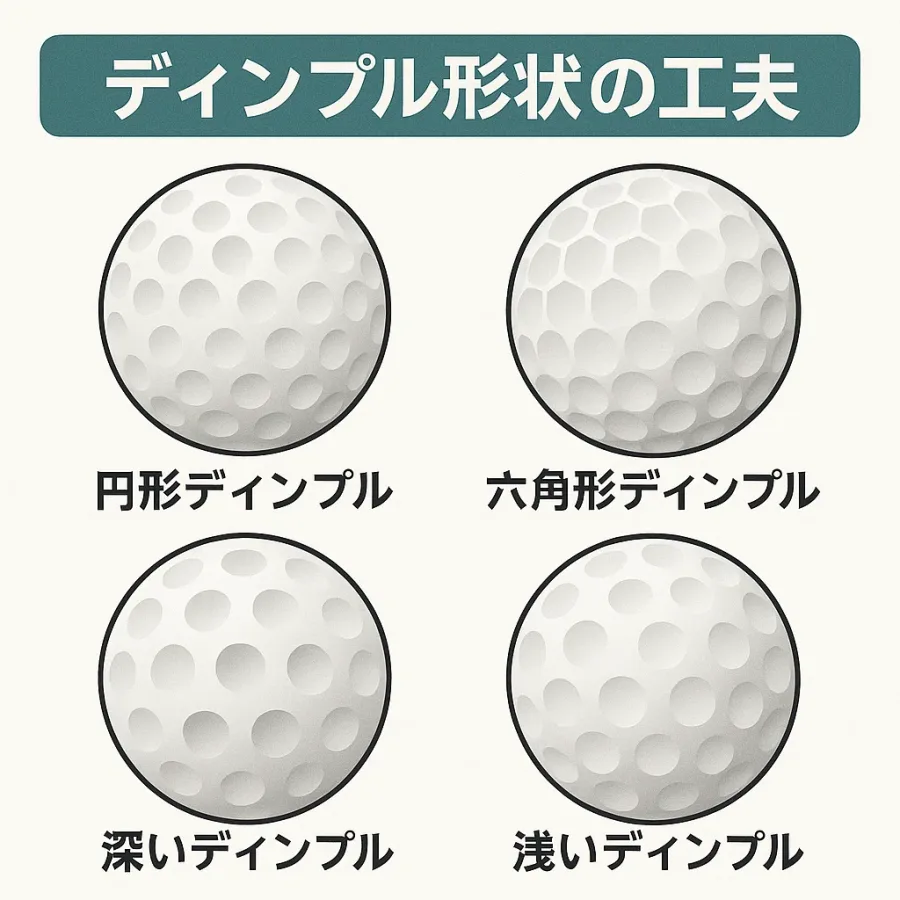
3. Innovations in dimple shape
Dimples are not just simple round holes.
Circular dimples: The most common and balanced type.
Hexagonal dimples: Reduce gaps and suppress air resistance.
Deep dimples: Low trajectory, wind-resistant.
Shallow dimples: High trajectory, focus on carry distance.
When Callaway released hexagonal dimples, tour pros joked, "It looks like a soccer ball, I feel like it's going to fly!" In fact, their contracted pros had a string of victories that year, and it became a hot topic that "when the shape changes, the tour changes."
4. Dimple strategies and representative models of each manufacturer
Titleist
Representative models: Pro V1 (388 dimples), Pro V1x (348 dimples)
Patent details: Dimple arrangement based on polyhedrons.
Goal: To achieve both distance and wind resistance.
Anecdote: The arrival of the "Pro V1" was truly revolutionary. It is said that this dimple arrangement technology is the reason it jumped to the top of usage rates on tour overnight.
Bridgestone
Representative models: Tour B X (330 dimples), Tour B XS (330 dimples)
Patent details: A "seamless structure" that connects dimples to one another.
Goal: To be wind-resistant and improve straight-line flight.
Trivia: The reason Tiger Woods trusts it to "not lose to the wind" lies in this unique dimple structure.
Callaway
Representative model: Chrome Soft X (332 dimples)
Patent details: Hexagonal dimples.
Goal: To fill the gaps between circular dimples and reduce air resistance.
Anecdote: When it first appeared, people laughed and asked if it was a "soccer ball," but the results have been well-proven on tour. Since then, it has become synonymous with Callaway.
Srixon (Dunlop)
Representative model: Z-STAR XV (338 dimples)
Patent details: Dual dimples (combining large and small depths).
Goal: Achieve both carry and roll to maximize total distance.
Trivia: Delicate tuning typical of Japanese manufacturers. Highly popular overseas as a "Japan-spec" ball that performs well in the wind.
TaylorMade
Representative models: TP5 (322 dimples), TP5x (322 dimples)
Patent details: Optimizing trajectory height by varying dimple depth.
Goal: Freely control spin rate and trajectory in combination with the 5-layer structure.
Trivia: When Rory McIlroy started using them, he praised them by saying, "I can use the same feel from driver to wedge," which is a testament to the brilliance of the dimple design.
5. The Invisible Battle of Patent Wars
In the golf ball industry, there is a mountain of patents related to dimples. As one developer put it—
"Ball patents are a minefield. If you change the shape even slightly, you might infringe on another company's patent."
Because of this, each company puts unique effort into the arrangement and shape, fighting with their own proprietary dimples as a weapon.
6. Summary
Dimple count determines the balance between distance and stability.
Dimple shape significantly influences air resistance and trajectory.
Patents from each company are truly a 'battle of wits over a white ball.'
Next time you hold a ball, try to think of it not just as a white ball, but as a crystallization of the manufacturer's wisdom, patents, and hard work.
That single ball is packed with science, history, and the player's desire for victory.