This article contains spoilers for the film "Sinners."
If you haven't seen the film yet, we have a "Preparation Edition" that summarizes the background knowledge of this work, so please take a look at that first.
With its beautiful IMAX film cinematography—the first since "Oppenheimer" (2023)—music and performances that seem to steal your very soul, and realistic characters that make you instantly empathize with "them" living in Clarksdale, Mississippi, "Sinners" is packed with compelling pieces. Among them, an unforgettable presence isthe vampire Remick, played by Jack O'Connell. Like Killmonger in "Black Panther," he is a villain who cannot be called purely evil—someone who speaks a truth about the system of oppression but practices it in a twisted way. Ryan Coogler has once again created a fascinating villain with such complex shadows.
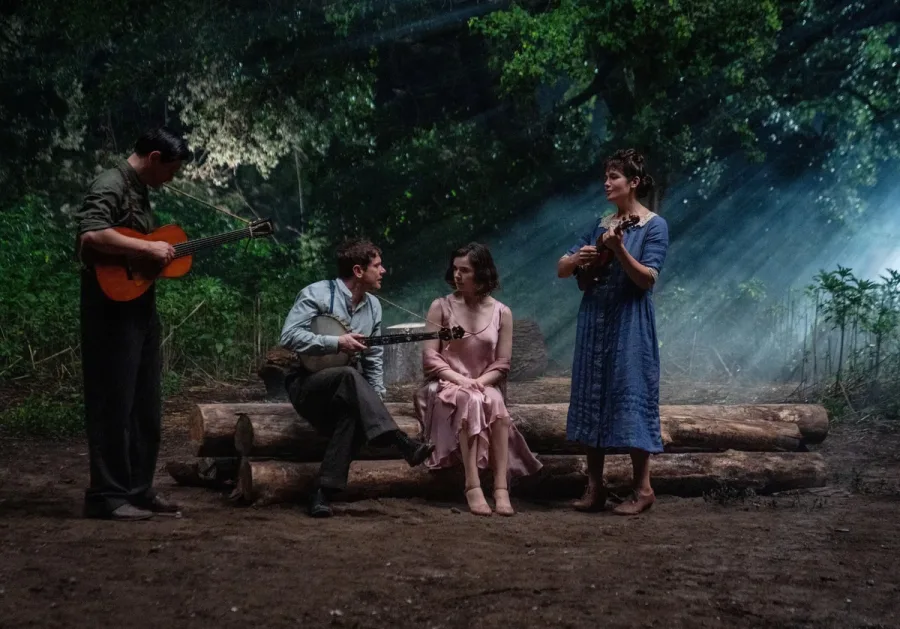
The scene where the vampires sing and dance to his homeland's folk song, "The Rocky Road to Dublin," is one of the most impressive scenes in the film, alongside the moment Sammy (Miles Caton) summons ancestral spirits with a soul-stirring blues performance. But why did this
sad vampire, hungry for a connection to "family," have to be Irish?
Remick is irresistibly drawn to the sound of Sammy's voice as he calls upon the spirits of his ancestors, saying, "Won't you give me your song and your story?" Needless to say, this is a metaphor for cultural appropriation and cultural assimilation.
The first song Remick and his two companions sing to gain the trust of the twins (played by Michael B. Jordan in a dual role) is "Pick Poor Robin Clean." They are turned away by the twins, who say, "This is a blues joint," but in fact, this song is a folk song of Black origin, well-known through the singing of country blues singer Geeshie Wiley. The performance by the vampire trio, which feels slightly comical, is too synchronized and too polished—a performance that is quintessentially "white." It stands in contrast to the moment Remick sings his homeland's folk song with such deep emotion.
By depicting Remick as Irish, Coogler adds depth to this motif of cultural appropriation.
When asked by the twins, "Are you KKK?", Remick reacts as if to say, "Of course not." On the contrary, he even conveys the KKK's plan to wipe out the Black people gathered at the juke joint and warns them. Perhaps Remick saw in those holders of discriminatory ideology the image of the invaders who once tormented his own people.
Since England conquered Ireland by force in 1653,Ireland has been subjected to colonial rule, religious persecution, and economic and cultural oppression for centuries.In the 17th century, many Irish people were sent to British colonies, including Virginia in America, asindentured servants and forced into grueling labor.
(How long has Remick been wandering in foreign lands? In the final confrontation with Sammy, he hears words from the Bible and mutters, "A man who once stole my father's land forced these words upon me." If this is a memory of the Irish Catholic persecution by English Protestants that occurred in the first half of the 17th century, Remick would be a vampire about 300 years old.
The Choctaw were chasing Remick likely because of a past where Remick had approached them. Perhaps aiming for the power of theChoctaw "Fire Keeper"who possesses power similar to Sammy's. Incidentally, this is also a nod to the historical bond where the Choctaw sent donations to the Irish people suffering from the Great Famine during the Potato Famine of 1847.)
Remick shows empathy for the Black people gathered at the tavern because of the memory of the oppression that tormented his own people. However, the method Remick proposes as a shield to protect them from the KKK is to join the ranks of the vampires. Of course, the price is high. By joining this vampire hive mind that shares knowledge and memories,individual spiritual and cultural freedom is lost.
This development is reminiscent of the history in the United States from the late 19th century onwards, where Irish immigrants, who were once on the side of the oppressed, acquired the privileges of being "white" and eventually became complicit in anti-Black racism.
It also simultaneously evokeswhat minorities lose in the process of assimilating into that white society.Remick seeks Sammy's song because he is trying to somehow regain the connection to his severed Irish ancestors.
Will they become victims of American intolerance, or will they assimilate at the cost of the soul of their own culture?—Coogler depicted the struggles of people living in this country as immigrants through the battle between the townspeople gathered at the juke joint and the vampires. (Of course, the image of Sammy, whose soul is targeted by vampires, overlaps with the legend of Robert Johnson, a blues legend who "sold his soul to the devil to gain guitar talent.")
The Irish folk song that Remick sings powerfully and poignantly,"The Rocky Road to Dublin"sings of the hardships and adventures an Irish man faces on his journey to England via Dublin. For the Irish, this song also symbolizes the struggle against oppression from England.
The scene where the vampires dance Irish dance is, alongside the scene where Sammy summons ancestral spirits, particularly memorable in this film. What is contrasting is that while the ancestral spirits Sammy summons are deeply connected to the roots of the people dancing in the juke joint,the vampires' dance is one that is severed from their own roots(except for Remick). In the middle-credit scene, set in a 1992 Chicago blues club, the immortal Stack and the mortal Sammy both look back on that party night, which eventually turns into a tragedy, as the "best day of their lives." It is a one-night-only freedom where a community, forced to inherit a white-dominated culture and having even their way of life decided by others, plays music directly connected to their own traditions and owns that space completely as their own.
"Sinners" is a work where Ryan Coogler faced his own roots head-on. This film was produced as a tribute to his uncle James, who was diagnosed with terminal cancer during the post-production of "Creed" and passed away.It is said to be a love letter to the blues that his uncle, who was good to Coogler during his lifetime, loved all his life, and to Mississippi, where his uncle lived.*1 Coogler's grandfather and uncle James escaped the constraints of the Jim Crow system and moved from the South to California after World War II. They were part of the wave of people who took part in the so-called "Great Migration." *1
Also, while preparing for "Black Panther: Wakanda Forever," Coogler saw a real cotton field for the first time in his life in Byron, Georgia. He said he was deeply shocked by the fact that his ancestors were deprived of economic freedom and lived tied to this very cotton field. *1
In that sense, "Sinners" became the most personal work for Coogler to date, delving deeply into his family's history and the footsteps of his ancestors.
"Sinners" opens with a scene where the authoritarian father, a priest, persuades his son, Sammy, to abandon the blues, which is "the devil's music," and take over the church. In the South in the 1930s, the value system thatfaith is good, and the blues is a sinwas widely believed among Christians.
So, in the end, did Sammy abandon his faith and make a deal with the devil?
The Christian motifs that appear in the final moments of the confrontation between Sammy and Remick are interesting. Remick submerging Sammy in water three times is a perverse baptism by the devil. At the very moment Remick is about to achieve his goal, what protected Sammy (and bought the time for Smoke to drive a stake into Remick's heart) wasthe resonator of his blues guitarandthe "Lord's Prayer" taught by his father(Matthew 6:9-13).
Ultimately, what Sammy chooses is neither the sacred protection of the church nor the eternal peace promised by the vampires. He chooses the vulgar, secular blues and a finite life. It seems like the very form of expression called "the blues" that Black people have cultivated throughout their history of oppression. They take on suffering, put it into a song over a dominant 7th chord, and affirm life.
After the end credits, in the very last post-credit scene, Sammy sings "This Little Light of Mine," which the choir sang at the beginning of the film, with a guitar in hand.He is reinterpreting this sacred gospel as blues. It is not a departure from faith. It is a redefinition.
This scene is the very essence of the film "Sinners" and embodies Coogler's authorship. Redefinition and reinterpretation—a hip-hop sensibility of pulling from the accumulation of past culture and art and remixing it. Just as he infused Afrofuturism and African American history into a superhero movie with "Black Panther," Coogler composed "Sinners" with a unique combination of
vampire horror, Southern Gothic, and musicaland sublimated it into entertainment like nothing seen before. And as he practiced in this work, to truly redefine something, one must face the history that lies behind it. Zinzi Coogler, Ryan's partner in both public and private life and producer of "Sinners," says the following.
In the middle and post-credits scenes of this film, Coogler also redefines the "conventions" of that famous franchise. Coogler used this space not to pitch his next project, but to allow the audience to delve deeper into the story they just watched, quietly closing the circle with "This Little Light of Mine." He has repainted the space once used for sequel teasers with his own story this time.
For Coogler, "Sinners" is his first completely original work since his feature debut, "Fruitvale Station" (2013). The fact that such a film has become a major hit in North America is nothing but bright news for this writer, who is tired of the popular series and famous IP franchise works mass-produced in Hollywood today.
If you enjoyed this article, it would encourage me if you could give it a "like."
<Citation>
1. Ryan Coogler says 'Sinners' inspiration felt 'like a bolt of lightning'
https://www.npr.org/2025/04/23/nx-s1-5373434/ryan-coogler-says-sinners-inspiration-felt-like-a-bolt-of-lightning