0. Purpose of this article
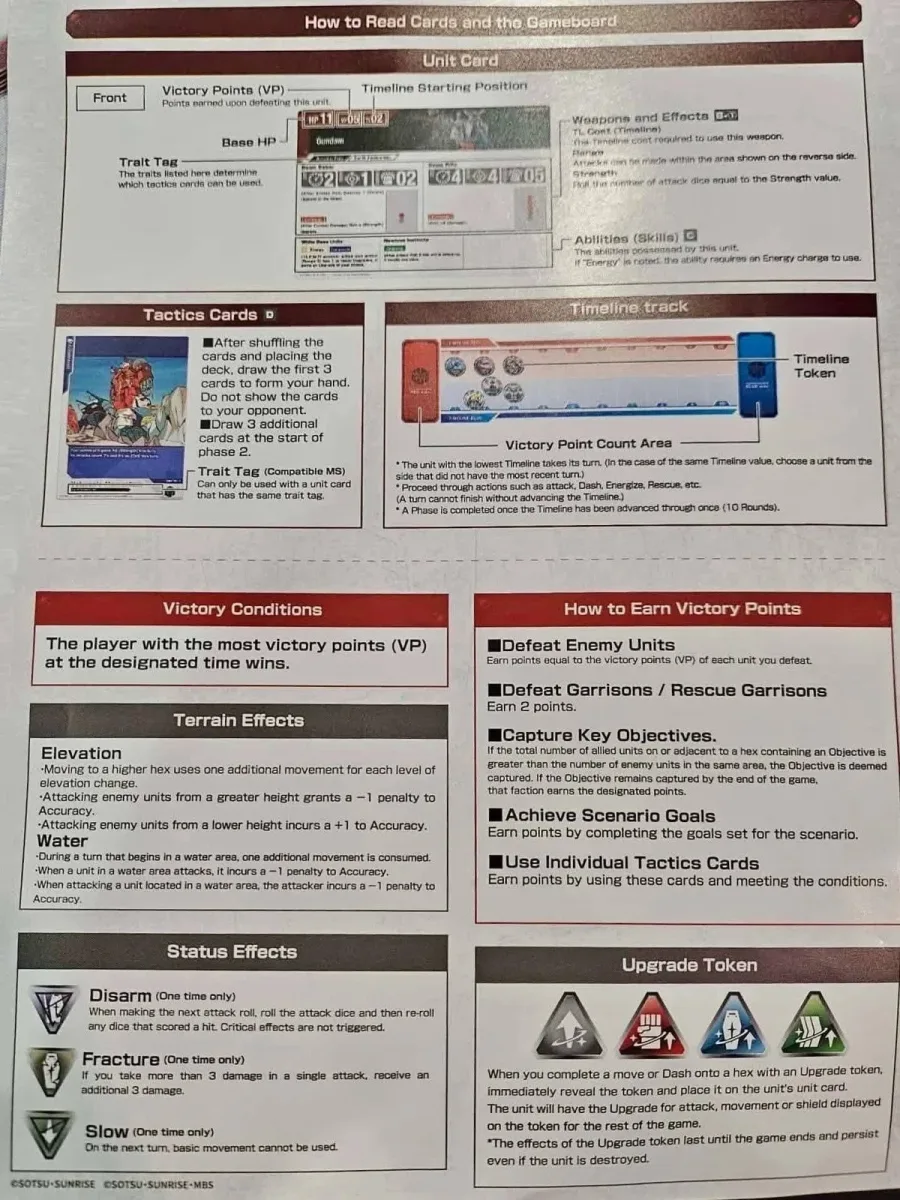
In this article, I will review the game rules for Gundam Assemble that were showcased during the demo play in Las Vegas.
This exhibition displayed not only the game board but also the actual rules.
*Updated 10/5/26
This article is a review based on the pre-release exhibition rules.
Please see the article below for a review of the official retail version rules.
Compared to the initial prototype, which was more like a board game as introduced in the following article, I got the impression that it has shifted toward a standard miniature game (in Warhammer terms, it feels like a shift from Underworlds to Kill Team).
As the official English X post below also labels it as the “world’s first demo play,” this exhibition is likely very close to the final product state.
Let’s take a look at what it was like right away!
1. Main rules of Gundam Assemble
I will extract and introduce the characteristic elements from the Gundam Assemble rules that were exhibited.
1-1. Gameplay using a small number of miniatures and cardsGundam Assemble appears to be a game where you fight while supporting 3 to 5 miniatures with cards drawn from a deck.
First, regarding the number of miniatures, the demo play exhibition featured
Gundam, Guntank, and Guncannon
Char’s Zaku and two Zakus
as the matchup.
Also, according to the official Japanese explanation, the starter set is 3vs3, and the Deluxe Set (which is likely a box containing models and expansion rules, similar to a Warhammer Tomb World set) is for large-scale 5vs5 battles.
The 2000pt battle, the most popular format for the miniature game Warhammer 40k, is a very heavy game that requires dozens of miniatures to be prepared in advance and takes over 3 hours to play.
In contrast, because Assemble requires only a small number of miniatures, it will likely be a game that is easier for beginners to play with less burden for preparation and shorter play times.
Next, regarding the cards, it is explained that at the start of the game, you draw 3 cards from the deck, and you can use up to 1 card each time you move a miniature (hands are replenished by 3 cards at the start of each subsequent round).
Also, it seems that the cards you can use are determined by the miniature.
In Warhammer terms, the usage feels close to the strategy cards in Underworlds.
In fact, standard miniature games have gameplay similar to Shogi/Chess, which has the drawback of having few luck elements and making skill gaps easily apparent.
※See the following article for details.
On the other hand, incorporating a card deck increases the TCG-like luck element. Also, by creating synergy between miniatures and cards, deep strategic gameplay can be achieved even with few miniatures.
This allows for the coexistence of the following two seemingly contradictory points:
A moderate luck element that is easy for beginners to grasp
Deep strategic depth that can withstand competitive tournaments
Continuing from the initial prototype, hex (hexagonal) grids are used on the Assemble board.
Miniature games that use grids have the following characteristics:
Processing is easy to understand, making it easy for beginners to play
Competitive rigor is improved, making it easier to run tournaments
Many miniature games, including Warhammer, often use a format where you "measure distances with a tape measure on a board without grids to move miniatures."
This format allows the battlefield to be a realistic diorama, increasing immersion during play.
However, whether an attack on an enemy is possible is decided by an ambiguous judgment of "whether the player can see the enemy from the miniature's perspective." Also, there remains ambiguity in measuring movement distance with a tape measure.
It takes some getting used to to smoothly handle these ambiguous processes in a game.
On the other hand, grids allow for easy and objective determination of enemy visibility and movement distance. This realizes the above benefits.
Terrain was introduced as an element not present in the initial prototype.
Many miniature games incorporate battles that take advantage of the terrain of the battlefield.
What is noteworthy is the introduction of terrain elevation differences.
This makes it easier to land attacks by looking down on opponents at a lower position than yourself, and conversely, makes it harder to land attacks on opponents at a higher position than yourself (miniature gamers are familiar with this from Warhammer 40k, etc.).
Also, Water has been introduced.
While movement is slower in Water, it becomes harder to attack enemies/be attacked by enemies.
Presumably, amphibious mobile suits can ignore the disadvantages of Water while still making it harder for enemies to attack them.
A timeline track has been introduced as a unique way to determine the turn order in this game.
The timeline track is a strip-shaped table with turn order positions 1 through 10 set on the horizontal axis. Miniatures located at lower values on this table can act on the board first.
Each miniature has a predetermined starting position on the timeline. For example, the Gundam starts at position 2 (relatively fast).
When it is a miniature's turn at its value, it can perform one action, such as attacking or moving additionally, in addition to moving 3 spaces.
When an action is performed, the miniature's position on the timeline moves down according to the action's content. For example, if the Gundam attacks with a beam rifle, it moves down by 4 (if it was at 2, it moves to 6 after the attack).
When the turn for the moved-to position arrives, that miniature can act again. However, once it exceeds 10, it can no longer act.
Once actions up to 10 are finished, one round ends, and in the next round, actions start again from 1. The game ends after 10 rounds.
The timeline track suggests that the feel of playing one round will be as follows:
A single miniature will act multiple times during one round
Enemy and friendly miniatures will act almost alternately during one round (unlike Warhammer 40k/AOS, where one side's miniatures do not move all at once)
Because of this system, ace units will likely start moving before mass-produced units and be able to act many times during a round.
In the Gundam series, speed has been an important expression of a unit's strength, starting with Char's custom units.
The timeline track is perfect for expressing the strength of ace units through this speed.
Also, because enemy and friendly miniatures are more likely to act one by one alternately, it is less likely to become a game of who goes first, making it easier to play carefully (in Warhammer, where one side's miniatures often move all at once, there is often a risk that the first player will trample and win from the first turn if there is a large difference in skill or if the battlefield setup is wrong).
1-5. Status Ailments/Buffs During the GameIn Assemble, miniatures can suffer from status ailments or be buffed during the game.
When suffering from a status ailment, a miniature may become unable to move or become easier for enemies to hit (this is similar to being 'shattered' in Warhammer Underworlds).
Although the conditions are unknown, it is likely that you can inflict status ailments on opponents through attacks or cards.
Conversely, if a miniature stops on or passes through a space with a buff, that miniature will be buffed for the remainder of the game.
In the game, movement that takes into account the terrain and buff spaces seems important.
1-6. Determining Victory by PointsIn Gundam Assemble, the player with the most points earned during the game wins.
The scoring conditions are similar to Warhammer 40k and Underworlds.
First, defeating enemy miniatures earns points based on the miniature (stronger miniatures will likely be worth more points).
Next, performing a rescue action with a miniature next to a friendly Garrison space (meaning fortress, likely an image of a base) or destroying an enemy Garrison earns points.
Rescuing a Garrison is an action where you give up an attack to gain points, like an action in 40k.
Enemy Garrisons can likely be destroyed by attacks.
What is familiar in Warhammer, securing objectives, is also a scoring condition. The side with more miniatures in spaces adjacent to the space with the objective secures it. Points are awarded to the side securing it at the end of the game.
Achieving objectives determined for each scenario also earns points. Miniature games, like TRPGs, involve selecting scenarios, and the scenarios determine positions, victory conditions, or generate additional rules.
In Assemble, there are likely scoring conditions for each scenario, such as defeating the enemy leader or moving to a specific location.
Card effects also earn points. It seems that points are earned when you use a card and achieve the conditions written on it (this seems close to objective cards in Underworlds).
Overall, I think the conditions are set up so that you cannot win simply by including miniatures with high combat power. While miniatures with high combat power are advantageous for defeating enemy miniatures, it is more efficient to have miniatures that are cheap to field in numbers or have high mobility handle tasks like rescuing Garrison units or securing objectives.
Ace units will likely excel at defeating enemy miniatures, while mass-produced units will be useful for rescues and securing objectives.The balance between adopting ace units and mass-produced units seems to be important for victory.
The Japanese official site suggests that the number of usable miniatures will increase through expansion packs (which I assume are individual miniature sales in Warhammer terms).As more expansions are added, it seems possible to build squads with diverse balances.
While combat resolution in miniature games often involves rolling dice multiple times while comparing the stats of the miniatures, Assemble is resolved with a single roll of a 10-sided die. You roll a 10-sided die for each point of STRENGTH determined for the miniature's weapon, hitting on a 4 or higher, and scoring a critical (a strong hit) on a 9-10; however, even with roll modifiers, a roll of 1 is always a failure.
The opponent's defense is not handled by a die roll, but rather by reducing damage based on their shield value.
Simple dice processing significantly reduces the burden of play, making it easier for beginners to enjoy.Also, shorter play times make it easier to run tournaments.
Furthermore, the resolution mechanics are exquisite; since there is about a 1/3 chance of failure and a 1/5 chance of an over-performance, it seems likely that even if an advanced player plays well, there will be a moderate number of cases where they lose due to bad luck.
As mentioned earlier, miniature games inherently tend to show skill gaps, so this is a good resolution mechanic that makes it easy for beginners to play. Also,
to overcome bad luck, it seems important to select miniatures with an awareness of the number of attacks.
2. Impressions received from these rules
Regarding my impressions of this set of rules, as I have mentioned many times, I felt that the Assemble rules are generally aiming to achieve both of the following two points.
Ease of play for beginners
Game design suitable for competitive tournaments
The former is likely because they are leveraging the Gundam brand to look into acquiring players other than existing miniature gamers.
The latter is likely because this title is a cross between Gunpla and Bandai TCGs. It seems they want to build excitement around tournament events, just like other Bandai TCGs.
However, compared to the initial prototype that leaned more towards board games, I also got the impression that it has shifted closer to a standard miniature game.
Three-dimensional, bulky terrain and a board surface that is slightly larger than the initial prototype create difficulties in storage and securing play space.I think the barrier to entry from outside the miniature game hobby has become slightly higher than with the initial prototype.
However, tactical maneuvering based on three-dimensional positioning is very familiar to miniature gamers, and the revised board is still on the small side for miniature gamers (since they are the type of people who usually play on 1.5m x 1.1m battlefields).
I think these rules have been tuned to be familiar to existing miniature gamers.
This is likely because this title is being created with an eye not only on Gundam fans but also on the miniature game market in the West (especially North America).
While Gundam is popular in Asia, it faces challenges in sales in the West.
Looking at the Bandai Namco Group's 2021 IR report, "BANDAI NAMCO GROUP Integrated Report 2021" (https://fs2.magicalir.net/tdnet/2021/7832/20210930404667.pdf), sales in the West are only 10%.
On the other hand, along with China, where it is already popular, North America has been chosen as a priority region for the time being.
Page 47 of the same report also discusses the marketing strategy that has begun in North America and the importance of the North American market with an eye toward expansion into other regions.
On the other hand, while miniature games have low recognition in Japan, they are content that has been enjoyed in the West for over 40 years.
However, looking at the scale of corporate sales, Games Workshop (hereinafter GW), which sells Warhammer, is almost the sole dominant player, and while other manufacturers also make good games, their scale is significantly inferior.
If Bandai Namco Group, which is about 10 times the size of GW, can create a hit miniature game here, they might be able to exert a significant presence that surpasses even GW, the leader in the North American miniature game market.
And through miniature games, they might be able to create an opportunity for people in North America who don't know Gundam to become interested in it.
The strength of Assemble as a pure miniature game, apart from Gundam, is the ease of tournament operation.
GW has also been putting effort into tournaments recently with the 10th edition of 40k, but considering the number of miniatures required and the play time per session, there is inevitably a barrier to entry.
Also, Privateer Press, which was traditionally good at tournament-oriented miniature games, seems to have been struggling with its management in recent years.
In that context, if they can create a miniature game where official tournaments thrive by leveraging TCG tournament operation know-how and abundant financial resources, this title might become a work that can compete with the established miniature games of the West.
The game design for this title was created overseas (likely in the West), and the demo play was also first held in America, not Japan.
This might be because this title carries the mission of penetrating the North American market with Gundam content through the lens of miniature games, which are popular in North America.
3. Source of images in this article
For the demo play images in this article, I referred to the following Reddit thread. I would like to express my sincere gratitude to all the contributors.
1. Board images
Forum name: r/gundamassemble
Thread title: Some floor pics from BCF
Posted by: Swordsmen00
Date posted: 2026/2/15
URL:
https://www.reddit.com/r/gundamassemble/comments/1r4tnb3/some_floor_pics_from_bcf/
2. Rules sheet images
Forum name: r/gundamassemble
Thread title: Assemble Rules Sheet
Posted by: BlackLuigi7
Date posted: 2026/2/15
URL: https://www.reddit.com/r/gundamassemble/comments/1r4vrr7/assemble_rules_sheet/