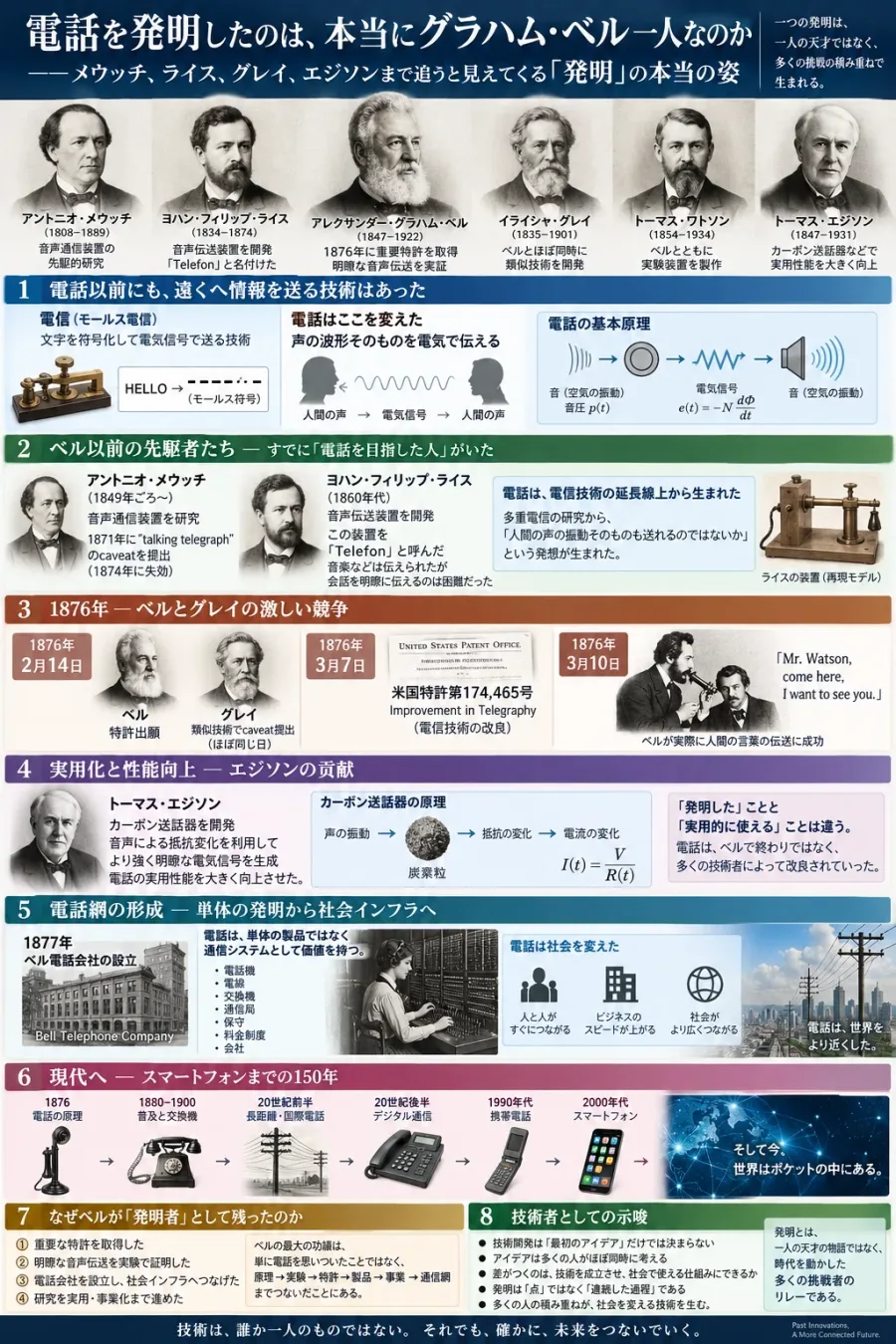
Was Alexander Graham Bell really the only one who invented the telephone?
――The true nature of 'invention' revealed by tracing the contributions of Meucci, Reis, Gray, and Edison
If asked, "Who invented the telephone?"
I think most people would answer,
Alexander Graham Bell.
In school textbooks and general quizzes,
it is often taught that
"the inventor of the telephone = Alexander Graham Bell."
This is basically not wrong.
Bell obtained an important patent for the telephone in 1876 and succeeded in an experiment to transmit human voices as electrical signals.
This subsequently led to the establishment of a telephone company, developing the telephone from a laboratory experiment into a social infrastructure.
However, if you look into the history of the telephone in a little more detail,
you will find that the explanation that
"Bell alone invented the telephone from scratch"
is a significant oversimplification.
The telephone was established through the accumulation of technologies from multiple inventors such as
Meucci,
Reis,
Bell,
Gray,
Watson,
Edison
The telephone was established through the accumulation of technologies from multiple inventors such as these.
The history of the telephone raises the question,
"Does an invention belong to the person who thought of it first, or to the person who established it as a technology that can be used in society?"
contains a very interesting question.
1. Even before the telephone, there were technologies for sending information over long distances
Before the telephone appeared, technologies for long-distance communication using electricity already existed.
A prime example is the
telegraph
.
With the Morse telegraph, information is sent in the following flow:
characters
↓
code
↓
electrical signals
↓
code
↓
characters
.
For example,
"HELLO"
if you want to send the string,
you do not send the human voice itself, but convert the characters into Morse code and send them through the wire.
In other words, the telegraph was
a technology for encoding and sending information
.
The reason the telephone was revolutionary is that it changed this process.
With the telephone,
human voice
↓
air vibrations
↓
electrical signals
↓
air vibrations
↓
human voice
is the conversion that takes place.
In other words,
it transmits the sound waveform itself as an electrical change.
It is.
This is taken for granted by us today, but in the 19th century, it was an extremely significant technological leap.
2. There were people who researched the telephone before Bell
Even before Bell began his research on the telephone,
there were people who thought,
"Could human voices be sent over a distance using electricity?"
A prime example of this is
Antonio Meucci.
It is.
It is said that Meucci, an inventor from Italy, had been researching voice communication devices since around 1849.
In 1871, he submitted a caveat regarding a
"talking telegraph"
to the United States Patent Office.
A caveat was a system that existed in the United States at the time,
"I am researching an invention like this"
which was a mechanism for notifying the Patent Office in advance.
However, this was not a formal patent.
Due to financial circumstances and other reasons, Meucci was unable to continue the renewals, and it expired in 1874.
A few years later, Bell would obtain the patent for the telephone.
3. The Story That 'Meucci Was the True Inventor'
When researching the history of the telephone,
one sometimes encounters the story that
'in fact, it was not Bell but Meucci who invented the telephone.'
There is a background to this.
In 2002, the U.S. House of Representatives
adopted a resolution known as
H.Res.269.
This resolution recognized Meucci's life and his research and contributions to telephone technology.
Because of this,
it is sometimes explained that
'the U.S. Congress recognized Meucci as the true inventor of the telephone.'
However, this is not entirely accurate.
This resolution
acknowledged Meucci's significant contributions
but
did not revoke Bell's patent.
Furthermore,
'Bell is not the inventor of the telephone' is not the case.
nor was it officially decided as such.
Therefore, in terms of the history of technology,
it is reasonable to consider Meucci a very important pioneer of telephone technology.
4. There was also someone who named it 'Telefon'
There is one more important figure before Bell.
He is the German physicist,
Johann Philipp Reis.
In the early 1860s, Reis developed a device that transmitted sound via electricity.
What is even more interesting is that
he called this device
Telefon.
In other words, the very concept of a 'telephone' existed even before Bell.
However, Reis's device had a major problem.
Although it could transmit sound,
it was difficult to transmit human conversation stably and clearly.
While it could transmit music and simple sounds, its performance was not sufficient to accurately reproduce complex human voices.
In other words,
the ability to 'transmit sound via electricity'
and
the ability to 'become a practical telephone'
still had a technical gap between them.
5. Why did telephone research accelerate all at once in the 1870s?
What is important here is
that it was not just Bell who suddenly thought of the telephone,
but rather that many others were involved.
At the time, many researchers
were studying
harmonic telegraphy.
Because telegraph lines were expensive,
there was a challenge to 'send multiple signals simultaneously over a single wire.'
Therefore,
research progressed on sending multiple communications simultaneously by utilizing
different frequencies,
different vibrations,
and different electrical signals.
Research progressed on sending multiple communications simultaneously by utilizing these methods.
If you take this research to its logical conclusion,
'couldn't we send not just telegraph codes, but the vibrations of the human voice itself?'
arrives at the idea that.
In other words, the telephone is
an invention born from an extension of telegraph technology
as well.
6. Bell had a background in researching 'sound'
Alexander Graham Bell had a slightly different characteristic compared to other inventors.
Bell's father was a researcher of elocution, and Bell himself had long been researching
voice
vocalization
hearing
education for the hearing impaired
about.
Bell was not just an electrical engineer, but a person who thought deeply about
what the human voice is
.
The human voice is a vibration of air.
If that vibration could be reproduced in another location,
the voice could be sent far away.
This idea became an important background for Bell's telephone research.
7. February 14, 1876: Bell and Gray acted almost simultaneously
Particularly famous in the history of the telephone is
February 14, 1876
.
On this day,
Bell's side filed a patent application for the telephone.
However, on the same day,
American inventor,
Elisha Gray
also filed a caveat regarding a very similar voice transmission technology.
Bell and Gray,
at almost the same time,
"sending sound as electricity"
had arrived at the same problem.
This would later
develop into the telephone patent dispute
between Bell and Gray.
In the history of technology, such phenomena are not rare.
When a certain technical field becomes sufficiently mature,
multiple researchers may arrive at the same invention at almost the same time.
The telephone was a typical example of this.
8. On March 7, 1876, Bell obtained the patent
Bell,
on March 7, 1876
to,
U.S. Patent No. 174,465
was obtained.
What is interesting is its name.
The title of the patent was
Improvement in Telegraphy
.
In Japanese, this would be
'Improvement in Telegraphy'
.
At that time,
a massive telecommunications industry called the 'telephone' did not yet exist.
It is clear that the telephone
was recognized as a new communication method that further developed telegraph technology
.
9. Three days later, a famous experiment takes place
March 10, 1876.
Bell conducted an experiment with his assistant,
Thomas Watson
.
Bell spoke into the transmitter,
"Mr. Watson, come here, I want to see you."
and said.
And Watson, who was in another room, heard those words.
This is one of the most famous scenes in the history of the telephone.
What is important is that,
not only did Bell obtain a patent,
but he also demonstrated in an experiment that he could actually transmit human speech
is the point.
10. How does a telephone transmit voice?
The basic principle of the telephone is still very beautiful even when viewed today.
When a person speaks,
the air pressure fluctuates due to the voice.
Let this be sound pressure
p(t)
.
This sound pressure causes the diaphragm of the transmitter to move.
Let that displacement be
x(t)
.
By combining a diaphragm with a magnet and a coil, the magnetic flux changes.
The basic equation for electromagnetic induction is
e(t)=-N\fracd\Phidt
.
In other words,
magnetic flux
\Phi
changes over time, which generates
voltage
e(t)
.
This electrical signal is sent through wires.
On the receiver side, the process is reversed:
electrical signal
↓
change in magnetic force
↓
vibration of the diaphragm
↓
air vibration
↓
sound
is restored.
Therefore, the telephone is essentially an energy conversion device that goes from
sound → electricity → sound
.
11. However, the first Bell telephone was not that high-performance.
I think this is extremely important when looking at the history of invention.
To "invent" something
and
to make it "practically usable"
are not the same thing.
Bell's early telephone could certainly transmit human voices.
However, the signal was weak,
long-distance communication
volume
clarity
and other factors had their limitations.
In other words,
the principle was sound, but as a product, it was still unfinished
.
12. That is where Edison enters the picture
One of the people who further developed the telephone into a practical product was
Thomas Edison
.
Edison
developed the carbon transmitter
.
The basic concept is:
Voice
↓
Diaphragm
↓
Pressure change on carbon material
↓
Change in electrical resistance
↓
Current change
is.
If the voltage is
V
and the resistance is
R(t)
then, according to Ohm's law,
it becomes.
I(t)=\fracVR(t)
it becomes.
When the resistance changes due to the voice, the current also changes.
This method made it easier to create stronger and clearer electrical signals than Bell's initial method.
In other words, the telephone,
was not something that Bell completed once and for all.
Bell established the principle,
Edison and others improved its performance,
and many more engineers went on to develop the communication network.
13. A telephone cannot exist with just the 'machine' alone
What is even more important in the history of the telephone is,
that inventing the telephone device itself does not change society,
is what it means.
A telephone is meaningless if it cannot connect to the other party.
What is needed is:
a telephone
wires
a switchboard
a central office
maintenance
a billing system
a company
.
In other words, the telephone is
not a standalone product,
but only holds value
as a communication system.
14. In 1877, the Bell Telephone Company is established
One of Bell's great achievements
is that he did not let his invention end in the laboratory.
In 1877,
Bell and his associates
established the Bell Telephone Company.
.
From here, the telephone
research
↓
invention
↓
patent
↓
experiment
↓
product
↓
company
↓
communication network
↓
social infrastructure
develops into.
This progression is precisely why Bell is, to this day,
the 'inventor of the telephone'.
is one of the major reasons why it is known as such.
15. So, who actually invented the telephone?
To summarize, it is as follows.
Person Main Role
Antonio Meucci An important pioneer who researched voice communication devices from around 1849
Johann Philipp Reis Developed an electrical voice transmission device in the 1860s
Alexander Graham Bell Obtained a key patent in 1876 and demonstrated clear voice transmission
Elisha Gray Developed similar technology around the same time as Bell
Thomas Watson Conducted the construction and experimentation of telephone devices with Bell
Thomas Edison Greatly improved practical performance with the carbon transmitter, etc.
Therefore,
if you are asked on a test,
'Who invented the telephone?'
then,
Alexander Graham Bell
is the correct answer.
However, when viewed as a history of technology,
'Bell alone invented the telephone from scratch'
is not an accurate understanding.
16. Is an 'inventor' the person who thought of it first?
I think this is the most interesting part of the history of the telephone.
If,
we consider only the person who first thought of voice communication
to be the inventor,
then the evaluations of Meucci and Reis become extremely important.
On the other hand,
If you consider the person who actually established the principle,
obtained the patent,
proved it through experiments,
turned it into a practical product,
and spread it to society
to be the inventor,
then Bell's role is extremely significant.
In other words,
invention has multiple stages.
Idea
↓
Principle
↓
Prototyping
↓
Experimentation
↓
Patent
↓
Performance improvement
↓
Commercialization
↓
Business development
↓
Social implementation
The technology of the telephone was not completed by a single person across all these stages.
17. Technological development is not determined by the 'initial idea' alone
Looking at the history of the telephone's invention,
we can learn something quite important about technological development.
Bell was not the only one who
'wanted to transmit human voices via electricity'.
Multiple inventors were moving in the same direction at almost the same time.
What made the difference was
not just the mere concept,
but whether they were able to advance it to the point of making the technology viable
or not.
Furthermore,
the established technology,
was...
Whether it could be transformed into a system usable in society
was what mattered.
I believe this is the same for current AI and construction DX.
For example,
'checking construction drawings with AI'
'automatically creating schedules with AI'
'determining construction conditions from BIM'
—these ideas themselves are being thought of by many companies and researchers at almost the same time.
Where the real difference is made
is not in the
idea
itself, but in whether you can connect it to
data, evaluation methods, verification, actual projects, standardization, business workflows, and organizational implementation
until the end.
18. The essence of 'invention' as seen from the history of the telephone
You can learn the invention of the telephone
with just the single sentence, 'Bell invented it in 1876.'
However, if you look a little deeper,
the telephone is
something where the accumulation of technology by multiple researchers crystallized into a practical system at a certain point in time
This is what we understand.
Meucci conducted pioneering research,
Reis built a voice transmission device,
Bell and Gray arrived at the practical principles of the telephone,
Watson gave shape to the experimental equipment,
Edison improved the transmission performance,
and telecommunications companies built the network.
In other words,
an invention is not a 'point' but a 'continuous process'.
And Bell's greatest achievement
was not simply coming up with the telephone.
It was that he connected voice transmission
from↓principle↓experiment↓patent↓product↓business↓communication network
all the way through.
That is why even today,
the name Alexander Graham Bell remains
as the inventor of the telephone.
However, behind that lies the accumulation of work by many engineers and inventors.
The history of the telephone is,
...
'Coming up with an idea for a technology' and 'turning it into a technology that changes society' are different things
This is demonstrated very clearly.
References
Library of Congress, Alexander Graham Bell Papers
Library of Congress, “Who is credited with inventing the telephone?”
Smithsonian National Museum of American History, Alexander Graham Bell telephone collections
U.S. Patent No. 174,465, Improvement in Telegraphy, 1876
U.S. House of Representatives, H.Res.269, 2002
The Telephone Cases, 126 U.S. 1
Smithsonian Institution, Thomas Edison and carbon transmitter materials. If necessary, I can also create a NOTE version of this content that connects it all into a single 150-year history of technology, from 'pre-Bell' to '1876' to 'the formation of telephone networks' to 'modern smartphones.' Image conversion