I read Nakaba Suzuki's Sunday serialization, "Kongou Banchou." It was Jump.
■ Work overview, who cares about that!!??
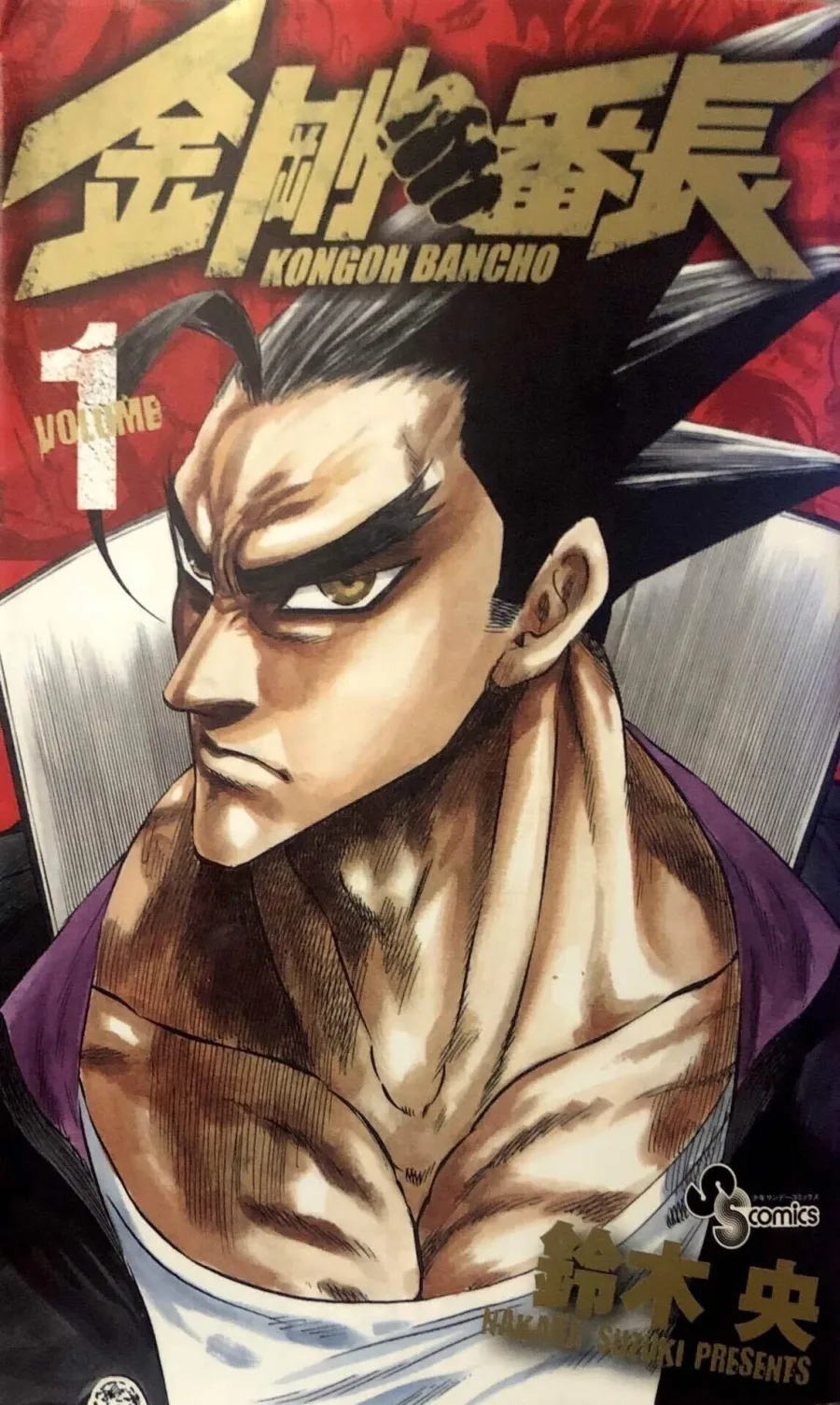
Title: Kongou Banchou
Author: Nakaba Suzuki
Magazine: Weekly Shonen Sunday
Publication period: 2007 to 2010
Volume count: 12 volumes in total
Personal score: 73 points
■ I've followed the plot!
Akira Kongou, who transferred to Shiritsu Raimei High School, is a big man with a delinquent spirit who hates anything crooked. He saves a devious student guidance teacher, whose reason for living is bullying students, from a falling steel beam by saying, "You have a family too, don't you?" and reforms him. He then goes alone to dismantle a yakuza gang simply because they tore up a picture a girl drew. He is truly the delinquent among delinquents. Assassins are sent one after another to this Kongou Banchou. It is all due to the Japanese government's "23-Ward Project," which decided to "hold death matches among the banchou placed in the 23 wards to determine a new leader to rebuild Japan." To follow his own path, Kongou decides to crush the "23-Ward Project."
■ "Kongou Banchou" has everything from Jump!
The three major principles of Jump are "Friendship, Effort, and Victory," and it is safe to say that this is common knowledge, butKongou Banchou is packed with all the classic developments that lead a story to "Friendship, Effort, and Victory."
So, I'm going to look at what's in Kongou Banchou one by one.
As introduced in the "synopsis," Kongou Banchou possesses the spirit of poetic justice: saving the weak, crushing the strong, and hating the sin but not the sinner. No matter who the opponent is, he dislikes killing, yet he fights with all his might while showing respect. The moment he truly gets angry is precisely when his friends are hurt.
Well, this kind of thing is common in other manga, and it's not limited to battle manga. Let's move on.
Kongou Banchou has that thing where a battle that started with just one person leads to defeated opponents becoming friends, eventually becoming irreplaceable existences as they are defeated.
This is essential, right? Enemies turning good is essential for Jump, right? Although the character designs are quite unique, the development where they are touched by the protagonist's manliness, change their hearts, and decide to share his fate is a golden rule of Jump battle manga.
This is so appreciated!!!!!!!!!
The small-fry enemies who appear at the beginning just to commit evil deeds and get beaten up to show the protagonist's strength...
There's no way any otaku hates the development where they stand up to uphold the "conviction" instilled in them, even if they know they can't win!!!!!!!!!
I seriously love this; the more despicable the mob is in the beginning, the bigger the rebound when they turn good. I want every manga to do this.
I love this.
Is there any otaku who dislikes a petite girl who has a strong sense of justice but can't think logically, so she ends up carrying out justice in a self-righteous way? You dislike her? Then you don't have to read it anymore. The end.
It's a letdown when a girl like this gets forced into a heterosexual romance later on, but in Kongou Bancho, that doesn't happen, so you can read with peace of mind. Feel free to stan Punch-chan with peace of mind.
To put it simply, this is the best part of Kongou Bancho.
The name "Hikyo Bancho (Cowardly Bancho)", which is too direct, is funny, but if a popularity poll were held for "Kongou Bancho", this Hikyo Bancho would definitely win 1st place by a landslidewithout a doubt.
Actually, I could write an entire note article just by talking about the "charm of Hikyo Bancho", but once you know he is a dark hero who had to resort to crime and become "cowardly" to support his 13 younger siblings at an orphanage, it makes perfect sense.
Hikyo Bancho is truly great. First of all, it's good that he's not just cowardly but also normally excellent in combat. It's also too good that he takes on the role of the villain himself despite, or rather because of, the fact that he truly admires Kongou Bancho. In fact, Hikyo Bancho's shadow is present in almost every important scene in Kongou Bancho, and it's no exaggeration to say that "wherever Kongou Bancho is active, Hikyo Bancho is there."
Maybe they said it in Bakuman too, but a manga that has a dark hero who shines even brighter than the protagonist or the final boss is the real deal. They said that in Bakuman, right? I think they did. Sorry if they didn't.
Fist of the North Star?
Kenshiro and Rei from Fist of the North Star?
Fist of the North Star?
Kenshiro and Raoh from Fist of the North Star?
HUNTER×HUNTER?
This is Jump
Is there any Jump manga that doesn't do this?
It's that thing where it's broken up into 'XX Tournament Arc' or 'XX Deathmatch Arc' and so on.
I like it when they don't just settle things with an all-out war, but use their individual traits and tactics to fight, because you get to see the characters' limits and, conversely, their new possibilities.
I love this more than anything in the world
In the end, this kind of thing is the best. The composition where the only one who can control overwhelming power is a single innocent girl with no vices or ambition is the best, after all. It's Melonpanna and Rollpanna. Even though Anpanman isn't serialized in Jump.
It becomes
It has become
Actually, it would be unnatural if there wasn't one
Incredibly strong
You can also tell he is incredibly strong from the character files included at the end of each volume of the manga.
The very first boss is often used to explain the world-building, but since they function simply as a barrier for the protagonist to overcome, I really love it when they fulfill their function as that character once again toward the end. In Kongou Bancho's case, he is demonstrating his power as an ally, though.
The enemy boss who was the strongest in volume 1. He gradually fades into the background as the battle against new, powerful enemies begins, but
In the final volume, he shows new feats, such as fighting one-on-one against one of the strongest enemies in the series.
"Iai Bancho" is really cool; if there were a popularity poll, he'd probably come in second after Hikyō Bancho.
As you can see, Kongou Bancho follows the template leading up to "friendship, effort, and victory" to an extreme degree, and because it is "more Jump-like than Jump," it has turned into something that is "interesting as a Sunday work."
■ Bye Bye Jump
Are you familiar with the term "Bye Bye Jump"? Bye Bye Jump refers to a manga artist who had an exclusive contract with Weekly Shonen Jump being cancelled and leaving Jump.
The creator of this term is Nakaba Suzuki, the author of Kongou Bancho. It originates from the fact that Suzuki was serializing a work called Ultra Red in Jump, but in the final chapter, he hid the words "BYE BYE JUMP" on the clothes of a background character, and after publishing a one-shot in Ultra Jump, he left Jump.
Later, Suzuki published serialized works in all of Weekly Shonen Jump, Weekly Shonen Sunday, Weekly Shonen Champion, and Weekly Shonen Magazine, and is also known as an artist who has published serialized manga in all four weekly shonen manga magazines.
Kongou Bancho might be the result of Suzuki giving shape to his own feelings toward Jump.
■ Summary
Kongou Bancho is a manga that stands as a Sunday work packed with everything from Jump. This work, which sublimates well-worn developments into new fun through unique characters and the author's skill, should look attractive to readers seeking classic battle manga!