This month, I will be reviewing "The Panda Rooms" released by Purafied.
Click here for a walkthrough of the plugin.
Click here for the video series where Sam Pura explores the studios modeled in this plugin.
It is extremely long, so only for those who are truly interested...
The theme of this plugin is "Natural Sound Wetness".
Since there is no precise translation for "Wetness," it is hard to express, but
for now, this is not what you would call a "Reverb."
I think this is more of a "Glue" plugin, as it is used to control the sense of distance between instruments, add width to material that is a point source, or bond material recorded with multiple microphones.
At first glance, it has quite a lot of knobs, and the output sound is unlike anything I have heard before, so I think it is a difficult plugin to get into.
However, its effect is unique; while it cannot beat live recording, it allows you to retroactively add the natural room resonance and sense of distance that could previously only be obtained through studio recording.
I received a question about this on "Marshmallow" before, and I agree that it is hard to imagine without recording experience, so this time I will explain the overview of the plugin and summarize some ideas on how it can be used.
Overview
First, I will briefly introduce the structure of the plugin.
"The Panda Rooms" is a plugin that captures 10 rooms in a studio owned by Sam Pura using 5 microphones, and by combining and adjusting them, you can add room glue and a natural wet feel to your mix.
Sam Pura describes the experience of using this plugin as "being able to book a studio infinitely and build up room mics," and my impression after using it is exactly that.
Rooms IncludedThe rooms included in The Panda Rooms are as follows.
1. West Live Room
The infamous drum brawler room.
A place Sam often uses to record the massive drums you can hear on records by Basement, Spiritworld, The Dangerous Summer, The Story So Far, State Champs, and more.
2. West Ctrl Room
A control room generally used for vocals and acoustic guitars.
Provides a fast dry decay that creates a natural and delicate space.
3. Hallway
The hallway is where Sam places mics when he needs a lot of reflections and ambience.
He considers this the place where "The Sound of Hits" is found, and recommends it especially for drums.
4. Kitchen
While it is a place for ham sandwiches and paper towels, for some reason it has a solid ambience.
Literally and figuratively, it is located between the live room and the hallway.
5. Bedroom
I tried to capture the smell of fresh linen and the coziness of nap time, but all I got was the sound of a natural room with a creamy, smooth decay.
This room is one of the larger rooms in the studio with fewer reflections, so it might be the "Goldilocks" you need.
Goldilocks... Named after Goldilocks, the protagonist of "Goldilocks and the Three Bears." Based on the story, it refers to a state that is just right, not "too much."
6. Bathroom
If you like singing in the shower, it goes without saying.
7. Iso Room
An ambience with super-fast response for spaces with little decay.
Use it for acoustic guitars, speaker cabinets, vocals, punchy drums, etc.
You might be surprised at how much a "dead" room can bring sound to life.
8. East Live Room
Dave Grohl would probably like the East Live Room.
It is live, reflective, fast, and punchy.
LDC mics were kept in storage for this setup, giving the sound wonderful decay and options.
9. East Ctrl Room
Basically similar to the West Ctrl Room, but larger.
You get a tight and controlled response.
The stereo image is the highlight of the mic setup.
10. Warehouse
You cannot smell the lovingly grown California greenery, but it remains one of the most iconic sounds of Panda Studios.
It is not only an ambience that makes acoustic instruments sound warm, but it is also famous for Sam literally using this room for snare re-amping.
Like the snare on records such as The Story So Far's "Proper Dose" or Spiritworld's "Deathwestern."
He was playing through a speaker cabinet in the warehouse to get a bigger sound. He must have wished there was a plugin for that.
Since the manual contains a lot of Sam Pura's vibe,
it has become quite a liberal translation, but these are the details of the rooms included.
I think it is hard to imagine if you do not have actual recording experience or due to the living environment in Japan, but please consider that all rooms except the Iso Room have natural room resonance.
The expression "Dead Room" for the Iso Room is often used at recording sites, but please think of it as a room where the decay does not extend.
It certainly has volume as a room, but the reverberation disappears without becoming muffled immediately after playing or making a sound. That is the image.
1. U47
Mono.
Placed 8 feet (approx. 2.44 meters) away from the source.
Sam's popular effect used on all The Story So Far works; you can confirm its fame with Parker Cannon's vocal reverb.
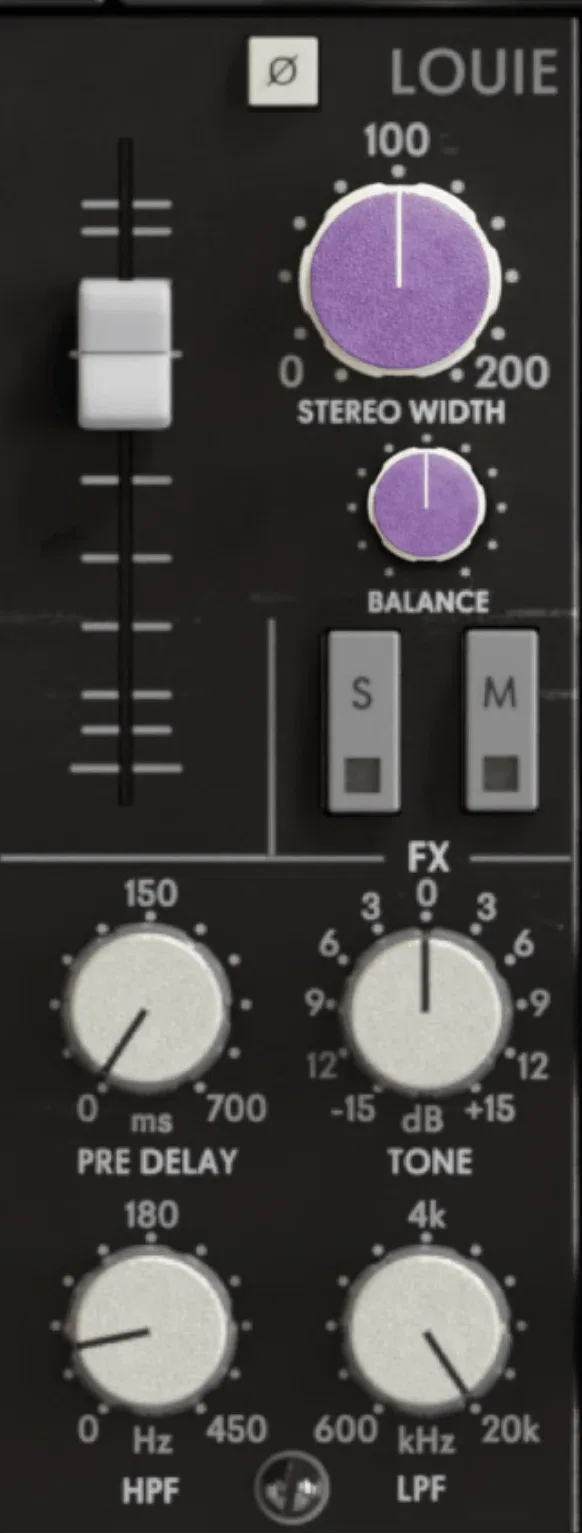
2. Louie
Binaural microphone.
Placed 4 feet (approx. 1.22 meters) away from the source.
Even if it does not work out musically, Sam has this to make ASMR roleplay videos.
The sound of standing in the room is unique to this plugin.
3. SDC (Small Diaphragm Condenser)
Stereo XY setup.
Placed 8 feet (approx. 2.44 meters) away from the source.
It goes well with hard transients while still having plenty of vibe.
4. Ribbon
Stereo Blumlein ribbon setup.
Placed 12 feet (approx. 3.66 meters) away from the source.
A reliable room mic, yet coated with layers of character.
5. LDC (Large Diaphragm Condenser)
Famous stereo XY custom Panda mic.
Placed 25 feet (approx. 7.62 meters) away from the source.
Known as an overwhelmingly high-reflectivity, ambient-specialty source.
Regarding stereo microphones, you can learn about setup methods and sounds in this video. If you find it difficult to visualize the sound, I recommend watching it once.
These are the microphones included in the plugin.
Details for microphones other than the U47 are not disclosed, but I think it is best to demo the plugin and get a feel for them.
Given that the stereo miking is limited to XY and Blumlein, it seems that Sum Pura is careful about phase.
Perhaps they are trying to ensure that center-positioned sources like snares and vocals do not become muddy.
And furthermore, in The Panda Rooms, you can perform the following detailed settings for each ambience sound.
Phase[Ø]
Phase switching
STEREO WIDTH
Adjustment of the microphone's MS balance
100 for a natural stereo sound
0 for MID only, 200 for SIDE only
BALANCE
Adjustment of LR balance
Allows control of the wet sound's positioning via LR
Solo and Mute
Microphone solo and mute
Muting unused microphones can reduce CPU load
PRE DELAY
Delays the signal input by the microphone between 0msec and 700msec
*It is easier to understand if you imagine this not as a typical reverb pre-delay, but as a knob that moves the microphone position further away from the source.
Since the speed of sound is approximately 340 meters/second, delaying by 100msec is equivalent to moving the microphone 34 meters away from the source.
TONE
A seesaw filter (≒Tilt EQ) centered at 700Hz
Allows for 15dB of boost or cut
HPF
0-450Hz high-pass filter
LPF
600Hz-20kHz low-pass filter
Combining these to build up a room sound is what
The Panda Rooms is all about. Honestly, it is quite difficult.
For the same purpose, plugins like UAD Ocean Way Studios or T-Racks Sunset Sound Studio are much more approachable.
So, you might ask why I am going out of my way to write a review and recommend it, but
The features of The Panda Rooms and suggestions for how to use them will be in the next chapter...