I first learned of Michio Hoshino through his collaboration with musician haruka nakamura, which took place during the COVID-19 pandemic.
The music played by haruka nakamura, who was born and raised in the northern region of Aomori, is imbued with a unique sentimentality—a blend of sorrow, nostalgia, and a sense of solitude as if isolated from the rest of the world.
Just like the deep, "hushed" silence that remains after fallen snow absorbs the surrounding sounds, it envelops everything. As I listen to the music and delve into its depths, I feel as though I am stepping, while still alive, into a world where I can truly sense the breath of those who are no longer with us.
In haruka nakamura's music, life and death are fused together. Therefore, boundless warmth and an irreparable sense of loss coexist there without contradiction.
Seeing the photographs Michio Hoshino took in Alaska with my own eyes for the first time, I strongly felt that there is something shared deep within the two of them, despite their different methods of expression—photography and music. Hoshino's photographs, which captured the activities of animals and plants living in the freezing lands, also depicted both the warmth born from the touch of life upon life and the cruelty of death that all living things must inevitably face, without distinction.
The "Michio Hoshino Photography Exhibition: Traveling Through Eternal Time," currently being held at the Higashiosaka City Art Center, is a retrospective that spans from records of the Alaskan village Hoshino first stepped into at age 20 to photographs taken on the Kamchatka Peninsula in Russia just before his death. Starting with the Sendai exhibition in May 2021, it has been touring across the country for many years (the Okayama exhibition will be held starting September 12 of this year).
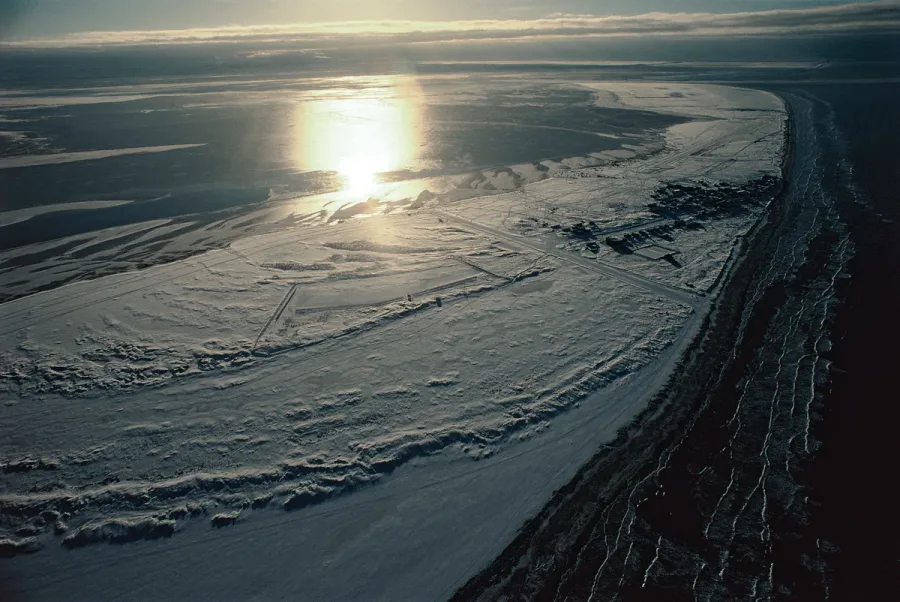
What led Hoshino to Alaska was a foreign photo book titled "ALASKA" (National Geographic Society) that he encountered at a used bookstore in Kanda when he was 19. Captivated by an aerial photograph of Shishmaref, a village where Eskimos lived, Hoshino set foot on the Alaskan land for the first time about two years later, aiming for that very village.
At the beginning of this exhibition, photographs of the village children that Hoshino took when he first visited Alaska are on display. There are children with Caucasian-like features and others with Mongoloid-like features, but all of them turned their eyes, filled with curiosity, toward the camera. Of course, the same light shone in the eyes of Hoshino, who still retained much of his boyish appearance.
Hoshino made Fairbanks, Alaska, his base of life after entering the University of Alaska at age 26. The first thing he became deeply interested in was the ecology of caribou (reindeer), especially their seasonal migration covering thousands of kilometers in the spring and autumn. The aerial photographs of the massive caribou herds are filled with a power reminiscent of a river in flood, flowing violently.
For caribou, herding was also an act of protecting their lives from predators like wolves and grizzlies. For this reason, for a newborn caribou calf, being able to run as soon as possible was literally a matter of life and death.
Among the rows of photographs of these massive caribou herds, there was one that stood out with a mysterious composition. It was a long-distance shot capturing a single caribou that had been separated from the herd.
In the center of the photograph, a caribou stands alone on the plain. Behind it, something like white mist hangs in the air, and beyond that, a new plain spreads out as if it had emerged from a completely different world. A fantastical atmosphere covers the entire frame.
It is likely that a valley-like space stretches between the caribou and the plain in the background. If you look closely, you can see some of the snow that has accumulated along the terrain falling away in a tapering line.
What this photograph implicitly indicates is the fate of death awaiting the isolated caribou. However, there is no tragic tone to it. In accordance with the laws of nature, the fragility of a single life of a caribou facing death is captured just as it is, without any staging.
Despite being a single shot that captures only a fleeting moment in the countless stories of life and death unfolding in Alaska, this photograph seemed to convey, without omission, the magnificent and harsh natural conditions of the Far North, the preciousness of each individual life lived there, and the inseparable connection between the two.
Even before he became interested in Alaska, Hoshino had always held a longing for the world of the North.
Perhaps it is because he had cherished a special feeling for them since he was small. Many of the polar bear photographs, which can be called Hoshino's masterpieces and are also exhibited in this exhibition, capture their adorable figures, making one feel a spiritual closeness to the photographer.
It is said that there are many stories in old Eskimo folklore about anthropomorphized polar bears. The polar bears Hoshino photographed also have gestures that look as if they are relaxing or playing like humans. Looking at the photos, I even feel as if I can strangely hear the conversations being exchanged between the animals. And I find myself becoming so warm-hearted that I almost forget these photos were taken in the Arctic.
Also, in contrast to other animals, polar bears (and grizzlies) do not act in herds, but alone or in small groups of two or three. Polar bears are apex predators in the food chain and are also called the "Kings of the Arctic." In the venue, there is a photograph capturing one with its eyes gently closed, its paws with sharp claws softly folded, and its face turned toward the light. That figure looks as if it possesses the composure befitting a king, and also like a humble elder deep in thought.
Leaving the polar bear photographs behind and entering the next gallery, the atmosphere shifts completely from the animal photography seen until then, with a long line of photos capturing the people living in Alaska and the Alaskan seasons. Hoshino's interest gradually shifted from the animals living in Alaska to the people who reside there and their customs, eventually taking on a new theme: the exploration of the 'relationship between nature and humanity.'
The exhibition concludes with a new journey that became an unfinished project for Hoshino: tracing the roots of Alaska's hunter-gatherer peoples. What kind of relationship have they formed with nature? Seeking clues to this, Hoshino crossed the Bering Strait, traveling from the western edge of the North American continent to the eastern edge of the Eurasian continent.
This new project remained 'unfinished' partly because Hoshino's life was suddenly cut short at the age of 42 due to a brown bear accident on the shores of Lake Kurile on the Kamchatka Peninsula, which he had visited for photography.
Furthermore, this project can be called 'unfinished' because the theme Hoshino raised—the 'relationship between nature and humanity'—is a pressing and relevant topic for us today, as we live through the era of a pandemic and worsening climate change.
Climate change is also affecting the Arctic ecosystem, such as through the reduction of sea ice. In connection with this, Nono Toyoshima, the curator in charge of this exhibition at the Higashiosaka City Art Center, shared an interesting story.
Polar bears and grizzlies, which are apex predators in the Arctic food chain, lived in different habitats. However, in recent years, hybrid species of polar bears and grizzlies have been discovered. While there are various theories, one view is that as a result of having to change their habitats due to the effects of climate change, the two species, which were never meant to meet, have interbred.
Furthermore, standing in front of Hoshino's photographs of Alaskan nature, Toyoshima explained the following.
Finally, the title of this exhibition is 'Traveling Through Eternal Time.' Since the exhibition displays Hoshino's photographs of Alaska, it would not seem contradictory to express it as 'Traveling through Alaskan nature.'
What emerges when we look at Hoshino's photographs while being conscious of the word 'time'? What I realized is that in Alaska, there flows something that could be called 'primordial time,' which is not governed by clocks or calendars, but felt through the flow and cycles of nature.
As Hoshino often mentioned in his essays, the seasons in Alaska change completely 'like turning a page.' Unlike time divided equally by fixed rules, there seems to be a non-linear time flowing there that accelerates or decelerates according to the rhythms of the weather and the ecosystem.
Thinking about the photography in Alaska, which involved many contingencies, I could not help but imagine how much distance Hoshino walked and how long he waited before encountering the landscape in each of these photographs. I think it must have been a time that was almost like a prayer.
The photographs taken and the words spun by Hoshino, who placed himself in primordial time, are overflowing with the reality of life to the utmost degree. There, the cycle of life repeats within the flow of eternal time. It seemed to me that 'traveling through eternal time' could also be read as 'traveling through eternal life.'
*
References
・Michio Hoshino, "New Edition: Traveling Through Eternal Time" (Crevis, 2022)
・Michio Hoshino, "Traveling Tree" (Bunshun Bunko, 1999)
・"Coyote No. 89 Special Feature: Michio Hoshino, The Dreaming Journey" (Switch Publishing, 2026)