Translated from the following video.
9. Miquella's Haligtree
Miquella's Haligtree is one of the late-game dungeons and is one of my favorite areas in the game. The Haligtree itself is 1,165m tall, which is only about a quarter of the height of the Erdtree. However, this is still 10 times larger than the world's tallest coast redwood, known as Hyperion.
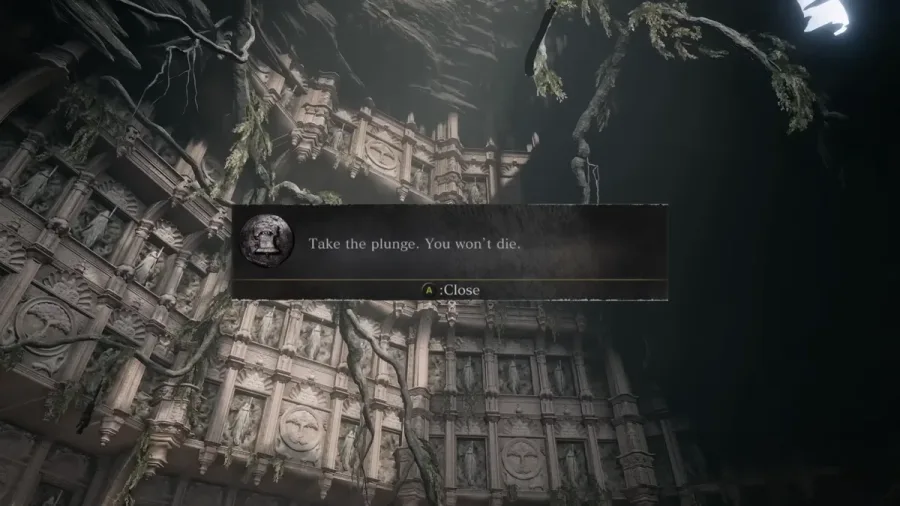
This dungeon begins around the middle of the Haligtree. Players descend approximately 600m while fighting enemies to confront Malenia at the very roots of the tree. One way to skip this process is to jump off. The Haligtree has a hollow structure, and Malenia is waiting at the bottom. If you use a cheat to prevent fall damage, you will find that there is a spot where you can jump down 160m right after leaving the 'Elphael Inner Wall' Site of Grace. Once you land, Malenia is right there.
Because this dungeon has such an intricate structure, measuring its area was truly difficult. Based on my best estimate, the explorable area is about 0.1 sq km, which is about the same size as Crumbling Farum Azula, and only about 1/5th of the area occupied by Radahn's battlefield alone. It's no wonder Malenia held a grudge against Radahn. It's a bit selfish for Radahn to have a space this large when his half-sister is literally living inside a tree.
10. Underground Areas
Finally, we can include the underground areas in our calculations.
The Siofra River is the largest of the three underground areas, with an explorable range of about 0.5 sq km. The Siofra River is also the deepest point in the Lands Between. The Siofra River Well is located more than 500m below a relatively low point in Limgrave. In other words, when the lift arrives, the player is nearly 500m below sea level.
The area right next to the lift is the deepest point in the game, at exactly 492m below sea level. This depth is comparable to building a 100-story underground skyscraper. Strictly speaking, however, there is an even deeper place in the game's geography: the Ainsel River.
The area of the Ainsel River is about half that of the Siofra River, and it includes the Eternal City of Nokstella and the Lake of Rot. By entering a stone coffin, players can cross the abyss at the end of the Grand Cloister to reach the location of Astel, Naturalborn of the Void. The bottom of this abyss is nearly 600m below sea level, which is technically deeper than the Siofra River, but it is not an explorable area.
I initially thought that the deepest place in the game must be Deeproot Depths. This area, the smallest of the three underground regions, is located at the base of the Erdtree, and it is hidden very deeply, not just in name. As you know, you can easily be sent to Deeproot Depths by coffin, but this is essentially a teleport, and it doesn't tell you exactly where it is underground.
Instead, you can measure its depth by following an insanely long and twisted path from the surface. To do this, you must descend into the Subterranean Shunning-Grounds from the first entrance found by going down the well in the city of Leyndell, Royal Capital, and navigate the maze woven by the Leyndell sewers.
Then, you must take a long lift to the Cathedral of the Forsaken, find a hidden door behind the cathedral, and jump across platforms while descending a hole. The bottom of the hole leads to the path to the Three Fingers' door, and beyond a hidden door there, another hidden door exists. Only after passing through that can you finally enter Deeproot Depths. The deepest point is another 200m down, and surrounded by the roots of the Erdtree, the journey of descending 615m underground finally ends.
However, the starting point in Leyndell, Royal Capital is about 1km above sea level. At that stage, you haven't even reached sea level, let alone the roots of the Erdtree, so in reality, Deeproot Depths is located at the same height as Liurnia of the Lakes. In short, it's a trick. But it is a very convincing trick. The path to Deeproot Depths is so complex and hidden that by the time you reach the bottom, you really feel like you have arrived at the roots of a hidden world.
11. Total Area
This survey started with the figure of 88 sq km (110 sq km if you include the underground), and by excluding parts that didn't fit the measurement, I narrowed it down to about 28.5 sq km. Then, by carefully measuring the explorable range, I can finally estimate the playable area in Elden Ring.
That area is approximately 13.5 sq km. This is even smaller than 1/6th of the initial figure. However, this number does not include the area of the 18 catacombs, 20 caves, and 5 hero's graves, nor does it include some legacy dungeons like Stormveil Castle or the Subterranean Shunning-Grounds. But in terms of area, these closed spaces are just rounding errors compared to the massive open world. If we are being quite generous, we could add the approximately 1.5 sq km of these spaces to the total area. That would bring it to a nice, round 15 sq km. Compared to the real world, this is about the same size as Shibuya Ward, one of the central areas of Tokyo.
Now, in terms of gameplay alone, the Elden Ring map is much smaller than the approximately 80 sq km of Breath of the Wild or GTA 5. In terms of area, it is actually closer to the scaled-down New York in 'Marvel's Spider-Man 2'.
The fact that Elden Ring feels like a very huge game despite actually being smaller than similar games is, I think, further proof of the developers' skills. Besides, bigger is not necessarily better. This also became clear in parts of the DLC area. While it had visual impact, my personal opinion is that it lacked actual playable content.
12. Shadow of the Erdtree
Oh right, about the DLC. If you've stuck with me patiently this far, let's take a look at the Realm of Shadow.
Following the same method as mentioned earlier, the map of the Realm of Shadow is (by simple calculation) around 29 sq km. This figure includes the beautifully depicted Scadutree, but to get a more accurate area, we need to cut out the Scadutree along with the sea. Thus, the more accurate area becomes approximately 8 sq km. Compared to the real world, it is about the same size as downtown Manhattan.
Many people noticed right after the game's release that the center of the perfect hexagon formed by the six Divine Towers of the Lands Between lies in the suspicious, cloud-covered area right in the middle of the inner sea. And there were many theories that the upcoming DLC area would be something carved out of the Lands Between to fit into this inner sea.
And in the Realm of Shadow, the Suppressing Pillar, a place described as the "center of the Lands," was actually found. What happens if we overlay the DLC map using the Suppressing Pillar as the center of that hexagon? Well, it doesn't work very well. Even if you rotate or shift it, it doesn't fit very neatly. The Realm of Shadow is too large to fit into the inner sea.
Hidetaka Miyazaki has actually admitted in interviews that the Realm of Shadow was once part of the Lands Between. However, it was formed from the Lands Between through some process, and it is not something that simply emerged from the inner sea, nor does it accurately reflect the world map.
Another interpretation concerns the giant hole in the center of the Lands Between. That hole has existed since the early concept art stage, and it is said to have been created by a massive explosion that occurred in the center of the Lands Between. Such hollow structures can be seen on islands around the real world, and in reality, these are caused by caldera volcanoes. However, the impact of a meteorite must surely leave similar scars on the earth, which is why it is said that "The Greater Will once sent a beast to the Lands Between along with a golden meteor."
13. DLC Map Area and the Abyssal Woods
Let's return to the DLC map. After removing the unreachable areas, it turned out that most places on the map are actually reachable. Major exceptions include Jagged Peak and others. The total explorable area is around 5.5 sq km, which is not far from the 8 sq km figure I gave at first, and is larger than 1/3 of the main game's map. This is an exceptional size for a DLC. Even if, as I repeat, it is unfortunate that some areas have become hollow spaces.
Conversely, what I liked was the vertical scale of this DLC. In the Lands Between, to complete the main quest, you must follow a journey of climbing. It is a journey that starts from Limgrave, climbs to Liurnia of the Lakes, the Altus Plateau, and then to the Mountaintops of the Giants. On the other hand, the adventure in the Realm of Shadow starts from a relatively high place, and many of the explorable areas exist deep below. These places are often clearly visible below, but because of the steep heights, they are designed so that you cannot reach them immediately.
And the vertical scale of this map is mind-blowing. In particular, the Abyssal Woods is located at a place that lives up to its name, at 570 meters below sea level. This is even deeper than the Siofra River in the main game, but the Abyssal Woods do not even reach the underground. They are just a very deep valley floor on the surface. For reference, the lowest place on earth in the real world is the Dead Sea, and that is only 430 meters below sea level.
From the place where Miquella's Cross is, the ground of the Abyssal Woods is exactly 1,030 meters below. Therefore, as a point connecting two explorable areas, this is the place where you can make the longest fall in the game. You can try jumping off here too, but because you fall for so long, you cannot reach the woods just by cheating to avoid fall damage. This is because after 13 seconds of free fall, the game automatically kills the player as a fail-safe.
14. The Highest and Lowest Points on the DLC Map
However, even the Abyssal Woods are not the lowest point in the Realm of Shadow. This is because there is a "great hole" at the southern end of the map. Inside the hole, a massive underground cavern filled with mysterious boat-shaped stone coffins spreads out. At the very bottom of this hole is the Garden of Deep Purple, where Saint Trina, who has fallen into a deep sleep, is abandoned.
The Garden of Deep Purple is the deepest point in the entire game, reaching 740 meters below sea level. What is interesting is that while Saint Trina is here, her other half, Miquella, is at the top of Enir-Ilim, in front of the Gate of Divinity. That is the highest point reachable within the DLC.
But even higher is Jagged Peak, the highest peak in the Realm of Shadow, boasting 1,655 meters above sea level. However, the player cannot climb to the very top of this one.
Most of Jagged Peak is occupied by the arena where you fight Bayle the Dread, which is located exactly in the center of the mountain. We are told that Bayle the Dread is the arch-nemesis of Dragonlord Placidusax, and perhaps reflecting this, there is an interesting commonality between the places where these two dragons reside. Although Bayle's arena is smaller, the size of this entire stadium-like structure is exactly the same as the place where you fight Placidusax. Some of the details are also surprisingly similar; for example, the hollows around Bayle's arena mimic the appearance of the beastman graves in Farum Azula.
Speaking of dragons, I cannot fail to mention the drake corpse near the foot of Jagged Peak. This drake is even larger than Gransax of Leyndell and is (what was) the largest creature in the entire game. This corpse is so large that it is counted as part of the terrain, and as such, it even appears on the map.
The area occupied by the corpse is 34,000 square meters, which is roughly the size of five soccer fields. By comparison, the Fire Giant, one of the largest bosses in the game, is only about as big as the horn on the drake's head. Meanwhile, the total length of the drake's head is about 70 meters, equal to the height of a 20-story building.
The largest thing in the DLC, and indeed in the entire game, is, of course, the solemnly towering Scadutree. In fact, the Scadutree appears to be made of two trees, with one tree spiraling around the trunk of another straight tree. This spiral theme seems to reflect what is seen in the Hornsent and Enir-Ilim.
The Scadutree is about the same size as the Erdtree, but thanks to some of its dead branches standing quite high, its total length is 4,870 meters. This is 400 meters taller than the Erdtree and is about the same height as Mont Blanc, the highest peak in Western Europe.
14. The largest LEGO set in history
However, these trees are so large that I thought it would be difficult to compare them to anything in the real world. But we should be able to scale them down to a more familiar size. For example, how about replacing the Lands Between with a LEGO set?
The Tarnished's height is 1.68 meters, and a standard LEGO figure is 4 cm. In other words, if you use the Tarnished as a reference for this figure, the LEGO set should be usable as a 1:42 scale. For reference, at this scale, Dragonlord Placidusax's massive arena would be about the size of a large backyard pool. The door to enter the Erdtree is just a little narrower and taller than a normal door.
If you were to build the entire map out of LEGO at this scale, it would be by far the largest LEGO set in history. Even without the ocean, it would probably require hundreds of billions of LEGO bricks and would take up several entire city blocks. How big would the Erdtree be in this unparalleled LEGO set? Do you remember the 116-meter-tall tree called Hyperion that I mentioned earlier? This should be just about the height of the Erdtree and Scadutree built out of LEGO.
It is astonishing that even when scaled down to 1/42, these great trees are the same size as the largest trees in the real world and are larger than the Statue of Liberty or Big Ben.
Source channel: