The Tenno Sho (Autumn), the Japan Cup, and the Arima Kinen.
In the history of Japanese horse racing, only two horses have ever won all three autumn G1 races.
The last to achieve this was Zenno Rob Roy in 2004. Twenty-two years have passed since then, and while many legendary horses like Almond Eye and Equinox have appeared, this record remains unbroken.
When it comes to debating the greatest horse of all time, racing fans can talk for hours. The fact that everyone has a different opinion on the greatest horse is practically a traditional art form in the racing world.
However, even for those candidates for the greatest of all time, the Autumn Triple Crown is a different story. It is not just about winning all three G1 races; even simply entering all three is no easy feat.
Why is it so difficult?
Ahead of the Tenno Sho (Autumn) on November 1, 2026, we will look back at the footsteps of the two horses that achieved the Autumn Triple Crown and the legendary horses that fell short of this feat.
Tracing that history reveals the difficulty of the Autumn Triple Crown, which cannot be dismissed simply by saying that a strong horse wins three times.
What is the Autumn Triple Crown in the first place?
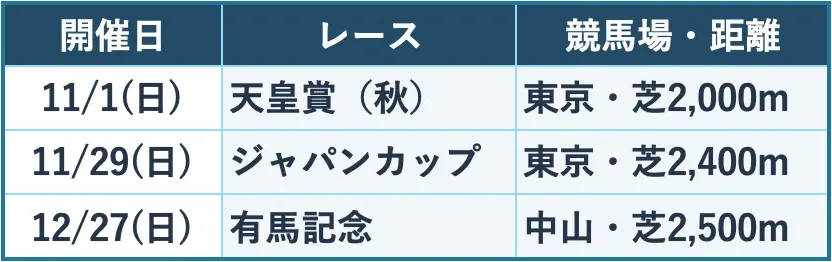
The Autumn Triple Crown is the feat of winning all three G1 races held in the same year: the Tenno Sho (Autumn), the Japan Cup, and the Arima Kinen.
The schedule for 2026 is as follows.
All three are the highest-level G1 races in the country, but the abilities required are not the same.
The Tenno Sho (Autumn) is 2,000 meters on the Tokyo turf. It demands speed and instantaneous power over a middle distance.
The Japan Cup is 2,400 meters on the Tokyo turf. It takes place on the same stage as the Japanese Derby and is an international race that includes entries from overseas.
And the final race, the Arima Kinen, is 2,500 meters on the Nakayama turf. In addition to handling the tight corners and steep slopes, it is crucial to maintain good condition until the end of the year.
Just because a horse won twice in Tokyo does not mean it will win at Nakayama. As the distance increases and the racetrack changes, a horse may not be able to demonstrate the same strength it had before.
Incidentally, unlike the Classic Triple Crown of the Satsuki Sho, the Japanese Derby, and the Kikuka Sho, three-year-olds can also challenge the Autumn Triple Crown. Although it is called the "Autumn Triple Crown," it is not limited to horses aged four and older.
The system to award prize money to horses that win all three races began in 2000. These G1 races, each with a long history, were linked together as one major challenge.
And in the very year the system began, the first winner was born.
The two heroes who achieved the Autumn Triple Crown
2000 | T.M. Opera OThe first horse to achieve the Autumn Triple Crown for older horses was T.M. Opera O.
In 2000, T.M. Opera O achieved an overwhelming record that remains in the history of Japanese horse racing.
The Kyoto Kinen, Hanshin Daishoten, Tenno Sho (Spring), Takarazuka Kinen, Kyoto Daishoten, Tenno Sho (Autumn), Japan Cup, and the Arima Kinen.
Eight races, eight wins in a single year. Moreover, five of those wins were G1 races, making it a completely undefeated year.
From the Tenno Sho (Spring) to the Arima Kinen at the end of the year, he won every G1 race for older horses at middle to long distances. He did not lose a single race throughout the entire year.
After winning his first race of the autumn, the Kyoto Daishoten, he also won the Tenno Sho (Autumn). In the following Japan Cup, he held off Meisho Doto by a neck, and finally headed into the Arima Kinen while still undefeated for the year.
However, the final race was by no means an easy one.
The Arima Kinen on December 24, 2000. He was positioned in the back during the race, and even at the crucial moment, he found himself in a difficult situation surrounded by the pack.
Even in the final stretch, the path ahead did not open, and perhaps everyone thought the winning streak had come to an end. Even so, once T.M. Opera O found a slight opening, he split the pack and surged forward.
And in the end, he edged out Meisho Doto by a nose to win.
Along with the record of eight wins in eight races for the year, he achieved the first Autumn Triple Crown for older horses in history.
In the saddle was 23-year-old jockey Ryuji Wada. The record built by the young jockey and the "End-of-the-Century Champion" still shines brightly in the history of Japanese horse racing.
It is often said that there is no such thing as a sure thing in horse racing. Of course, that is likely true. However, the 2000 T.M. Opera O kept winning as if to challenge that very statement.
However, I do not want to forget that the final Arima Kinen was won by a nose.
Even for a legendary horse that left behind such an overwhelming annual record, the final step to achieving the Triple Crown was by the narrowest of margins.
2004 | Zenno Rob RoyFour years after T.M. Opera O, the second Autumn Triple Crown winner for older horses was born.
It was Zenno Rob Roy.
The 2004 Zenno Rob Roy also won all three autumn G1 races, but the path leading up to that was in contrast to T.M. Opera O.
He finished 2nd in the Tokyo Yushun (Japanese Derby) and 4th in the Kikuka Sho. In the following year, 2004, he finished 2nd in the Tenno Sho (Spring) and 4th in the Takarazuka Kinen, continuing a streak of races where he just couldn't quite win the G1 title.
His ability was high. Yet, the G1 title remained out of reach. A horse that had been evaluated that way completely transformed in the autumn.
The turning point was the Tenno Sho (Autumn) on October 31, 2004.
In the saddle was the renowned French jockey Olivier Peslier. Moving powerfully from the middle of the pack in the home stretch, he overtook Dance in the Mood to secure his first G1 victory.
The momentum did not stop there.
In the following Japan Cup, he won by three lengths over Cosmo Bulk, who had entered from the local NAR circuit. Then, in the Arima Kinen, he caught the front-running Tap Dance City in the stretch to complete a sweep of the three autumn G1 races.
The winning time for this Arima Kinen was 2:29.5, a stunning record that stood as the course record at the time.
Thanks to his performance that autumn, Zenno Rob Roy was also selected as the 2004 Horse of the Year.
A horse that had been winless in G1 races until the spring had captured three G1 titles in just two months that autumn, rising all the way to become Horse of the Year.
T.M. Opera O, who kept winning throughout the year, and Zenno Rob Roy, who surged to the top in a single autumn burst.
Although their paths to achievement differed, what the two horses had in common was winning three G1 races under different conditions in a short period.
And as of the end of 2025, no triple crown winner has emerged to follow these two.
Great horses that fell short of the Triple Crown
To understand the difficulty of the Autumn Triple Crown for older horses, one must look not only at the two who achieved it, but also at the great horses who fell short.
What is important here is to distinguish between horses that ran in all three races but could not win them all, and horses that did not run in all three races to begin with.
Reflecting on this distinction makes the difficulty of the Triple Crown record even clearer.
1999 | Special WeekThe year before the bonus system began, there was a horse that came within a step of the autumn royal road. That was Special Week.
After winning the 1999 Tenno Sho (Autumn), he went on to win the Japan Cup. Had he won the year-end Arima Kinen, he would have completed a sweep of the three races later known as the Autumn Triple Crown for older horses.
However, waiting at the end was Grass Wonder.
The Arima Kinen on December 26, 1999. The two horses engaged in a fierce duel in the stretch, crossing the finish line almost neck and neck.
The result was Grass Wonder in first place and Special Week in second.
The difference was a mere nose.
Had it won this race, it would have left behind the historic record of three consecutive G1 victories in the autumn.
However, losing by a nose does not significantly lower Special Week's reputation. Rather, its legendary battle with Grass Wonder remains one of the most famous scenes in horse racing history.
It did not reach the record of the Triple Crown. Even so, it remains vividly in the memories of horse racing fans.
It is not only the horses that achieve the record that remain in history.
2017 | Kitasan BlackKitasan Black in 2017 was also a great horse that ran in all three autumn races.
The Tenno Sho (Autumn) was held on a heavy track due to heavy rain. It managed to win under tough conditions, but in the following Japan Cup, it finished third behind Cheval Grand.
Nevertheless, it achieved a magnificent victory in the final Arima Kinen, closing out its career with a G1 win.
Its autumn results were 1st, 3rd, and 1st.
It also won the Osaka Hai and the Tenno Sho (Spring) in the spring, making for a stellar record of four G1 wins in a single year.
Even winning two out of the three autumn races does not make a horse a Triple Crown winner. A single defeat closes the path to the record.
Kitasan Black's record also speaks to the difficulty of continuing to win.
2020 and beyond | Great horses that did not aim for the Triple Crown, and those that could notAmong the great horses of recent years, there are examples of those that won multiple autumn G1 races but did not run in all three.
Almond Eye won both the 2020 Tenno Sho (Autumn) and the Japan Cup consecutively before retiring. Equinox also achieved two consecutive wins in 2023 before ending its racing career.
Meanwhile, Efforia in 2021 and Equinox in 2022 achieved the double of the Tenno Sho (Autumn) and the Arima Kinen. They did not run in the Japan Cup, achieving results with their respective rotations.
And, particularly regrettable is the case of Do Deuce in 2024.
Having won both the Tenno Sho (Autumn) and the Japan Cup, it was aiming to become the third horse in history to achieve the Triple Crown in its retirement race, the Arima Kinen.
However, right before the race, lameness in its right foreleg was discovered, and it was scratched. The final challenge that fans had been waiting for ended without it ever entering the gate.
Looking at it this way, even among those who "failed to achieve the Triple Crown," the circumstances vary.
Some horses challenged all three races and were defeated, while others targeted specific races. And there were those who intended to challenge but were forced to give up due to the horse's condition.
As horse racing fans, we can't help but wonder.
"What if Almond Eye had also run in the Arima Kinen?"
"What if Equinox had run all three autumn races?"
"What if Do Deuce had been able to run in the final Arima Kinen?"
The debate over the strongest horse could go on for hours, but unfortunately, there is no entry for "probably would have won" in the official horse racing records.
And here lies another difficulty in the record of the Autumn Triple Crown for older horses.
It is difficult not only to win the three G1 races, but to challenge them in the first place.
Why is the Autumn Triple Crown for older horses so difficult?
Looking at the footsteps of legendary horses, there are considered to be three main reasons for the difficulty of the Autumn Triple Crown for older horses.
Different aptitudes are requiredFirst is the difference in aptitude required for the three races.
The Tenno Sho (Autumn) is 2,000m on the Tokyo turf, and the Japan Cup is 2,400m on the Tokyo turf. Although they are at the same Tokyo Racecourse, a 400m increase in distance changes the flow of the race, and the stamina and positioning required are different.
Furthermore, the final Arima Kinen is 2,500m on the Nakayama turf. It requires different abilities, such as handling tight corners and steep slopes, compared to Tokyo Racecourse.
A horse that showed an overwhelming finishing kick in Tokyo is not guaranteed to run the same way in Nakayama. Conversely, whether a horse strong in Nakayama can demonstrate its power on the long straight of Tokyo is another matter entirely.
To win all three races, one needs not only simple speed and stamina, but also the ability to adapt to different courses and race developments.
High ability is not enough; maintaining condition is also necessaryThe three races in 2026 are all held at four-week intervals.
A horse that has given its all in a G1 must fight the top class again four weeks later, and then be expected to achieve the best result again four weeks after that.
Of course, the suitable racing interval varies depending on the racehorse, but it is not easy to maintain high performance three times in a short period.
Having high ability and being able to demonstrate that ability every time are not the same thing.
In fact, Special Week in 1999 and Kitasan Black in 2017 both ran in all three autumn races and won two of them, but they could not reach the Triple Crown.
Even if a horse has the ability to win, various conditions such as the competition, race development, and track conditions must align.
Moreover, since top-class horses from both Japan and abroad compete in every race, it is never an easy task.
In modern horse racing, it is not necessary to run in every G1 raceAnother point that cannot be overlooked is the rotation in modern horse racing.
In recent years, it is not uncommon to select races based on a horse's aptitude and condition, and to adjust their schedule to focus on specific targets. High-prize races overseas have also become an option, and running all three autumn races in Japan is no longer the only royal road.
As with Equinox in 2023, there is also the option to retire after winning both the Tenno Sho (Autumn) and the Japan Cup, leaving behind a sufficient track record.
Also, as with Do Deuce in 2024, there are times when a planned entry must be abandoned due to the horse's condition.
For a racehorse, there is not only the race in front of them, but also their subsequent racing career and their future as a stallion or broodmare.
The high value of aiming for the Autumn Triple Crown for older horses and whether it is the best course of action for every horse are separate issues.
Thinking about it this way, the achievements of T.M. Opera O and Zenno Rob Roy take on a different weight.
The two horses did not just win three G1 races. They ran the autumn royal road to the very end and stood at the pinnacle of all of them.
A 300 million yen bonus for achieving the Triple Crown. Even so, it is not a challenge that can be taken lightly
There is another interesting mechanism for the Autumn Triple Crown for older horses.
That is the JRA bonus system.
The system was revised starting in 2025, and if a horse wins all three races—the Tenno Sho (Autumn), the Japan Cup, and the Arima Kinen—in the same year, a bonus of 300 million yen is set for domestically bred horses and 150 million yen for foreign-bred horses.
Previously, it was 200 million yen for domestically bred horses and 100 million yen for foreign-bred horses, so this is a significant increase.
This bonus is paid to the owner of the horse that meets the conditions, separate from the regular race prize money. For domestically bred horses, there is also a mechanism where a bonus is paid to the breeding farm that meets certain conditions.
Furthermore, starting in 2025, a bonus has also been established for horses that win any three of the six races—the Osaka Hai, Tenno Sho (Spring), Takarazuka Kinen, Tenno Sho (Autumn), Japan Cup, and Arima Kinen—in the same year.
This is 200 million yen for domestically bred horses and 100 million yen for foreign-bred horses. However, this bonus is not added on top if the Spring Triple Crown or Autumn Triple Crown for older horses is achieved.
This system reflects the JRA's aim to encourage top horses to actively participate in domestic G1 races for older horses over middle to long distances.
Looking at the prize money alone, it is certainly a dream-like prospect.
However, while increased prize money provides more reasons to take on the challenge, whether a horse can actually do so is a different matter.
The 300 million yen prize is attractive, but considering the fatigue of the racehorse, their suitability, and the impact on their future, the decision to enter cannot be based on prize money alone.
In fact, from the start of the prize money system in 2000 until the end of 2025, only two horses have achieved the Autumn Triple Crown for older horses.
Even with the system in place and the prize money increased, the difficulty of winning all three G1 races remains unchanged.
If anything, the fact that no horse has achieved it despite the clear goal of the prize money only highlights how difficult it is.
Will a third Triple Crown winner be born in 2026?
T.M. Opera O in 2000 and Zenno Rob Roy in 2004.
These are the only two horses to have achieved the Autumn Triple Crown for older horses by the end of 2025.
2026 marks 22 years since Zenno Rob Roy's achievement. Many great horses have appeared in Japanese horse racing, showing spectacular performances in the Tenno Sho (Autumn), the Japan Cup, and the Arima Kinen.
There is no doubt about the strength of recent greats like Almond Eye, Equinox, and Do Deuce.
Even so, the record of winning all three races in the same year remains unbroken for a long time.
Of course, whether a horse has achieved the Autumn Triple Crown does not solely determine its greatness. Racing conditions and rotations vary by era, and there are other factors such as opponents and overseas expeditions.
The greatness of a horse that achieved the Triple Crown and the status of one that did not are entirely separate matters.
However, looking back at history, the record of the Autumn Triple Crown feels like it carries more meaning than just winning three G1 races.
The ability to win on different stages, the difficulty of maintaining peak condition over a short period, and the ability to enter all three races.
Only when all those conditions are met and the horse continues to win until the end can it be achieved.
Now, November 1, 2026. The gates will open for the Tenno Sho (Autumn) at Tokyo Racecourse.
It is not yet known whether the winner of this race will head to the Japan Cup and then the Arima Kinen.
Even so, as horse racing fans, we can't help but wonder.
"Could this horse possibly go all the way to the Triple Crown?"
I would like to enjoy this year's Tenno Sho (Autumn) from that perspective as well.
Can the winner handle the Tokyo 2,400m turf? How will they fare at the Nakayama 2,500m turf? Is their condition good after the race? And will they head to the next Japan Cup?
By paying attention not just to the outcome of each race, but also to the rotation that follows, you should be able to enjoy the autumn road for older horses even more deeply.
Will the third Autumn Triple Crown winner in history be born? Or will the great achievements of T.M. Opera O and Zenno Rob Roy be passed down to next year once again?
The horse that clears the first hurdle to the Triple Crown will be decided on November 1st.
And the conclusion of that challenge will be revealed at the Arima Kinen on December 27th.
Will a new name be carved into a record that has remained unbroken for 22 years? I would like to keep an eye on this story that continues until the end of the year in the autumn of 2026.
Thank you for reading until the end.
If this article served as an opportunity to look back on the history of the Autumn Triple Crown, I would be happy if you could like or follow.
Now, let's look forward to the Tenno Sho (Autumn) on November 1st.
PR | The Arima Kinen is just around the corner
Will the great achievement, unseen for 22 years, finally be born this year?
Let's witness the challenge of the champions that continues until the end of the year together.
Thank you for reading until the end. If you found this article interesting, I would be happy if you could like and follow!