This time, using the CrinEar Reference as a starting point, I would like to re-examine the terms "neutral" and "standard" in IEMs more carefully than ever before.
Rather than simply talking about this model as an "IEM with good sound," I believe it is a type of product whose perspective changes if you first organize why it bears the name Reference and why there is meaning in advocating for "flat" or "neutral" at this particular time.
Therefore, in the first half, I will organize how the definition of neutral in IEMs has changed by following the progression of Etymotic ER4, Harman Target, IEF Neutral, B&K Type 5128, and JM-1.
If you only want to read my impressions of listening to the CrinEar Reference, please skip to "I Actually Listened to the CrinEar Reference" from the table of contents.
Introduction: The Difficulty of Discussing "Neutral" in IEMs
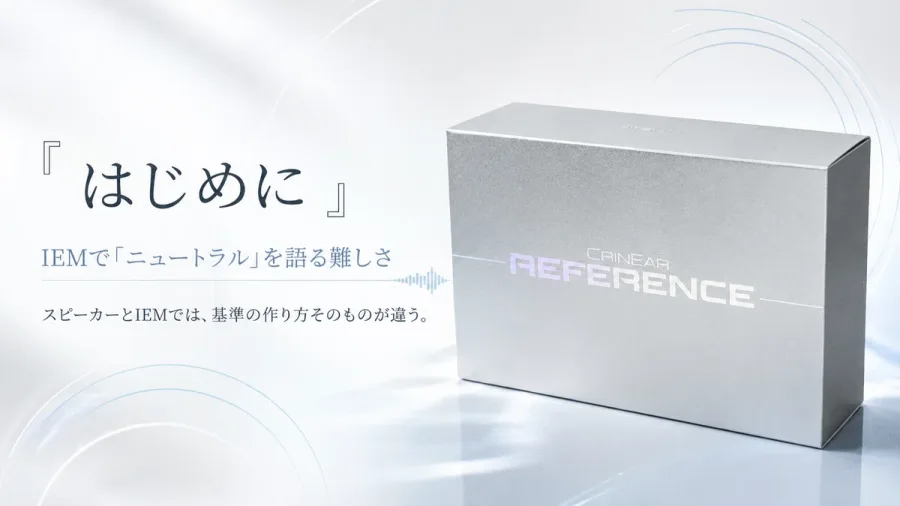
The term "neutral" in earphones, especially in IEMs, is more difficult to explain than in speakers.
In the case of speakers, the standard is relatively easy to understand.
You listen to well-designed speakers in a well-tuned room. The sound travels through space, is affected by reflections from walls and floors, the high frequencies naturally settle down due to distance, and the low frequencies gain a physical presence you can feel.
In other words, the speaker sound that we perceive as "natural," "flat," or "accurate" is not a perfect straight line when viewed at the ear.
It has a natural slope that gradually decreases toward the high frequencies.
On the other hand, IEMs deliver sound directly into the ear.
It does not pass through a room.
The influence of the pinna is also different from speakers.
Head-related effects, distance, spatial reflections, and the physicality of low frequencies are also significantly different.
Therefore, even if you aim for a flat measurement in an IEM, it will not result in the natural sound that humans hear when listening to speakers.
This is where the difficulty of "neutral" in IEMs lies.
Neutral in IEMs does not simply mean less bass.
It does not mean the graph is close to a straight line.
Essentially, it is a question of how close you can get to the timbre, sense of distance, and frequency balance of listening to speakers naturally, using a small acoustic device that plays inside the ear.
And until reaching this way of thinking, the definition of "neutral" has wavered many times in the world of IEMs.
The Era When "Less Bass = Neutral"
In the early days of the general earphone market, the term "neutral" was used loosely.
Especially in the era when headphones and earphones that strongly pushed bass became common, anything that didn't have strong bass was easily called "flat," "monitor-like," or "neutral."
However, that is a dangerous standard from today's perspective.
Things where the midrange is too forward just because there is less bass.
Things where the high frequencies are too bright and piercing.
Things where the sound is thin, hard, and prone to listening fatigue.
Such earphones were treated as neutral simply because they were not 'bass-heavy'.
The problem of this era is that neutral was not used as 'natural reproduction,' but rather as a collective term for sounds that are not bass-heavy.
The Era of Etymotic ER4 and the Diffuse Field
An essential presence in the history of neutral in IEMs is the Etymotic ER4.
The Etymotic ER4 appeared in the early 1990s and is still discussed as a historical reference device as an IEM based on the diffuse field. Stereophile also introduced the ER4S / ER4B as early commercial universal IEMs, and the ER-4S is described as a diffuse-field-response in-ear transducer.
Simply put, the Diffuse Field is a standard based on a sound field where sound reaches the ears equally from all directions.
By conforming to this standard, Etymotic aimed for measurement accuracy.
This philosophy was extremely important.
It demonstrated that IEMs could be designed based on acoustic theory and measurement rather than just being small earphones.
However, there were also problems with the Diffuse Field type of neutral.
Humans do not usually listen to music in an anechoic chamber.
Speakers play in a room, low frequencies have physicality, and high frequencies naturally settle due to distance and reflections.
From that perspective, the ER4-style Diffuse Field neutral is very clear and accurate, but it lacks low-frequency volume, and the mid-to-high frequencies tend to sound forward.
In other words, while the ER4 is still an important historical reference device, its goal is different from a 'speaker-like natural neutral' in the modern sense.
It was a neutral that prioritized measurement accuracy.
The Emergence of the Harman Target
The next major trend was the Harman Target.
Harman's research did not just look for a theoretically flat sound, but investigated what kind of frequency balance actual listeners prefer.
What is important here is that Harman viewed 'neutral' not as mere measurement flatness, but as the average preference that many people feel is a natural and good sound.
This was a major step forward.
Especially in IEMs, the Diffuse Field standard often feels like it lacks bass.
The Harman Target provided clear low-frequency volume there and showed a balance that is generally easier to listen to.
However, the Harman IE Target also had its problems.
When trying to get closer to Harman with many IEMs, the low frequencies can be strong, the lower mids can feel a bit thin, and the presence around 3kHz to 8kHz can feel strong.
While this balance makes it easy to bring out resolution and clarity, it can also make vocals feel hard, instruments thin, or high frequencies tiring for some people.
Therefore, rather than saying Harman was 'wrong,' it is more accurate to view it as strong as an average preference target, but it was unreasonable to treat it as the absolute neutral for IEMs as it is.
The Era of IEF Neutral and 'Neutral with Bass Boost'
In response to the strong bass and strong presence of Harman, the IEF Neutral by Crinacle emerged from the IEM community as an alternative standard.
The key point of IEF Neutral is that it avoids the stronger bass and presence of Harman, focusing instead on more natural mids.
However, another problem arose in this era.
As the name suggests, IEF Neutral was a standard aiming for 'neutral.'
However, in actual products and the community, the concept of 'neutral with bass boost'—adding preferred bass to that foundation—spread.
This idea itself is not bad.
IEMs often lack physical impact in the low end, and listeners have varying preferences for bass.
Therefore, it is reasonable to use a neutral midrange as a foundation and adjust the low end to one's preference.
However, as a result, the perception spread in the IEM world that 'neutral' is a slightly boring foundation, and that truly good sound is what you get after adding bass and treble to it.
The problem of this era was that neutral was no longer treated as a finished form, but rather as a baseline for adding coloration that was easy to manipulate.
B&K Type 5128 and JM-1 / New Meta
What significantly changed that trend was the widespread adoption of the B&K Type 5128.
While the conventional 711 coupler has long been used for IEM measurements, the 5128 updated the approach to IEM measurement as a device with a structure and acoustic impedance closer to the human ear.
However, it is not enough to simply use the raw Diffuse Field of the 5128.
The problem remains of how to handle the 5128's unique ear shape, especially the influence of the outer ear.
This is where the Population-Averaged Diffuse Field, or so-called JM-1, drew attention.
This is treated as a standard for approximating the sensation of listening with a more average human ear.
IEMs deliver sound directly into the ear canal, but the human brain judges sound based on the experience of sound passing through the pinna.
Therefore, in IEM measurement, it is necessary not only to look at the raw data obtained from the measurement device's ear but also to approximate the naturalness of listening with an average human ear.
The so-called 'New Meta' is based on this JM-1-like way of thinking.
It is a trend that moves away from the Harman-style strength of bass and presence, aiming for a thicker midrange, calmer treble, and natural timbre.
However, the New Meta also had its problems.
After obtaining the midrange thickness of the JM-1, if you add a large bass boost with the conventional mindset, the sound easily becomes too thick.
The low-mids swell, and the contours of vocals and instruments become dull.
If you add treble to compensate for that, the sound becomes colored in both the low and high ends.
In other words, a new kind of excess was born after the New Meta, in a different form from the 'bass + presence' of the Harman era.
What is CrinEar Reference?
The CrinEar Reference is an IEM that has emerged within this historical flow.
According to official information, the CrinEar Reference is a $349.99 IEM positioned after the CrinEar Daybreak, but it aims in a different direction. While the Daybreak was a balanced model aimed at a broad audience, the Reference is described as a model that emphasizes neutrality, accuracy, mix clarity, and a monitor-like presentation.
What is important in CrinEar's explanation is that the Reference is not simply a product given the name 'Reference'.
In the product description, it is stated that the Reference was built around an objective tuning target and then adjusted so that it sounds natural when actually listened to. The goal is to maintain the honesty and linearity required of a monitoring tool while retaining enough low-end physicality to make music sound complete and alive.
The configuration is a 5-driver hybrid with two 10mm dynamic drivers and three BAs. The low end uses dual DDs in an opposing configuration, the midrange uses Sonion BAs, and the high end uses a Knowles supertweeter. The shell is made of 5-axis CNC-machined aluminum.
Furthermore, in Crinacle's introduction video, there is a strong emphasis on durability. Including demonstrations like dropping it on concrete or throwing it, it is conveyed that this is a product designed with the strength of a practical tool in mind, rather than just a delicate prototype for measurement.
And most importantly, there is the target that the Reference is aiming for.
In the Headphones.com review by Fc-Construct, it is introduced as CrinEar's explanation that the Reference adds a -1dB/octave slope to the population-averaged diffuse field response, and further adds a few dB of low end to compensate for the physicality of low frequencies during speaker playback.
In other words, the Reference is not simply a 'flat IEM with the bass cut out'.
It attempts to achieve both measurement consistency and auditory naturalness by recognizing the difference between speaker playback and IEM playback.
This is a major difference from past neutral IEMs.
Is neutral really boring?
Here is one point that is easy to misunderstand.
The CrinEar Reference is, as the name suggests, an IEM that claims to be a 'Reference'. Moreover, it is treated on official and sales pages as one of the world's flattest IEMs.
So, is it a boring sound? Is it just a measurement IEM with thin bass that strips away the energy of the music?
As far as early reviews go, the answer is no.
In the Headphones.com Listener review, the Reference is evaluated as the most natural-sounding IEM from CrinEar and a highly complete package at the $350 price point. Furthermore, it is stated that although the Reference is the most expensive model for Crinacle, it is one of the most balanced and natural IEMs he has ever heard.
In Fc-Construct's review as well, the Reference is taken up as a model that puts forward the claim of being the 'world's flattest IEM,' and the meaning of that is verified through comparisons with actual sound.
In other words, the atmosphere of the early reviews is that the Reference is not a 'tasteless measuring instrument.' Rather, it is evaluated as a natural, listenable, and rewarding IEM that can be enjoyed as music.
This appears to be a contradiction at first glance.
Despite being a Reference, it is engaging to listen to.
Despite being flat, it functions as music.
Despite being neutral, it is not boring.
However, in reality, there is no contradiction here.
Neutrality does not mean making the sound thin.
It does not mean eliminating the low end, rounding off the high end, or making only the midrange stand out.
True neutrality is closer to the roles of the low, mid, and high frequencies within the music returning to their natural positions without excessive correction.
Because no part of the sound is forced to assert itself, the expression of the recording itself, the center of gravity of the performance, the texture of the vocals, and the sense of distance between instruments become easier to perceive.
In that sense, a correctly established neutral sound should not be 'boring'.
Rather, the past neutrality that was perceived as boring may have suffered from insufficient low end, overly strong mid-high frequencies, or a discrepancy between measurement accuracy and auditory naturalness.
The CrinEar Reference throws a direct counter-argument to that misunderstanding.
Boosting the bass significantly to create a fun sound.
Strengthening the high frequencies to create a sense of resolution.
Masking discomfort in the midrange with stimulation from other frequency bands.
It is a model for stepping away from such tuning and re-listening to what a truly natural standard for an IEM is.
That is what I believe is the value of the Reference.
I actually listened to the CrinEar Reference.
The first thing I felt was that the Reference is indeed a sound with little coloration.
However, it is not the 'boring flat' that is generally imagined.
Rather, it is closer to the feeling of listening to neutral speakers in a well-adjusted room where even the reverberations have been refined.
I don't think many people feel that high-quality speakers are 'boring because there is no bass' or 'plain because the high frequencies don't stand out.' The Reference is similar to that.
No single frequency band takes the lead.
The low, mid, and high frequencies each emerge naturally in the necessary amounts.
'Is this what it means for all sounds to emerge equally?'
That was my first thought.
Of course, in terms of human hearing, there are sounds that are easier to notice and sounds that are harder to notice.
The Reference does not arbitrarily bring forward sounds that were not emphasized in the source material.
Conversely, it does not correct that on the IEM side, but presents the relationships contained in the source material exactly as they are.
Therefore, when listening to songs I didn't know, there were moments where it felt like there was a lot of information and everything was playing a bit too much.
However, with songs I am used to listening to, the separation, placement, and texture of the sounds become accurately visible.
If I were to call this an 'IEM with strong separation,' the nuance would be different.
Many IEMs create a sense of separation through the strength of the sound, the contours of the high frequencies, or the contrast of the low frequencies.
The separation of the Reference is different from that.
It does not make specific instruments stand out, but places each sound in its location without breaking the relationship between the sounds.
It is a device that possesses separation in the sense that individual sounds are heard without deficiency within a flat presentation, rather than a manufactured sense of separation.
I want to strongly praise this from a technical standpoint.
Despite having a 5-driver configuration, the connection of the sound is almost as natural as a 1DD, and there is little discomfort from the driver configuration.
In this regard, I feel Crinacle's dedication and the high level of his tuning technology.
The claims of 'flat' and 'outputting all sounds equally' that the Reference puts forward are not mere marketing slogans.
At the very least, it was something I could fully accept with my own ears.
The low frequencies of the Reference are not the type that push with sheer quantity.
However, there is no impression that the bass is insufficient.
Drum beats are tight and have a solid texture.
It feels more like it is properly producing the sounds that should be there, rather than being emphasized.
The attack and decay of the sound are natural, and you can clearly feel the rhythm.
The sub-bass also reaches deep enough.
However, since it is not emphasized, how you perceive it depends heavily on the source material.
If the source has deep low frequencies, it will reach down, but if it doesn't, the Reference won't artificially create them.
This is also where I felt the precision of the driver itself is high.
If you want more bass, you can just add it with EQ.
However, even without adding anything, I think the sub-bass intended by the original source is sufficiently present.
If you use so-called monitor-like or neutral IEMs like Etymotic or Softears Studio 4 as a benchmark, many people will likely find the low frequencies of the Reference to be more solid than expected.
Neutral means the low frequencies are missing.
It's accurate because there's little bass.
That is different from this old image.
When you enter a well-tuned speaker room at an overseas audio show and listen, even speakers touted as neutral have a solid foundation in the low frequencies.
The low frequencies of the Reference are close to that sensation.
It is not an IEM that surprises you with the amount of bass.
However, it is not as if the bass is missing from the music.
I think this is a low-frequency response that allows you to fully enjoy music, rather than being 'boring flat'.
Vocals are conveyed very naturally.
They are not muffled by being pushed by the low frequencies, nor do they become harsh by being pulled by the high frequencies.
The singing style, the quality of the voice, and the distance captured in the recording are all easy to perceive as they are.
The Reference is not the type that creates emotional impact by pushing vocals to the front.
However, it is not as if the vocals are recessed either.
Voices are voices, and instruments are instruments, lined up in the same space.
This 'arrangement' is very natural.
There is also little sense of each sound bleeding into the others.
No matter which instrument you try to follow, you can hear it clearly.
However, it is not the type of separation where 'this instrument sounds well-separated' in the general sense.
What moved me about the mid frequencies of the Reference is that it doesn't make specific sounds stand out, but rather presents the whole equally while allowing you to follow each individual sound.
I think this is a unique expression of flatness as an IEM's performance.
It creates clarity not by adding coloration, but by reducing it.
The high frequencies also clearly show the character of the Reference.
There is a solid sense of air.
However, it is not the type that exaggerates or makes things sound overly brilliant.
The amount of air necessary for sound coloration is expressed naturally.
Even for those who value vocal clarity, I think you will be sufficiently satisfied here.
Unless you are someone who demands extreme high frequencies, you are unlikely to feel they are lacking.
The same goes for cymbals, hi-hat metallic sounds, and the crisp, popping sounds of programmed tracks; they spread appropriately and fade away appropriately.
If the original source is piercing, it will sound piercing accordingly.
Conversely, for songs not produced to be piercing, the Reference will not force the high frequencies to stand out.
I thought this was an important strength for a reference device.
If you experience listening fatigue with songs that have strong high frequencies, it is more likely due to the source material or your playback volume being too high, rather than the IEM's presentation.
You can safely turn the volume down.
In that sense, the Reference makes you think about the meaning of 'having a reference point'.
The scariness of honest sound
As a general assessment, the Reference has a scariness of honest sound that goes beyond its technical performance.
The quality of the original source comes through exactly as it is.
The IEM does not help you tailor the sound to your preferences.
Well-mastered sources sound clean and proper.
The center of gravity of the sound, the sense of air, and the texture of the vocals all come through as the quality of the recording.
On the other hand, if the original source is muddy, that muddiness comes through as well.
If the source material is poorly organized, the Reference will not pleasantly correct it for you.
I once saw a comment on X about the Reference saying it 'sounds like there is a veil over the vocals and high frequencies'.
However, in my own playlist, I never felt that the Reference was consistently muddy.
Rather, what I felt was that because the sounds are presented equally, it can sometimes appear blurry if you are not familiar with the source material.
Flashy IEMs show you to some extent what the listener should be following.
The bass is the star.
The vocals are the star.
The clarity of the high frequencies is the appeal.
They create highlights in that way.
The Reference does not do that.
Therefore, when listening to unfamiliar songs, the information is initially so evenly distributed that you might be confused about where to focus.
However, with songs you have listened to thoroughly, the separation and clarity actually appear more natural.
This time, I intentionally tried sources from artists I don't usually listen to.
What I learned there was that my analytical ability is strongly influenced by my understanding of and familiarity with the source material.
The Reference is an earphone that is also strict on the listener.
Since the IEM doesn't provide easy flavoring, it also questions how you listen to that source.
Can the Reference really become a reference device?
So, is the CrinEar Reference truly flat?
Can it really be called a reference device?
At the very least, it successfully made me understand its claim to 'want to be a reference device' in a way that overturns the common sense of the monitor-style IEMs I own.
Many modern IEMs and sources are based on a balance where the low frequencies are slightly emphasized.
On the other hand, older neutral-style IEMs had a sense of discomfort, as if they were based on the idea that the low frequencies were lacking.
There is little low end.
But the mids and highs are clearly audible.
If you call that neutral, are all sounds really being produced equally?
I have always had a nagging doubt about that.
I don't think what the Reference is aiming for is simply a 'mediocre sound'.
The Reference itself is trying to establish a position as a midpoint, a benchmark for comparison when discussing IEMs.
Compared to the Reference, this IEM has stronger low end.
Compared to the Reference, this IEM has brighter highs.
Compared to the Reference, the mids in this source are muddy.
Compared to the Reference, this track has solid sub-bass.
It becomes a benchmark for having those kinds of conversations.
In that sense, I think the Reference is not just a listening IEM, but also a communication tool.
I can imagine a future where this model sells well and many reviewers cite the Reference as a point of comparison.
At the very least, after listening to it myself, I strongly empathize with the reasons why overseas reviewers have rated it so highly.
The CrinEar Reference is not an IEM I would recommend to everyone.
People who want to feel good with the quantity of bass.
People who want to experience resolution through the stimulation and brilliance of the highs.
People who want to hear vocals close, large, and sweet.
For those people, the Reference might feel a bit plain at first.
However, I think it will resonate with the following types of people:
People who already own a reference unit and want a new flat standard to judge modern, colored IEMs
People who own many IEMs and want to understand the characteristics of each model more accurately
My top recommendation is for people like me who have chased the charms of low, mid, and high frequencies and have been drawn to the appeal of neutral sound
I like the texture and quantity of the low end.
But I also want the highs to be open without being too piercing.
I also don't like it when vocals recede.
For those who have listened greedily like that, I think the Reference has a slightly different kind of appeal.
The Reference is not an IEM that boosts any one frequency band to your liking.
However, depending on how you focus your ears, the lows, mids, and highs all come through clearly.
I think those who want to 'hear the charm of every sound' will easily understand its quality.
In conclusion
I am currently a bass lover who seeks both the texture and quantity of the low end.
That hasn't changed.
If you ask me if I would reach for the Reference first when I really want to enjoy music, the answer is probably no.
There are many days when I would choose an IEM with stronger bass, a more seductive IEM, or an IEM that is more fun and flashy.
Even so, the Reference had a sound that I wanted to include in my daily rotation.
That is because this IEM was not boring.
The Reference is not an IEM that embellishes music.
However, it is not an IEM that makes music sound thin, either.
The low end, vocals, atmosphere, sense of distance, roughness, and clarity that the original source possesses.
It tries to present them as equally as possible.
That honesty is sometimes a little scary.
But I believe that honesty is exactly what makes the Reference valuable.
The CrinEar Reference is an IEM for confirming with your own ears whether the saying 'neutral is boring' is truly correct.
And at least for me, neutral was not boring.
It was a sound that did not interfere with the joy within the music with unnecessary coloration.