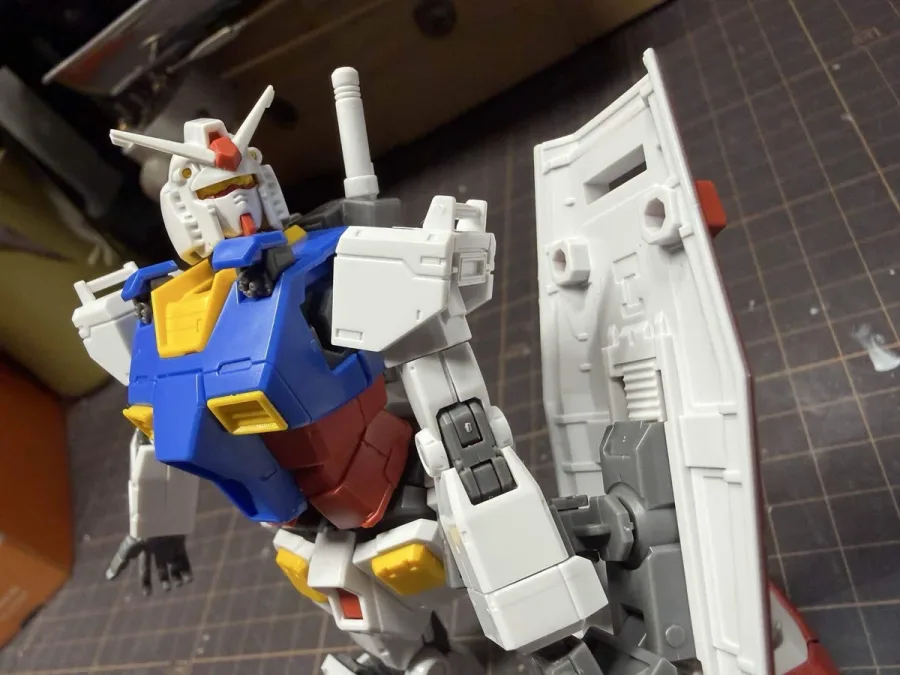
Do your best, Gundam-san!
Next time is "Single-blade vs. Double-blade Nippers"!
We'll be verifying "what exactly is the difference, honestly?" in real-time while actually cutting up parts!
Even though I said that, a month has already passed...
I'm scared.
Welcome, everyone!
It's Umenoki.
A few days after the Odaiba Unicorn ended, I thought, 'Oh crap' (lol).
So, for this experiment... ahem
Our guest is Gundam-san!
■ This theme: The truth about single-blade vs. double-blade nippers
Since this has gotten long, let's start with the conclusion.
Single-blade nippers are excellent, but they aren't perfect!
To those of you thinking, 'He's being vague again'... this was the truth.
Since Gundam-san is the Origin version kit, it was relatively easy to build.
■ Why are they 'not perfect'? A rough comparison of their features!
First, I'll share the features of each that I learned while cutting up parts for Gundam-san (HG 1/144 RX-78-2 Gundam INDEX/ORIGIN version) this time.
① Double-blade nippers (sturdy all-rounders)
Pros: The blades are thick and sturdy! Even if you cut roughly, the blades are hard to chip.
Cons: Because they cut by crushing, they tend to cause whitening.
Role: In charge of the 'first cut' to roughly remove parts from the runner.
② Single-blade nippers (precision knives with excellent sharpness)
Pros: The cross-section cuts smoothly like tofu, and whitening is drastically reduced!
Cons: The blade is extremely thin and super delicate. If you bend it or cut thick parts, the blade will snap in one go and you'll be crying.
■ Practical use! Real impressions of using single-blade nippers
I actually tried cutting right up to the parts with single-blade nippers, and...
'Whoa... what is this, it cuts so smoothly...!'
I was moved. It wasn't the 'snap!' impact of double-blade nippers, but the feeling of the blade sliding in 'smoothly...'.
Looking at the cut surface, it's so clean that it doesn't even need sanding!
'Wait, so if I just build everything with single-blade nippers, it's the best, right?'
There was a time when I thought that too.
This is the main point of why I said they aren't 'perfect'.
■ The 'traps' and 'weaknesses' of single-blade nippers
Actually, I hit a wall that I just couldn't cover with single-blade nippers alone.
① They die (break) instantly if you cut thick runners or hard parts
Single-blade nippers are structured to cut by pressing an 'ultra-thin blade' against a 'cutting board'-like part.
Because of this, if you force them on thick runners or hard clear parts, the blade will bend or break in one go. The terror of a nipper that cost thousands of yen becoming trash in an instant...!
② There are narrow gaps where the blade won't fit
Because the blade is delicate, it's too scary to stick it deep into intricate parts to cut. I get nervous thinking, 'What if the blade gets stuck here and breaks?', and end up being way too cautious.
③ In the end, it doesn't result in 'zero sanding'
No matter how hard it is to cause whitening, the gate (leftover material) doesn't disappear completely.
In the end, if you want to finish it as cleanly as possible, you'll eventually need to use sandpaper or a design knife.
■ Summary: What is the correct way to use them?
After building one Gundam-san, here is the optimal solution according to Umenoki!
1. Use double-blade nippers to 'roughly cut' a little away from the part (first cut).
2. Use single-blade nippers to carefully 'cut smoothly' the remaining gate (base) (second cut).
In the end, the conclusion this time was that a 'tag-team play of double-blade and single-blade' is the strongest, and single-blade nippers are not a magical all-purpose tool!
If you try to be lazy and finish everything with just one single-blade nipper, a 'next terrifying experience' of breaking an expensive nipper awaits you (lol).
Closing
What kind of nippers do you all use?
If you have any episodes like 'I recommend these nippers!' or 'I once broke an expensive single-blade nipper and was in despair...', please let me know in the comments!
Gundam-san, thank you for joining me for this verification experiment! (Are you going to finish building it properly?)
I look forward to working with you from now on!