Poka-Yoke is a collective term for improvements in manufacturing sites that prevent human errors (careless mistakes) through systems rather than relying on attentiveness.The term originates from 'poka' (careless mistake) and 'yokeru' (to avoid), and it is a concept that developed in Japanese manufacturing sites, most notably through the Toyota Production System, and is now used in all types of workplaces, including warehouses and logistics.
In this article, we will organize the basic concepts and types of Poka-Yoke, and then explain how to prevent errors that cannot be stopped by conventional physical Poka-Yoke alone using digital mechanisms such as smart glasses.
Two Types of Poka-Yoke
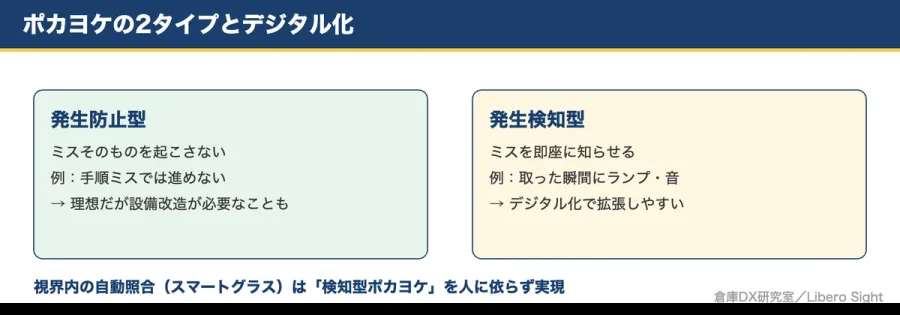
This is a mechanism where 'errors cannot occur in the first place,' such as not being able to proceed to the next step if the procedure is wrong, or not being able to set a part if the orientation is incorrect. While this is the most ideal, it sometimes requires dedicated jigs or equipment modifications.
Detection Type (Notifying of errors immediately)This is a mechanism that notifies the user via lights, sounds, or displays the moment an error occurs, preventing it from flowing to the next process. Even if it cannot be completely prevented, 'shortening the time to notice' can significantly reduce rework costs. This type is easier to expand through digitalization. In warehouse and logistics sites, notifying the user the moment they pick up the wrong item is a typical example of this detection type.
Limitations of Physical Poka-Yoke and Digital Poka-Yoke
Conventional Poka-Yoke focused on physical improvements such as jigs and sensors. However, with the advancement of high-mix low-volume production, 'making jigs for each product number' involves high costs and significant effort for changeovers, leading to an increasing number of situations where this is no longer feasible. Additionally, physical mechanisms are difficult to change once installed, and the need to rebuild them every time a new product is launched or a process is changed is another challenge.
This is where digital Poka-Yoke, realized through software and wearable devices, is gaining attention. Because 'rules can be changed via software'—such as barcode verification, procedure sequence control, and displaying the next task within the field of view—it can flexibly respond to changes in product numbers and processes.
Implementing Poka-Yoke with Smart Glasses
Smart glasses can embed Poka-Yoke 'into the flow of work using both hands' by overlaying information directly onto the worker's field of view. The major difference is that, unlike handheld terminals, one hand is not occupied, allowing Poka-Yoke to function while handling parts with both hands.
Detection of picking errors: Verifies within the field of view the moment a similar part is picked up, and notifies if it is incorrect
Procedure sequence control: Displays the next task to be performed in the field of view, preventing skipped steps or reverse order
Forced completion confirmation: Can be set up as a mechanism that does not allow proceeding to the next step without confirming the completion of each process
Automatic recording of results: 'When, who, and how the work was performed' remains, which can be used for tracking when defects occur
Processes suitable for physical Poka-Yoke and those suitable for digital Poka-Yoke are different. It is realistic to use them selectively: 'physical for processes with few changes and high volume, and digital for high-mix, high-change processes.'
Case Study: Digital Poka-Yoke at a Major Building Materials Manufacturer's Factory
At a major building materials manufacturer's factory supported by our editorial department (Libero Engineer), we introduced work instructions and verification within the field of view using smart glasses to address the high risk of picking errors due to handling a wide variety of parts with similar product numbers. This realized a detection-type Poka-Yoke that allows workers to "notice the difference the moment they pick it up." Operations began using only CSV integration without modifying existing systems (see the press release for details: PR TIMES: Joint Development Press Release by Libero Engineer)
"Libero Sight™," used at this site, is a patented smart glass field DX solution born from joint development with a major building materials manufacturer. In addition to its initial application in warehousing and logistics, it can also be applied to prevent errors in manufacturing sites. It was ranked 2nd in the featured product rankings at the "1st Logistics DX Expo" (July 2026, Tokyo Big Sight).
How to Establish Poka-Yoke
1. Collect Data on Error OccurrenceFirst, visualize "which process, what kind of error, and at what frequency" is occurring. By prioritizing based on data rather than intuition, you can implement Poka-Yoke starting from the processes with the greatest impact.
2. Combine Prevention and DetectionSince it is not cost-effective to make everything prevention-based, categorize processes: use prevention-based methods for critical processes and detection-based methods for others. With smart glasses, detection-based methods can be widely covered by software.
3. Gain Buy-in from the FrontlinePoka-Yoke will not take root if it is perceived as a "system to blame for mistakes." Communicating to the site that it is a "system that protects people from mistakes rather than blaming them" is the key to successful implementation.
Frequently Asked Questions
Q. What is the difference between Poka-Yoke and Fool-Proofing?Fool-proofing refers to a design philosophy where "no matter how it is used or what mistakes are made, it will not lead to a serious accident," while Poka-Yoke often refers to specific measures to "prevent or detect careless mistakes." In practice, there are cases where they overlap.
Q. Can digital Poka-Yoke be used in small-scale sites?Yes, it can. If you use a method that can start from a single process or a few units, you can implement it on a small scale by focusing on processes with high error costs. Start by taking inventory of processes with many errors.
Q. Is raising human awareness insufficient?While raising awareness and double-checking are necessary, human concentration has its limits. The essence of Poka-Yoke is to create a system that prevents errors without requiring constant attention.
Q. How do you measure the effectiveness of digital Poka-Yoke?The basic approach is to compare the "number of errors per process" and the "man-hours spent on rework" before and after implementation. If you have a system that automatically records performance, you can grasp the before-and-after results without the hassle of manual aggregation, and it can also be used to prioritize improvements. Q. Can Poka-Yoke be used in warehouses and logistics?
Yes, it can. Preventing picking errors and shipping mistakes is a direct application of detection-type Poka-Yoke. The concepts refined in manufacturing are now extending into warehouses and logistics.
Summary | Poka-Yoke prevents errors through "systems," not "people"
Poka-Yoke is a universal concept refined in manufacturing sites that prevents errors through systems rather than relying on human attention. In workplaces with high variety and frequent changes, traditional physical Poka-Yoke is not enough, making digital Poka-Yoke, such as automatic verification within the field of view, effective. Start by taking stock of "which processes have the most errors and what kind of errors they are" in your own company.
Recommended reading・Smart Glass Utilization in Manufacturing | A Complete Guide to Effective Points and Selection Criteria by Task and Process
https://note.com/skaneko414/n/n78f29815d917・How to improve parts picking in factories? Ways to eliminate kitting errors
https://note.com/skaneko414/n/neefff4c2fe80
・What is shipping inspection? Reasons why visual checks leave shipping errors and how to systematize them
https://note.com/skaneko414/n/nfa7a0ab9eadf
・[Libero Engineer Official] Improve factory work efficiency! 7 things you can do with smart glasses
https://libero-en.jp/btob/blog/2554/
──If you found this article helpful, I would appreciate your support with a like or follow. The "Warehouse DX Lab" shares practical knowledge on field DX using smart glasses.
▼Next steps
For estimates on implementation costs, seeCost estimates for introducing smart glasses in warehouses and how to choose without failing, and for designing small-scale trials, seeHow to proceed with Smart Glass PoC. Poka-Yoke is not a panacea. There are errors that can be physically prevented with jigs and mechanisms, and errors that cannot be prevented in principle. Distinguishing between these beforehand will help you avoid misallocating your investments.
Distinguishing between errors that can be prevented by Poka-Yoke and those that cannot
Errors that can be prevented by Poka-Yoke
Items with different shapes or dimensions (can be designed so they don't fit in the jig). Processes with a fixed order (prevent skipping with sequence control). Items with a constant quantity (guaranteed by counters or fixed-quantity containers). All of these satisfy the condition where "making it physically impossible" is achievable.making it physically impossible" is achievable.
Errors that cannot be prevented by Poka-Yoke
Items that look almost identical but have different part numbers. Cases with many varieties where it is impossible to prepare jigs for all of them. Frequent changeovers where jig replacement cannot keep up with the work. Items where only the last digit of the model number is different. Thesecannot be physically distinguished, so they cannot be stopped by jigs. You are left with two choices: rely on human attention or solve it through verification.
Criteria for distinction
If either of the following applies, it is an area to be solved by verification rather than jigs.
・The number of target varieties per jig exceeds 3 (jigs cannot be made for each variety, and shared jigs reduce accuracy)
・Changeovers occur more than twice a day (jig replacement itself becomes a new source of error)
For workplaces that do not meet either of these two conditions, thorough Poka-Yoke is the most cost-effective measure. Conversely, in workplaces that meet either one, errors will remain even if Poka-Yoke is strengthened. How to stop the remaining errors is the next point of discussion.
▼For those who want to gather information first | Free Guide
Smart Glass Field Improvement Guide starting with zero additional development costs (Free Download)
https://libero-en.jp/btob/dl01/
▼For those who want to understand their own site with numbers | Simple Diagnosis (3 minutes, free)
https://libero-en.jp/btob/sight-shindan/
▼For those who have started concrete considerations | Product Information & Free Consultation
https://libero-en.jp/btob/Liberosight/