Aspiration pneumonia does not end with treatment.
It is a condition where the same patient repeatedly develops the disease, losing physical strength each time.
The situations where a PT should be involved are not limited to 'after' the pneumonia has healed. In fact, what is done within the first three days of hospitalization determines the subsequent outcome.
This article organizes the interventions that PTs can directly participate in for the prevention of the onset and recurrence of aspiration pneumonia.
Aspiration pneumonia occurs not only in respiratory wards but also in patients in orthopedic, neurosurgical, and gastrointestinal surgery wards.
It is not a matter that can be dismissed as 'not my patient'.
What is the pathology of aspiration pneumonia?
Aspiration pneumonia is a disease in which the contents of the oral cavity and pharynx accidentally enter the airway, causing inflammation in the lungs.
Even healthy adults may aspirate small amounts of saliva while sleeping. However, if immune function and coughing strength are maintained, it does not lead to pneumonia.
The problem arises when the following three factors overlap:
Decline in swallowing function (prone to aspirating food boluses and liquids)
Bacterial growth in the oral cavity (aspirated contents become pathogenic)
Decline in airway defense (unable to expel via coughing)
Of these three, the areas where PTs can be particularly involved are
maintenance of swallowing function and maintenance of physical strength and coughing strength.
Aspiration includes not only 'choking' but also aspiration without choking (silent aspiration).
Silent aspiration is likely to occur during sleep at night and progresses without the patient even noticing.
In elderly patients and patients after a stroke, pharyngeal reflexes and cough reflexes are reduced, so they may not choke even if they aspirate.
An assessment of 'it is fine because they are not choking' is dangerous.
Who is at riskAspiration pneumonia is a major cause of pneumonia in the elderly and recurs frequently, especially in patients with impaired swallowing function.
In wards where PTs are involved daily, the risk of aspiration is also high for patients with advanced disuse syndrome, post-stroke patients, and patients forced to remain on bed rest after surgery.
Prognosis changed by early PT
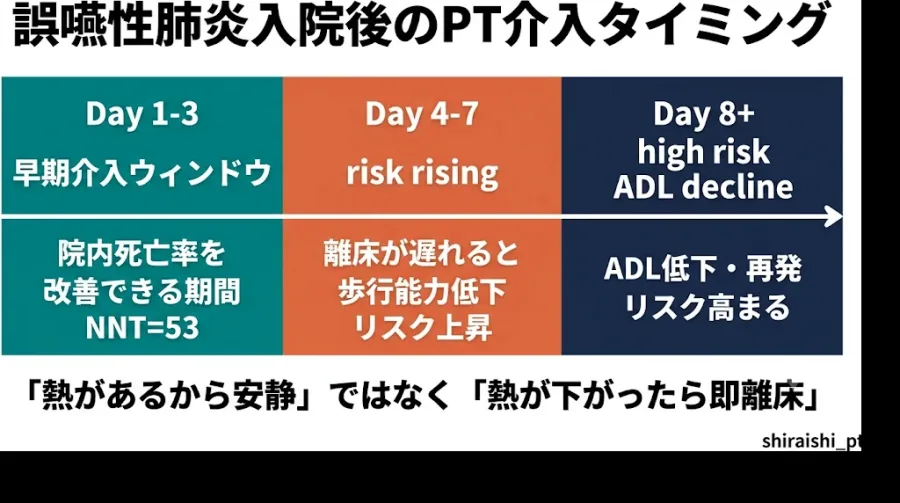
Intervention within 3 days of admission changes mortality ratesA large-scale retrospective cohort study in 2015 compared in-hospital mortality rates between a group that received PT intervention within 3 days of admission and a group that did not, involving 68,584 patients aged 70–100 hospitalized with aspiration pneumonia.
In the early PT intervention group, the 30-day in-hospital mortality rate improved by a risk difference of -1.9% (95% CI: -2.3 to -1.5%), showing an NNT (one death prevented for every 53 interventions).
What this figure means is not that "moving early is dangerous," but the fact that "not moving is more risky."
Early mobilization and maintenance of walking abilityStudies tracking patients hospitalized with aspiration pneumonia have shown that the longer the time until the first mobilization after admission, the lower the walking ability at discharge.
The three independent risk factors identified were:
• A-DROP severity score
• Nutritional index (GNRI)
• Days until first mobilization
Conversely, mobilizing patients early while monitoring their nutritional status is a direct intervention to protect their walking ability.
Relationship between ADL improvement and early rehabilitationIt has also been reported that early rehabilitation intervention within 7 days is effective for improving ADLs.
The timing of "starting rehabilitation after the pneumonia has settled" may be too late.
It is important to coordinate with doctors and nurses and share a policy of starting intervention as early as possible once the fever subsides.
Four interventions that PTs can take on
The initial PT intervention for patients with aspiration pneumonia begins with checking their ability to sit on the edge of the bed and stand.
Prolonged bed rest increases the pooling of saliva and secretions in the pharynx. It also raises intra-abdominal pressure, which increases the risk of reflux.
Whether a patient can maintain a stable sitting position on the edge of the bed is directly linked to how they are positioned during meals.
While decisions regarding mobilization are made in collaboration with physicians, the fixed idea that 'fever means bed rest' needs to be reconsidered.
2. Posture Management Suitable for Eating and SwallowingPosture during meals is the foundation of aspiration prevention.
Standard practice recommends a semi-reclining position with the head elevated 30 to 45 degrees. However, the reclining angle should be adjusted according to the patient's swallowing function.
Points that PTs should check are as follows:
Can the patient maintain neck flexion (chin-down)?
Is there any trunk asymmetry (e.g., after a stroke)?
Is the patient lying down after eating? (Maintain a sitting position for 30 minutes after meals)
Neck flexion has the functional purpose of 'widening the vallecula to prevent aspiration.' While posture guidance is provided in collaboration with STs, PTs can also take responsibility for posture settings.
3. Maintaining Coughing Power and Respiratory Muscle StrengthThe ability to expel aspirated material is determined by coughing power.
Since coughing power depends on expiratory muscle strength (abdominal muscles and trunk muscles), it decreases as disuse progresses.
What PTs can do:
Ensure diaphragm range of motion by securing a sitting or edge-of-bed position
Resistance exercises for abdominal and trunk muscles (intensity adjusted to the patient's condition)
Instruction on huffing (exhaling with a 'huff' sound while applying abdominal pressure)
Practice of self-expectoration (including tapping and postural drainage)
Improving cough strength also helps build a body that is less prone to pneumonia even if aspiration occurs.
4. Understanding nutritional status and multidisciplinary collaborationImproving nutritional status is essential for preventing the recurrence of aspiration pneumonia.
The GNRI (Geriatric Nutritional Risk Index) is an indicator for assessing nutritional risk in the elderly. A score of less than 92 is considered to increase the risk of malnutrition, and it has been confirmed that this value is an independent risk factor for decreased walking ability.
Perspectives that PTs should grasp:
Weight change before hospitalization (be cautious of a decrease of 5% or more in the last 6 months)
Grip strength (simple screening for sarcopenia)
Decrease in food intake (collaboration with NST and registered dietitians)
Muscle strength is required for the recovery of swallowing function, and muscle strength recovery cannot be expected if nutrition is insufficient.
Collaboration with oral care
Why oral care prevents aspiration pneumoniaMany of the pathogens of aspiration pneumonia are commensal bacteria in the oral cavity (anaerobic bacteria, oral streptococci, etc.).
When the oral cavity is unclean, the number of bacteria per 1 mL of saliva increases significantly, increasing the risk of pneumonia even with a small amount of aspiration.
Review studies have confirmed that reducing the amount of bacteria in the oral cavity through oral care significantly lowers the incidence and mortality rate of aspiration pneumonia.
How PTs can be involvedOral care is primarily handled by nurses, dental hygienists, and STs, but PTs can also collaborate in the following ways:
Creating a posture that makes it easier to perform oral care by ensuring mobilization and edge-of-bed sitting
Sharing the sequence of "mobilization after oral care" with ward staff
"Oral care → Mobilization → Eating in a seated position" Establishing this flow as a daily routine becomes a prevention cycle for aspiration pneumonia.
It also occurs in orthopedic and gastrointestinal surgery wards
If you view aspiration pneumonia only as a "respiratory ward issue," the risk of overlooking it increases.
・Long-term bed rest after proximal femoral fracture surgery
・Shallow breathing and suppressed coughing due to pain after upper abdominal surgery
・Decreased consciousness level and reduced reflexes after neurosurgery.
These are all situations that increase the risk of aspiration pneumonia.
As a PT, it is important to have the perspective of "Is this patient prone to aspiration?" and to make it a habit to share with nurses and doctors if you judge the risk to be high.
Situations where you should stop or be cautious
Timing to refrain from active mobilizationIn the following cases, review the intervention plan after confirming with a doctor.
High fever (38.5°C or higher) persists and vitals are unstable
SpO2 is below 90% even at rest
Respiratory rate is 30 breaths/min or more and shows an increasing trend
Blood pressure is fluctuating significantly (risk of orthostatic hypotension)
However, "having a fever" does not automatically mean "stop rehab." Continuing low-intensity interventions such as maintaining a sitting position or oral exercises is often beneficial.
Posture management after mealsLying down immediately after a meal increases the risk of reflux and aspiration.
Share with the patient, family, and ward staff to maintain a sitting position for 30 minutes after meals.
Just by thoroughly implementing this one point, the risk of aspiration can change.
Clinical Mini-Case: Preventing aspiration in a patient I thought was "unrelated"
In an orthopedic ward, I was in charge of an 80-year-old woman who had undergone surgery for a femoral trochanteric fracture.
She had a history of mild dementia and was mostly bedridden for three days after surgery due to pain management.
When I attempted early mobilization on the fourth day, the patient's neck tilted backward and their trunk began to collapse before they could maintain a sitting position on the edge of the bed for even five minutes.
Concerned by the nurse's comment that the patient 'seems to have difficulty swallowing,' I checked their condition during feeding.
The timing of the swallowing reflex was delayed, and mild choking was observed every time they swallowed a small amount of liquid.
I consulted with an ST (Speech-Language-Hearing Therapist) and requested a swallowing evaluation, which confirmed a moderate decline in swallowing function.
Actions I took as a PT from that point on:
Trunk strengthening for stable sitting on the edge of the bed (15 minutes daily)
Setting a semi-reclining position during meals
Enforcing 30 minutes of sitting posture maintenance after meals (shared with nursing staff)
Instruction on self-training for oral exercises (tongue movement and mouth opening exercises)
Two weeks later, stability in the sitting position improved, and swallowing function also showed signs of recovery.
Even in orthopedic patients, paying attention to swallowing function and aspiration risk can sometimes prevent the onset of aspiration pneumonia.
Summary
Aspiration pneumonia will recur if you only 'treat the pneumonia'
Early PT intervention within 3 days of admission improves in-hospital mortality (NNT=53)
Early mobilization and nutritional status are independent risk factors that influence walking ability at discharge
Four pillars for PTs: early mobilization, posture management, maintaining cough strength, and interprofessional collaboration
Collaboration with oral care to reduce oral bacterial load is the foundation of recurrence prevention
Aspiration pneumonia also occurs in orthopedic, gastrointestinal, and neurosurgical departments
In this note, I continuously share respiratory care knowledge that PTs and OTs can use in both exams and clinical practice.
If you follow me or register for the official LINE account, you can receive early notification for the individual guidance program scheduled to start in August.
References
Momosaki R, Yasunaga H, Matsui H, et al. Effect of early rehabilitation by physical therapists on in-hospital mortality after aspiration pneumonia in the elderly. Arch Phys Med Rehabil. 2015;96(2):205-209.
https://pubmed.ncbi.nlm.nih.gov/25301440/
(Abstract reviewed; retrospective cohort study of 68,584 patients, early PT intervention improved in-hospital mortality with NNT=53)Tada A, Miura H. Prevention of aspiration pneumonia (AP) with oral care. Arch Gerontol Geriatr. 2012;55(1):16-21.
https://pubmed.ncbi.nlm.nih.gov/21764148/
(Abstract reviewed; review of the preventive effect of oral care on AP)Yanagita Y, Arizono S, Tawara Y, et al. Risk factors for decreased walking ability in hospitalized patients with aspiration pneumonia. J Int Med Res. 2023;51(4).
https://pubmed.ncbi.nlm.nih.gov/37013252/
(Full text available; days until initial mobilization, GNRI, and severity are independent risk factors for decreased walking ability)Yagi M, Yasunaga H, Matsui H, et al. Effect of early rehabilitation on improving activities of daily living in elderly patients with aspiration pneumonia. Geriatr Gerontol Int. 2016.
https://pubmed.ncbi.nlm.nih.gov/26460175/
(Abstract reviewed; early rehabilitation within 7 days is effective for improving ADLs)