On July 9, 2026, OpenAI announced "ChatGPT Work".
It is a work agent that researches materials, operates files and apps, and completes slides, spreadsheets, and documents.
Seeing this, many people must have felt the same way.
"How is that different from Claude Cowork?"
In fact, looking only at the list of features, the two are quite similar.
Neither is just a chat AI that answers questions. When you tell them your goal, they break it down into multiple steps—gathering information, analyzing, manipulating files, and creating materials—and return the finished product.
However, when compared in detail, the goals they are aiming for are slightly different.
In conclusion,
ChatGPT Work is a work environment that completes AI tasks in a single place
Claude Cowork is a foundation for building your own dedicated AI staff
is closer to the reality.
And in terms of pricing, there is a significant difference for small teams compared to individual use.
ChatGPT Work and Claude Cowork are targeting almost the same market
ChatGPT Work gathers information from apps and files, and breaks down complex tasks into small steps to proceed.
The things it can create are also wide-ranging.
Documents
Spreadsheets
Presentations
Reports
Web apps
Dashboards and internal sites
Furthermore, it supports Scheduled Tasks, which check for updates in tools like Slack and Microsoft Teams and update documents periodically. You can carry out work across local files, desktop applications, and web browsers.
Claude Cowork follows a nearly identical philosophy.
Using the same agent structure as Claude Code, you can entrust complex, multi-step tasks to Claude without needing to operate the terminal yourself.
It supports document creation, file organization, research, and scheduled execution, allowing tasks to continue across desktop, web, and mobile.
In other words, both are aiming for a world where you
.
Up to this point, they are nearly evenly matched.
Overwhelming Difference ①: ChatGPT Work is an "all-in-one" solution
The greatest strength of ChatGPT Work is that the features necessary for work are consolidated into a single product suite.
Beyond Work, ChatGPT includes the following features:
Research via Deep Research
Development via Codex
Image generation
Data analysis
Creation of slides, spreadsheets, and documents
Web browser operation
Integration with external apps
Scheduled Tasks
Sites for creating websites and dashboards
ChatGPT Work allows you to combine these to create final deliverables.
For example, you can carry out a series of tasks like the following in a single environment.
Researching the market and competitors
Gathering information from internal Slack and Drive
Analyzing data
Creating Excel files and slides
Compiling reports for management
Sharing results as a dashboard
Automatically updating information every week
OpenAI has designed ChatGPT Work not just as a standalone task automation feature, but as a way to transform the entire ChatGPT experience into an environment for completing work.
For those who use research, text, images, code, spreadsheets, and presentations across the board, the comprehensive power of ChatGPT Work is quite strong.
Taking a note article as an example, it is easy to complete everything from research, outlining, writing, and chart creation to cover images and promotional text within a single service.
Overwhelming difference ② Claude Cowork is strong at becoming a 'specialized agent'
The strength of Claude Cowork is that it allows you to assemble AI capabilities as components.
In Claude Cowork, you can group the following elements into plugins.
Skills: Business knowledge, procedures, and decision criteria
Connectors: Connections to external services and internal systems
Sub-agents: Specialized agents in charge of specific tasks
By combining these, you can specialize Claude for a specific role.
For example,
a legal officer reviewing contracts
an accounting officer supporting monthly closing
a PMO officer organizing project issues
a migration verification officer comparing design documents and source code
and so on.
It is not just about saving instructions.
You can bundle business knowledge, tools used, assigned agents, and processing flows, and distribute them within the organization as a single specialized capability.
This can be said to be an expansion of the concepts of SKILL.md, sub-agents, MCP, and Hooks cultivated in Claude Code into general business operations.
Therefore,
the structure of Claude Cowork is more suitable.
ChatGPT also has plugins and custom GPTs, but the philosophy of bundling Skills, Connectors, and Sub-agents to create experts is more central to the Claude Cowork product.
Overwhelming Difference 3: ChatGPT Work has the advantage in corporate auditing
If the AI only provided answers, humans could just check the content.
However, the situation changes when AI starts modifying files, operating external systems, and sending messages.
What is important for companies is:
who instructed the AI to do what
what the AI referenced
which operations the AI executed
being able to track which data was sent externally
is what it is.
With ChatGPT Enterprise, you can monitor not only ChatGPT Work conversations but also the actions performed through the Compliance API.
Administrators can also control available plugins, connected tools, browsers, networks, and executable operations. Auto-review is also available to confirm important operations before they are executed.
Claude Enterprise also has audit logs and a Compliance API.
However, as of July 10, 2026, Anthropic's official help explicitly states that 'Cowork activity is not currently captured by the Compliance API.'
While it is possible to monitor Cowork activity using OpenTelemetry, it is not fully integrated into the existing Compliance API.
Therefore, for large companies with strict auditing and compliance requirements that entrust full-scale operational tasks, ChatGPT Work currently has the advantage.
It is quite difficult for companies to handle a situation where they cannot fully track the footprints of AI agents while entrusting them with work.
Individual pricing is almost equal
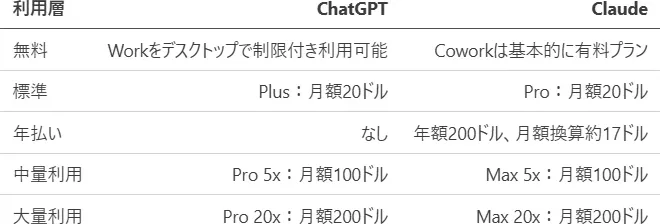
The main pricing for individuals is as follows.
ChatGPT Plus is $20 per month. Pro offers 5 times the usage limit of Plus for $100 per month, and 20 times the limit for $200 per month.
Claude Pro is also $20 for monthly payments, but if paid annually, it is $200 per year, which comes out to about $17 per month.
Max starts at $100 per month, and you can choose 5 times or 20 times the usage limit of Pro.
Assuming you use it for a year as an individual, Claude Pro's annual payment is $40 cheaper per year than ChatGPT Plus.
On the other hand, ChatGPT Work can be used with a free plan on the desktop version with limitations, so ChatGPT has the advantage in terms of ease of trying it out.
In other words, for individual use,
ChatGPT if you want to try it for free
Claude if you want to use it cheaply with annual payments
the price is almost the same if you use it in large quantities
This is the current situation.
For small teams, ChatGPT is clearly cheaper.
For corporations and teams, the unit price per person is the same.
ChatGPT Business costs $25 per person for monthly billing, or $20 per month when billed annually, with a minimum contract of 2 people.
Claude Team also costs $25 per month for a Standard seat, or $20 per month when billed annually, but requires a minimum of 5 people.
Therefore, the monthly cost for the minimum configuration is:
ChatGPT Business: $25 x 2 people = $50
Claude Team: $25 x 5 people = $125
.
For small teams of 2 to 4 people, ChatGPT Business is overwhelmingly easier to adopt.
Even if the unit price is the same, the initial cost is 2.5 times higher due to the minimum headcount requirement.
You cannot determine the true cost based on the monthly fee alone.
It is important to note that paying $20 per month does not mean you can have AI agents work indefinitely.
ChatGPT Work performs longer and more complex processing than standard chat.
OpenAI explains that usage varies depending on task complexity, and Work uses the same usage mechanism as Codex.
Claude also has usage limits per session and per week for each plan, such as Pro, Max, and Team. Once the limit is reached, you can continue processing via pay-as-you-go using additional usage credits.
When assigning full-scale work, the monthly fee is not what you should be looking at.
What is important is:
.
ChatGPT Work has just been announced, and the cost per task in practical work is not yet fully clear.
A final conclusion on price comparison can only be reached by having both perform the same tasks and comparing the finished quality, time required, number of revisions, and credit consumption.
Ultimately, which one should you choose?
ChatGPT Work is suitable for the following types of people and organizations:
Those who want to complete everything from research to the final deliverable in a single environment
Those who want to create slides, spreadsheets, documents, images, and websites across different formats
Those who want to implement it in a small team of about 2 to 4 people
Those who prioritize corporate auditing and operation logs
Those who want to work across multiple services like Slack, Drive, and Teams
Claude Cowork is suitable for the following types of people and organizations:
Those who are already utilizing Claude Code or SKILL.md
Those who want to accumulate business knowledge and decision-making criteria as Skills
Those who want to combine multiple specialized sub-agents
Those who prioritize MCP or custom connectors
Those who want to systematically cultivate AI personnel dedicated to their company
If you simply want to use a convenient AI, ChatGPT Work is easier to understand.
On the other hand, if you want to integrate AI into your company's business structure and design specialized agents, Claude Cowork is closer in philosophy.
The true competition between ChatGPT Work and Claude Cowork
Until now, the generative AI competition has focused on 'who can answer more intelligently.'
However, what ChatGPT Work and Claude Cowork are competing over is not just the quality of the answers.
How much long-term work can be entrusted?
How many tools can be operated?
How much organization-specific knowledge can be learned?
How safely can it be executed?
How close to a finished product can it return?
The competition has shifted to these areas.
In other words, AI has begun to transition from a 'search box' to a 'business execution platform'.
The current situation can be summarized as follows.
Neither one is completely superior.
However, the difference between the two will grow larger based on how you want to delegate work to AI in the future, rather than just the intelligence of the models.
Are you asking AI to perform one-off tasks?
Or are you teaching it your company's own way of working?
The product you should choose depends on that answer.