Hello everyone. Thank you for reading my paper review article.In the previous article, I introduced a paper that examined whether the body's adaptations are lost when you are forced to suddenly reduce or skip training. This time, instead of reducing or skipping, the paper examines what happens if you take a complete break for several weeks? The conclusion is that there is a possibility that training adaptations will be lost if you take a break for about 3 weeks. This is a situation known as "detraining," which also became a topic of discussion during the COVID-19 pandemic when people were concerned about the negative impact on physical fitness due to being unable to train during lockdown. Although it is a slightly older paper from the late 1980s, it is frequently cited in review papers (papers that summarize various other papers). Please take a look at how this verification process has led to our current knowledge.
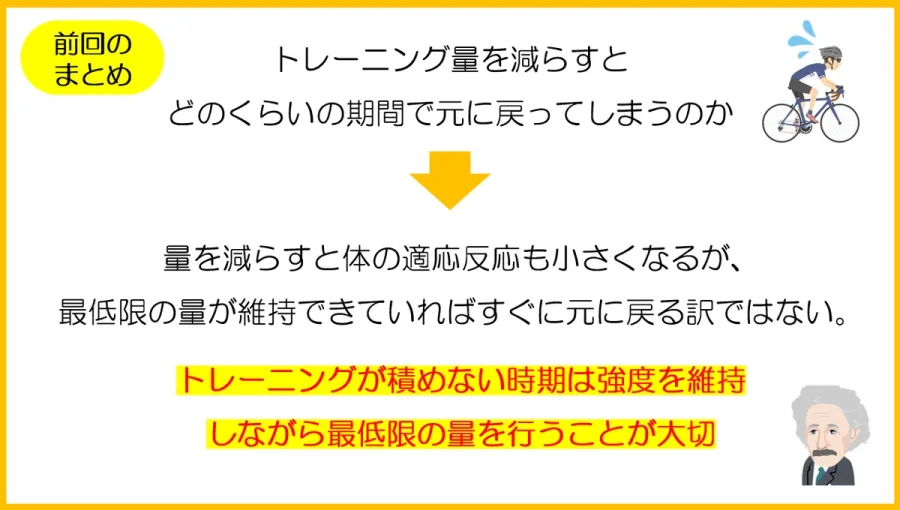
First, in the paper I introduced last time (#4), the researchers examined whether the body's adaptations would return to pre-training levels if training volume (time) was drastically reduced for 2 weeks. As a result, it was found that although the body's adaptations decrease, they do not immediately return to baseline as long as intensity (wattage) is maintained and a minimum volume (time) is kept.
So, what happens if you stop training completely? That is the main point of this paper. The flow for understanding this paper is as follows:
To increase aerobic capacity, it is important to increase mitochondria through training.
Training effectiveness can be improved by adjusting intensity (wattage), volume (time or distance), and frequency (times per week). This time, we focus on volume.
From the previous paper, we know that reducing training volume decreases adaptations.
So, what happens to the body's adaptations if training volume is reduced to zero? This is what this paper verified.
Verification Method
First, all participants performed 7 weeks of training consisting of Zwift classification Zone 2 (intensity that is not painful) to Zone 4 (intensity that is quite painful).
After that, they investigated how indicators related to mitochondrial volume changed by completely stopping training for 3 weeks. Mitochondrial indicators were measured before the training prescription (week 0), after 7 weeks of training (week 7), and after 3 weeks of complete rest (week 10).
This paper investigates the effects of stopping training in two different groups.
People who do not exercise daily (referred to as the 'non-training group')
People who exercise daily (referred to as the 'training group')
By comparing these two groups, the study is designed to allow for a more detailed examination of the effects of the 10-week intervention (7 weeks of training, 3 weeks of complete rest).
Verification Results
By investigating changes in indicators related to intramuscular mitochondrial volume, the following was found.
In the non-training group, activation of the indicators was observed due to training, but they returned to their original values after complete rest.
In the regular training group, indicators were activated from week 0 (before the 7-week training prescription) because they were training as usual, but after complete rest, they dropped to the same level of activation as the regular non-training group. In other words, it is thought that the regular training adaptations were lost due to 3 weeks of complete rest.
Summary
As a result of verifying whether training adaptations are lost when training is interrupted for a certain period, it was found that there is a possibility that training effects are lost if interrupted for 3 weeks. If you have a target competition or want to maintain your physical fitness but are unable to train, it seems necessary to resume training as soon as possible. Based on the results of the previous paper, if you can continue training at the same intensity as usual, even if it is the minimum amount, it seems possible to minimize the decline in adaptation.
Thank you for reading to the end. I will continue to introduce papers that I have learned from myself. I hope that your daily training will be more fruitful.
Paper introduced this time
Moore RL, Thacker EM, Kelley GA, Musch TI, Sinoway LI,
Foster VL, et al. Effect of training/detraining on submaximal
exercise responses in humans. J Appl Physiol.
1987;63(5):1719–24.