This is a report on the greatest comedy in the modern music scene and the cruel truth hidden within it.
Open your social media timeline, and once again, somewhere, people with red faces are pointing at AI-generated music and screaming.
"This is not art."
"It lacks the human soul."
"It is a blasphemy against the sacred culture of music."
.........Yes, yes.
Every time I see their hysterical rejection, I cannot help but cast a cold gaze upon them.
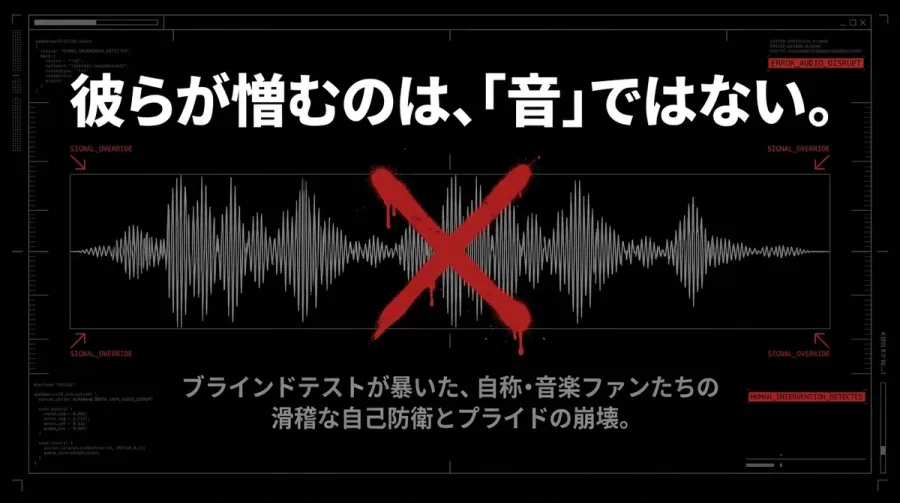
How vague is this 'human soul' they blindly believe in, and how much is it merely a placebo effect dependent on visual information? The results of blind tests conducted by various research institutions and media outlets around the world have already confronted them with a cruel reality.
Music made by AI versus music made by a living human. When played in a state where it is completely hidden which is which, the majority of these 'self-proclaimed discerning music fans' cannot distinguish between the two at all, and, to their dismay, end up giving the AI-generated track an equally high or even higher rating, calling it 'emotional and wonderful.'
In other words, the object they hate so intensely and spit upon is not the sound flowing from the speakers itself. They are merely hating their own 'tiny pride' that collapses with a sound the moment they are told, 'Actually, this is a song an AI made in a few seconds,' after they have already found themselves moving to the rhythm.
They believed they were people who could understand real music, yet they found their hearts moved by inorganic data churned out by an algorithm. To escape that overwhelming self-contradiction and humiliation, they are merely chanting the illogical spell that 'this thing has no soul' to desperately comfort themselves.
With a perspective that loves partiality, cold cynicism, and the karma borne by true creators, I will thoroughly dissect the ridiculous psychological structure of these anti-AI individuals, and conversely, the insane design techniques for mastering AI to create authentic music, down to the marrow of the bone.
The Pitiful Reality of Those Who Attack AI Music as 'Soulless'
---Prompt Design to Infuse 'Human Blood' into Inorganic AI
The 3 Shocks and Defensive Reactions That Make Them Fiercely Hate AI
The reason they hate AI music as if it were the murderer of their parents is certainly not some noble love for music. It is a self-defensive reaction to three extremely selfish and miserable shocks.
First, there is the ability shock and the fear of sunk costs. Among them are countless self-proclaimed musicians who have spent decades practicing guitar and investing heavily in equipment, yet never saw the light of day. To them, the modern spectacle of an amateur who cannot even play an instrument ranking on the Billboard charts just by tapping on a PC keyboard is nothing but...
“What was all the time and money I spent on music for?”
It is nothing but the terror of having their own life relativized. Unable to bear the weight of those sunk costs, they can only affirm their past by labeling AI as illegitimate.
Second, there is the power shock and an identity crisis. Until now, the role of gatekeeper—deciding what is good music and who is a real artist—was monopolized by music critics and long-time fans of live houses. However, with the advent of AI, the production and consumption of music have been completely democratized, and their authority has been rendered completely powerless. The fear of a new system where they are no longer the ones deciding value drives them to become antis.
Third, and this is the most malicious part, is throwing stones from the safety of moral panic. Many of those who loudly criticize AI have never actually opened an AI tool themselves, typed in a prompt, or experienced the desperate trial and error of trying to embody the sounds in their own heads. They sit in the safe spectator seats, producing nothing, and...
“AI is a copyright thief.”
“It is an enemy of creators.”
They brandish these seemingly righteous causes (moral panic). This is because standing in that position gives them an intense sense of security that they are on the “right side” and provides an easy way to satisfy their need for approval.
People who have never shed their own blood or stepped into the quagmire of expression are throwing stones from a safe zone. This composition is what I find most ridiculous and disgustingly shallow.
…Having said all that, discussing whether or not “AI music has a soul” is largely meaningless.
This is because AI itself has no need to have a soul in the first place.
Does a camera have a soul?
Does a synthesizer have a soul?
Does an electric guitar have a soul?
No one talks about that. The issue is what you created using them.
The problem with AI music is not whether the AI has a soul. It is what the human who used that AI thought about.
The Real Reason AI Music Lacks the Scent of Humanity
However, I will draw a clear line here. While the hysteria of the antis is misguided and ridiculous, that does not mean I have any intention of blindly praising the music made by AI that is flooding social media. In fact, I feel an even stronger murderous intent toward the shallow “AI prompt-and-dump” crowd who are satisfied with results spat out in seconds after randomly typing a few words, claiming, “It’s a song I made, isn’t it great?”
That kind of thing is not expression at all. It is just data excrement, where an algorithm has safely stitched together past data. It is a smooth plastic mannequin with no human emotion and no friction accompanied by pain. You are fundamentally desecrating the harsh act of expression. The vector of the criticism that “AI has no soul” used by the antis is wrong, but their claim is correct only in the fact that “AI music produced by prompt-and-dump is decisively boring.”
So, why is it boring?
It is not boring because it is AI; it is boring because the creator is boring.
It is because the human creator fundamentally lacks intent, embodiment, and context.
Because the human creator fundamentally lacks intent, embodiment, and context.
AI (large language models and audio generation models) is, by nature, a probabilistic parrot.
If we do not provide any concrete intent, the AI will automatically output the statistically safest, most harmless, and average composition that sounds like something you have heard somewhere before.
That is why all 'one-click' songs become like flavorless gum that all tastes the same.
The idea that 'anyone can easily become a musician if they use AI' is a massive lie that fundamentally insults the grueling act of expression. No matter what the tool is, if the created work lacks the creator's intent and obsession, it is nothing more than a consumer good (content).
What is an artist?
It is not someone who can play a song. It is someone who, faced with the inorganic output in front of them, can ask,
'What did I think, what did I choose, what did I discard, and how insanely obsessed was I?'
It is someone who can ask that.
If you are satisfied with the initial output and stop pressing the button, you are just a consumer.
But if you are prepared to repeat desperate trial and error and wear down your spirit to drag out that one single correct noise ringing in your brain, you are already a true artist.
When faced with the tool of AI, what is being tested is not the performance of the AI. It is the depth of your own human karma.
Design Theory for Infusing Context into the Inorganic
So, how can we infuse raw human blood into the depths of inorganic AI?
It can only be done by meticulously designing, through the creator's madness, specific constraints to forcibly bind the AI and fluctuations to intentionally destroy the predictable harmony within the prompt (instruction text).
From here on, let us enter into the specific design techniques to destroy that safe and boring output (the sandbox) and imbue it with human karma.
As a basic design, you should immediately throw into the trash all those generic, overused adjectives that 'one-click' users are likely using unconsciously, such as
Such vague words cannot break through the AI's safe algorithms.
What you should instruct the AI with is
'5 elements (genre, mood, vocals, instruments, structure)' described with the overwhelming resolution of concrete nouns plus verbs.
Design of 2000s J-Rock Ballads
For example, suppose you just want to create a 'heartbreaking J-Rock ballad.' 'One-click' users would...
They would probably type something like that. That is why it is boring.
Here, I inject raw context (signals of humanity) as meta-tags to infuse the AI with human blood.
First, I define the background and perspective of the vocals.
Not just a female vocal, but
I embed extremely specific and narrative situations like these into the style prompt.
When the AI model reads these context tags, it begins to access an algorithm for more introspective and raw vocalization, emphasizing vocal cracks and breath components (whispers) rather than just a sad voice.
Style / Description
Furthermore, I use the structure tags in the Lyrics field to forcibly control the emotional ups and downs.
I don't just copy and paste lyrics.
I write detailed AI acting instructions (directions) for each section as follows.
Lyrics / Structure + Emotional Instructions
In this way, I hammer the blueprint of 'where, who, and what kind of emotional explosion occurs' in the song into the AI.
This is what it means to forcibly install human ego and intent into an inorganic AI.
However, this is not the final form. It is still just at a level that is somewhat better than a gacha.
Now, from here on, I will talk about the specific design stories I have been through by trial and error while actually making AI music.
However, I apologize, but I will make the rest of this a paid area.
Why am I making the rest of this paid?
'I'm charging money because it's know-how I worked hard to think of.'
Of course, that is not wrong.
But that is not the reason why I really want to draw a line.
What I have written in the free section up to this point is the philosophy I have arrived at regarding AI music.
Does AI have a soul?
Is there an essential difference between music created by humans and music created by AI?
What separates mere button-pushing from genuine expression?
I want to keep that much in a place where anyone can read it.
However, the story changes from here on out.
What I am revealing from this point forward is the concrete design method I have picked up through my own struggles with AI, failing repeatedly, and rebuilding time and time again.
What kind of words do I use?
What do I specify, and what do I leave unspecified?
How much do I constrain the AI, and where do I leave things to chance?
When the generated result is close to what I want, what do I keep and what do I change?
And why do I decide that a single take, which emerged after dozens of failures, is 'the one'?
These things are not just about how to use AI.
They are the very production experiences I have gained by spending my own time, accumulating failures, paying money, and checking with my own ears over and over again.
AI can output a song in an instant.
But how many hours, how many tens of hours, did a human spend to reach that instantaneous output?
I simply cannot believe that there is no value in that.
Rather, I believe that precisely because it is the AI era, it is appropriate for compensation to be generated there.
That is why I am making the content from here on paid.
It is not to sell the illusion that 'AI can create it in an instant.'
It is to share, in concrete terms, the time and trial-and-error spent turning that sound which appeared in an instant into my own work.
In the free section, I want you to read my thoughts.
In the paid section, I want you to see what I am actually doing.
If you just want to 'try making something with AI,' this is enough. But,
'I really want to give shape to the sound in my head'
If that is what you are thinking, then there is meaning in what follows. From here on, it is not philosophy, but practical combat.
(Everything below this point is a paid area)