This time, I analyzed Alhaitham's motifs.
He is a character who incorporates the culture of the Abbasid Caliphate (Egypt to the Arab region) while being quite conscious of Hellenism (Greek culture).
He is a character who incorporates the culture of the Abbasid Caliphate (Egypt to the Arab region) while being quite conscious of Hellenism (Greek culture).is what he has become.
The person and dynasty that served as motifs
The person thought to be Alhaitham's motif is an Islamic scholar named Ibn al-Haitham.
If you call his name in a Latin style, it becomes Alhaitham.
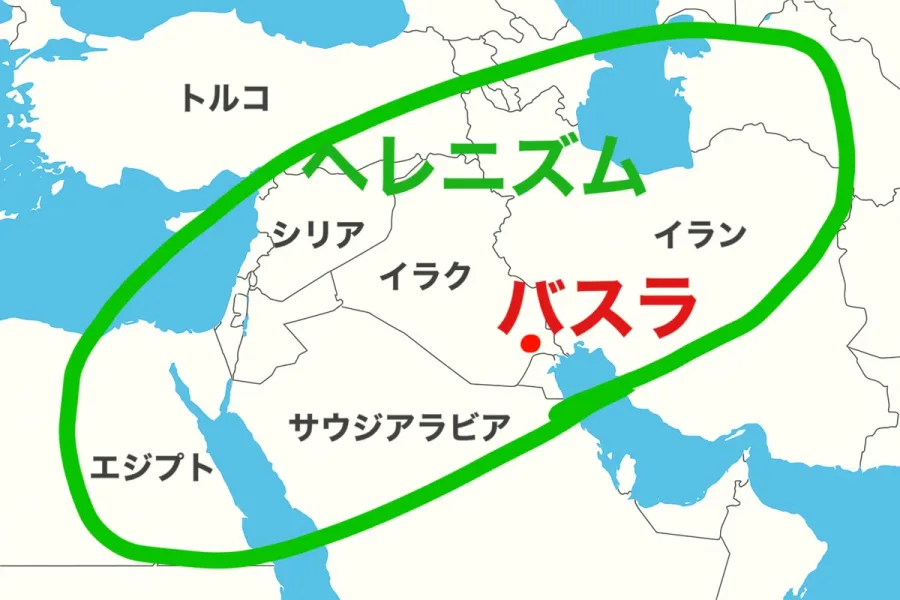
Ibn al-Haitham is said to have been born in Basra under Abbasid rule in 965.
Sumeru has strong Abbasid elements, and the Akademiya might be modeled after the House of Wisdom, an academic institution that existed in the Abbasid Caliphate.
The region that Sumeru is modeled after is an area where Hellenistic (Greek) culture flourished due to the expedition of Alexander the Great.
And long after that Hellenism, the Abbasid Caliphate ruled that region.
The House of Wisdom was an institution that studied Greek academic literature and translated it into Arabic.
It is said that the House of Wisdom mainly focused on Greek academics while also translating various languages.
Even though the person who became Alhaitham's motif was an optics scholar,
the fact that Alhaitham himself specializes in linguistics (Haravatat) might be because of this background.
Aristotle's "Physics" motif
Port Ormos, where you first meet Alhaitham, is also a place name derived from Greek.
Ormos means a seaside place suitable for anchoring (where ships stay) in Greek.
The book Alhaitham often reads is "Physics" by the Greek philosopher Aristotle.
In Book II of Aristotle's "Physics," the "four causes" are mainly discussed.
Words related to these four causes of physics appear in Alhaitham's idle animations.
"TELOS", "HULE", "DUNAMIS"
Aristotle divided the causes of change and motion in the world into four.
Material cause, formal cause, efficient cause, and final cause.
Among them, the material cause is HULE.
The final cause is TELOS.
Potentiality, DUNAMIS, is a concept linked to the formal cause.
Explaining these concepts would fill a book, and opinions even among experts are divided, so I will omit them.
Ibn al-Haitham, who is considered Alhaitham's motif, was greatly influenced by Aristotle's academic books.
However, Haitham did not just agree with Aristotle; he further developed his own views from Aristotle's way of perceiving light.
I think the reason Alhaitham uses Chisel-Light Mirrors is also because Haitham conducted research on light using mirrors and lenses.
It seems that Alhaitham inherited elements of both Aristotle's physics (philosophy) and Haitham's physics (optics).
Constellation (1)
Alhaitham's constellation is Vultur Volans.
Many people seem to connect this to Horus, the falcon sky god of Egyptian mythology, but the connection to Greek mythology is also very strong.
The "al-Haitham" in Ibn al-Haitham means young hawk (eagle) in Arabic.
Also, Alhaitham's constellation is written as Vultur Volans (Flying Eagle) in the English version.
This is the ancient Roman name for the constellation now known as Aquila. It is based on Greek mythology.
In Greek mythology, Zeus transforms into an eagle (hawk), and that eagle form became the constellation Aquila (Vultur volans).
This constellation Aquila contains the bright first-magnitude star "Altair."
Ancient Arabs called this star Al-Nasr al-Ta'ir.
Like Alhaitham's constellation, this means "Flying Eagle" in Arabic.
In other words, within the constellation of the Flying Eagle (Vultur volans) as conceived by the Greeks and Romans,
there is a star called Al-Nasr al-Ta'ir (Flying Eagle) derived from Arabic.
The reason this is happening is that Greek culture itself was influenced by Babylonian astronomy.
For those wondering where Babylonia is,
it is right around the region influenced by Hellenistic culture. The Abbasid-ruled region is also around here.
In other words, Babylonia influenced Greece, and now Greece is influencing the Arab region.
It's complicated...
Because of that history, I think Alhaitham's constellation became "Vultur Volans (Flying Eagle)."
Overall, there are many wing-like designs.
Constellation (2)
Alhaitham's constellation probably represents the process by which his motif, Haitham, pursued his optics research.
Research begins with C1 Intuition,
pursued with researchers through C2 Debate,
back to the drawing board with C3 Negation,
approaching the truth with C4 Elucidation,
entering the final stage of research with C5 Sagacity,
and with C6 Structuration, Haitham completed his "Book of Optics."
The constellation effects strengthen attacks using light and mirrors, which I think is synonymous with the progress of optics research.
Talents and Aristotle
1. Normal Attack: Abductive Reasoning
Abductive Reasoning.
Abduction is also called retroduction, and abduction (retrograde inference) was a method used by Aristotle.
2. Mirror's Edge: An Elaboration on Form
Universality: An Elaboration on Form
Many people seem to think of Plato because of the Japanese word "Idea," but I think it's almost a mistranslation.
I think the English word "Form" refers to Aristotle's form.
It also appeared in the four causes mentioned earlier.
Of the material (hule) and form (eidos), eidos is written as Form in English.
Strictly speaking, this Aristotelian form (eidos) is different from Plato's Idea, but to those who don't know well, it is easily treated as the same thing.
So I think it was confused at the translation stage.
This is also derived from Aristotle.
3. Particular Field: Fetters of Phenomena
Fetters of Phenomena, in other words, seeing the essence without being caught by what is in front of you, has an Aristotelian feel that changed the way this world is perceived, but it is a word often used in philosophy, so it seems impossible to specify.
4. Four-Causal Correction
The four causes refer to the four causes of Aristotle mentioned earlier.
As described above, it can be seen that the talents are also generally conscious of Aristotle.
Weapon and Eye
Alhaitham is often said to be an Egyptian motif,
but I think it is more accurately a motif of the region ruled by the Abbasid Caliphate (from North Africa including Egypt to the Middle East).
Light of Foliar Incision, the weapon tailored to Alhaitham's performance, is slightly more curved than weapons from other nations.
The motif of this sword is probably the "Shamshir," a sword of the Sassanid Persian Empire that ruled the Iranian and Mesopotamian regions before the Abbasid Caliphate.
(Though it seems it only started curving to this extent in a much later era...)
This shamshir was also used in regions under Abbasid rule.
This sword is characterized by its slightly curved shape.
The word 'shamshir' is said to mean 'curved like a lion's claw' in Persian.
The prince 'Faramarz' who appears in the story of Light of Foliar Incision is also a hero from Persian mythology.
These foreshadowing elements related to Persian mythology often appear when researching the civilization of King Deshret.
There are various theories regarding the relationship between King Deshret and Alhaitham.
Many eye-like designs are incorporated into Alhaitham's character.
The Eye of Horus from Egyptian mythology is often pointed out,
but I believe the Eye of Providence from Christianity is also added as a motif.
Eye of Horus from Egyptian mythology ↓
Eye of Providence from Christianity (the all-seeing eye of God depicted above a pyramid) ↓
Mausoleum of King Deshret ↓
As I mentioned earlier, as for the foreshadowing of King Deshret himself, besides Egyptian elements, there are quite strong elements of Persian mythology.
I mentioned that Alhaitham's eye design contains not only Egyptian but also Christian elements, but another easy-to-understand one is the Ichthys (which means 'fish' in Greek).
It was a hidden symbol of early Christianity.
Alhaitham wears something that combines this Ichthys with an eye.
Summary
I hope this helps you understand a little bit about why Alhaitham possesses not only Egyptian and Arabian elements, but also Greek ones.
I would be happy if not only Alhaitham fans, but many different people could read this analysis.
May Alhaitham continue to be loved by many people.
(If you could 'like' this article, it will lead to the next motif analysis. I believe even those who are not registered can press it, so please do so )