Introduction: Paradigm Shift - OpenAI's Return to Open-Weight AI
The release of gpt-oss-120b by OpenAI is positioned as a landmark event in the AI industry. This is the first major open-weight language model release by the company since it open-sourced GPT-2 over five years ago, underscoring the significance of this strategic pivot.
In this report, we will delve deeply into the core themes of this model, based on the following: architectural efficiency, overwhelming performance in inference benchmarks, the strategic importance of the essential 'Harmony' format, and the new paradigm of shared responsibility for safety.
Chapter 1: Architecture Pursuing Efficiency: Deconstructing gpt-oss-120b
Advantages of Mixture-of-Experts (MoE)The core of this model's architecture lies in Mixture-of-Experts (MoE). This is a technology that achieves both a massive scale of 117 billion total parameters and a lightweight active parameter count of just 5.1 billion per token. Specifically, the model consists of 36 layers, with each layer containing 128 sub-models called 'experts.' However, when processing a specific token, only four of these experts are active, which dramatically reduces the computational cost during inference. This sparse MoE design makes it possible to significantly reduce computational volume without sacrificing the model's capabilities.
Quantization and AccessibilityAnother key technology supporting the accessibility of gpt-oss-120b is native MXFP4 quantization. This is a 4-bit format applied to MoE weights, which significantly reduces the model's memory footprint. Thanks to this technology, the 120B model can run on a single 80GB GPU (such as an NVIDIA H100 or AMD MI300X), and the smaller 20B model can even run on consumer-grade hardware with just 16GB of VRAM.
Key Architectural SpecificationsOther major technical details include the following:
Context Window: Supports a very large context length of 128k to 131k tokens, enabling the analysis of long documents or hours-long conversations.
Attention Mechanism: Employs Grouped Query Attention (GQA) to improve inference efficiency.
Positional Encoding: Uses Rotary Position Embeddings (RoPE) to enhance context understanding capabilities.
Tokenizer: Uses the same advanced o200k_harmony tokenizer as GPT-4o, efficiently processing diverse text and code.
Chapter 2: Comparison with Competitors: Rigorous Benchmark Analysis
While benchmarks do not provide a complete picture of a model, they are essential indicators for revealing the characteristics of its capabilities and its design philosophy. To evaluate the performance of gpt-oss-120b based on data and to understand its capabilities in context, we will compare it with competing models.
Analysis of Performance Profile
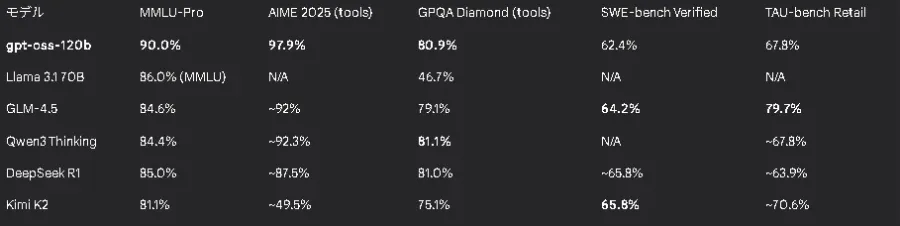
Superiority in Reasoning and Knowledge: gpt-oss-120b demonstrates exceptional performance on reasoning-intensive benchmarks. It records an impressive score of 90.0% on MMLU-Pro, surpassing major rivals. Furthermore, its scores on AIME 2025 (97.9%) and GPQA Diamond (80.9%) indicate frontier-level capabilities in specialized fields of mathematics and science.
Competitiveness in Coding and Tool Use: In other areas, while powerful, it is not always at the top. Its score of 62.4% on SWE-bench is solid but falls short of GLM-4.5 (64.2%). Similarly, its 67.8% on TAU-bench is competitive but can lag behind other models. This suggests a clear specialization.
Chapter 3: The Harmony Protocol: An Essential Handshake for gpt-oss
The Harmony Response Format is more than just a technical specification. It is a clever strategic tool for binding the open-weights ecosystem to OpenAI's commercial API standards. By making best-in-class open models dependent on this proprietary-compliant format, OpenAI shapes industry-wide toolsets to be compatible with its own paid products, creating a powerful lock-in effect within the ecosystem. The reason for forcing a new format rather than adopting existing ones is that OpenAI can control the standard.
Because the highly attractive gpt-oss-120b model requires this format, developers of key community tools like vLLM and Ollama are forced to support Harmony. Once developer infrastructure, code, and workflows are built around parsing the Harmony format, the friction associated with switching from the free gpt-oss-120b to more powerful paid OpenAI API models (such as future GPT-5) is dramatically reduced. This creates a seamless 'on-ramp' to OpenAI's commercial services. It is a strategy to win the open-source battle by making its own standard the de facto standard, thereby ensuring long-term relevance and commercial dominance.
What is Harmony?Harmony uses a structured syntax to ensure consistent output. Its main components are as follows.
Special Tokens: Special tokens such as <start>, <message>, <end>, <return>, and <call> are used to define the structure of the conversation.
Roles: Roles such as system, developer, user, and assistant specify the sender of the message.
Channels: The most distinctive feature is the concept of channels. Channels such as analysis, final, and commentary categorize the intent of the message. Particularly important is the distinction between the analysis channel, which stores the model's internal thought process (Chain-of-Thought), and the final channel, which stores the response ultimately displayed to the user. This balances reasoning transparency with output control.
There is rarely a need to handle this complex format manually. Common tools such as Hugging Face's transformers (when using chat templates), vLLM, and Ollama are designed to handle this format processing automatically. For developers who need manual implementation, a dedicated library called openai-harmony is also provided.
Chapter 4: From Theory to Practice: Implementation Guide for Developers
This chapter provides practical and concrete guidance for developers to actually use gpt-oss-120b.
Introduction: Deployment OptionsHugging Face transformers: Python code snippets using pipelines and chat templates. The Harmony format is handled automatically.
from transformers import pipeline
import torch
パイプラインを初期化
generator = pipeline(
    "text-generation",
    model="openai/gpt-oss-120b",
    torch_dtype=torch.bfloat16,
    device_map="auto"
)
チャットテンプレートを使用
messages = [
    "role": "user", "content": "gpt-ossモデルについて、そのアーキテクチャと主な特徴を教えてください。",
]
テキストを生成
outputs = generator(messages, max_new_tokens=512)
print(outputs["generated_text"][-1]["content"])
High-Performance Serving (vLLM): Commands to launch an OpenAI-compatible web server using vLLM. Suitable for efficient operation in production environments.
# vLLMと依存関係をインストール
uv pip install --pre vllm==0.10.1+gptoss \
    --extra-index-url https://wheels.vllm.ai/gpt-oss/ \
    --extra-index-url https://download.pytorch.org/whl/nightly/cu128 \
    --index-strategy unsafe-best-match
vLLMサーバーを起動
vllm serve openai/gpt-oss-120b
Local Deployment (Ollama & LM Studio): Simple commands to run the model locally on consumer-grade hardware. Ideal for experimentation and testing.
# Ollamaを使用してモデルを実行
ollama run gpt-oss:120b
LM Studioを使用してモデルを取得
lms get openai/gpt-oss-120b
Adjusting Inference Levels: How to set inference levels to low, medium, or high by modifying the system prompt. This allows for balancing response speed and output quality.
# システムプロンプトで推論レベルを設定
system_prompt = "You are ChatGPT... Reasoning: high..."
Chapter 5: Strategic Significance and Safety of Open Weight Releases
OpenAI's release strategy for gpt-oss-120b is a careful performance, designed to skillfully navigate the dangerous path between fostering open innovation and mitigating catastrophic risks.
Remaining closed risks losing influence over the rapidly growing open-source movement, while opening up risks that their technology could be misused, causing immense reputational and societal damage. Their solution is a multi-layered defense strategy. First, they conducted and published extensive internal safety testing to demonstrate that they have performed due diligence. This is a preemptive move to prevent accusations of recklessness. Next, they use precise legal and ethical language—'model cards, not system cards'—to clearly distinguish where responsibility lies. The composition is that they provide the engine, and the developers assemble the car and are responsible for its brakes and seatbelts. Finally, what they released is a model that is powerful but, according to tests, has not reached the threshold of 'high-capability' risk, which is the most dangerous. This is a calculated risk assessment.
The Important Distinction Between 'Open Weights' and 'Open Source'This release means that the model weights are available under the permissive Apache 2.0 license, but the training data, source code, and development methodology are not public. This is why it is defined as 'open weights' rather than 'open source'.
A New Safety Paradigm: Shared ResponsibilityOpenAI clearly positions this release as a 'model card' rather than a 'system card.' This distinction is crucial, as it formally shifts the responsibility for implementing system-level safety measures, such as content filters, to the developer side. Since the model is text-only and does not have a built-in moderation system, users must implement their own guardrails depending on how they deploy it.
Pre-release Due Diligence by OpenAIOpenAI conducted extensive safety evaluations based on its Preparedness Framework. The results confirm that even when adversarially fine-tuned, this model did not reach the 'high-capability' threshold for catastrophic risks such as biological weapons or cyber warfare.
Conclusion: A New Powerful Pillar in the AI Ecosystem
Integrating the key takeaways, it can be said that gpt-oss-120b is a groundbreaking model that redefines the performance ceiling of accessible open-weight AI, particularly in the critical area of inference.
The true long-term impact of this model may lie in its role as a medium for the proliferation of the Harmony format. This format could subtly draw the open-source ecosystem toward OpenAI's standards and facilitate integration with the company's commercial platforms.
As a final assessment, gpt-oss-120b is a very powerful and valuable tool for developers. However, it also heralds a new era of shared responsibility, requiring the community that adopts this model to take a more sophisticated approach to safety and implementation. This model is not just a release of technology, but an important step that questions how cooperation and responsibility should look in the future of AI development.