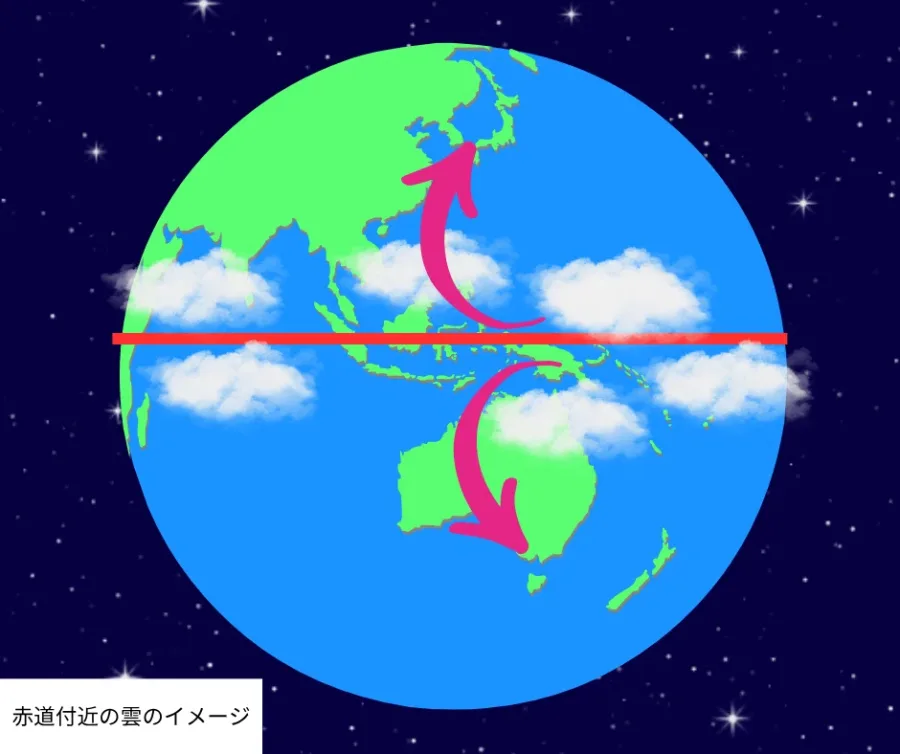
Near the equator, a special phenomenon called the "Intertropical Convergence Zone (ITCZ)" is deeply involved in cloud formation! To explain the process simply:
Strong Sunlight: Near the equator, sunlight is strong, and the air warms up as the land and sea absorb heat.
Air Rising: The warmed air becomes lighter, so it rises and cools in the upper atmosphere.
Condensation of Water Vapor: The water vapor in the rising air cools and condenses into tiny water droplets. These become the seeds of clouds.
Cloud Formation: As a large amount of water vapor condenses, cumulus and cumulonimbus clouds form. And these clouds can sometimes bring rain!
Phenomena like the Baiu front or linear precipitation zones are sometimes collectively referred to as "precipitation systems" or "rain cloud systems." Meteorologically, these are phenomena formed by the influence of atmospheric humidity, temperature, and wind conditions, and they are involved in rain and weather on various scales.
The movement of clouds flowing from Okinawa to Kansai and KantoThat is the movement known as the "northward movement of the Baiu front"! Clouds arrive from around Okinawa to the Kansai and Kanto regions along with the humid air of the rainy season, making you feel the change of seasons
Is there a name for the Baiu front used throughout the year?Since the Baiu front is a seasonal phenomenon, there is no specific name for it that is used throughout the year. However, meteorologically, it can sometimes refer to phenomena similar to "stationary fronts" or "linear precipitation zones." For example, the band-like clouds of rain that form during typhoons are sometimes called "linear precipitation zones," so they might be a bit similar!
Explanation of linear precipitation zonesA linear precipitation zone is a phenomenon where rainfall concentrates in a narrow area, and it is often formed by the influence of terrain and wind. In Japan, it is frequently seen during the rainy season or during typhoons. This phenomenon occurs when water vapor in the atmosphere aligns and condenses under specific conditions, bringing heavy rain. It often occurs in connection with low-pressure systems or warm fronts, and in some cases, the long-lasting rain can even cause flooding!
Conditions and mechanisms for the occurrence of linear precipitation zonesSeveral important conditions must overlap for a linear precipitation zone to occur
Supply of abundant water vapor: Linear precipitation zones form when the atmosphere contains a large amount of water vapor (evaporation from the ocean). This is often supplied from the sea or humid regions.
Atmospheric (atmospheric pressure) instability: When warm air is pushed up over cold air, the atmosphere becomes unstable, and cumulonimbus clouds form. (A phenomenon during the formation of warm fronts and cold fronts.)
Wind convergence: When low-pressure systems or fronts are present, wind may converge in a specific area, concentrating water vapor and forming rain clouds.
Topographical influence: When mountains are nearby, the terrain can cause wind to rise, helping water vapor condense and create rain clouds.
When these conditions are met, a linear precipitation zone forms, bringing torrential rain. Note: If the sea surface temperature is low, the amount of evaporation decreases.
Multiple factors such as atmospheric flow, pressure patterns, and wind affect the frequency of linear precipitation zones.
Difference in shape: Linear precipitation zones have a long, narrow shape, with rain concentrated in a specific area, whereas normal precipitation zones often have a spread-out shape with rainfall distributed over a wide area.
Formation conditions: Linear precipitation zones are prone to occurring when atmospheric convergence and wind direction align under specific conditions, and regional and meteorological factors are strongly involved. On the other hand, normal precipitation zones can be formed by more general meteorological phenomena, such as warm fronts or cold fronts.
Concentration of rainfall: Linear precipitation zones are characterized by a large amount of rainfall concentrated in a specific location, which can cause floods and landslides. Because normal precipitation zones are widely distributed, the impact on any single location is often relatively mild.
Torrential rain: Intense rain continues to fall over a narrow area, which can cause floods and landslides.
Impact on transportation: Roads often become flooded, and train or flight operations are frequently suspended.
Damage to agriculture: Fields may become waterlogged, and crops may be washed away.
Disruption of lifelines: Power outages and water supply interruptions may also occur.
As you can see, while linear precipitation zones are a wonder of nature, they can sometimes cause disasters. Nevertheless, by studying this phenomenon in detail, we can improve prediction accuracy and help mitigate damage!
Supplementary Note 1: Can the Sun be affected by other gas giants?Because the Sun has extremely large gravity and energy, its activity level does not decrease due to the direct influence of other gas giants.
Supplementary Note 2: Can the Earth be affected by other gas giants?While the Earth is rarely directly affected by other gas giants (such as Jupiter or Saturn), indirectly its influence can sometimes be seen within the dynamics of the entire universe!
Influence of Gravity: The strong gravity of massive gas planets like Jupiter can affect the orbits of asteroids and comets. This can potentially increase or decrease the number of celestial bodies that approach Earth.
Orbital Stability: The presence of gas planets contributes to the overall balance of the solar system, and as a result, the orbits of other planets, including Earth, remain stable.
Comet Protection: Jupiter is sometimes called the "shield of the universe," and its massive gravity can play a role in attracting comets heading toward Earth, preventing collisions.
In space, everything is subtly interconnected!
<Pattern 2> Processes that occur near the North and South PolesCloud formation near the North and South Poles involves conditions unique to cold regions.
Effect of Low Temperatures: Because polar regions are extremely cold, the amount of water vapor in the atmosphere tends to be low. However, even in those conditions, water vapor can condense to form thin clouds.
Effect of Updrafts: In polar regions, wind touches warmer parts of the surface and rises, cooling down in the process to form clouds.
Sea Ice and Water Vapor: Small amounts of water vapor are generated from the ice and seawater present in polar regions, which become important ingredients for cloud formation.
Polar Night Jet Stream: Under specific conditions, the flow of wind circling near the poles can collect water vapor to create clouds.
Gas from space almost never mixes directly into clouds near the North and South Poles. However, tiny dust and particles from space (such as meteorite fragments or cosmic dust) may have a slight influence on cloud formation. By functioning as "condensation nuclei" (simply put, these are particles that act like tiny "seeds" when creating clouds), water vapor can attach to them to form cloud droplets.
Earth's atmosphere is like a defensive shield that catches particles entering from space to some extent, but even that slight influence plays an interesting role in the workings of nature!
Supplement 1: Earth's Atmospheric SystemA simple explanation of the mechanism that acts as a defensive shield:
Atmospheric Layers: Earth's atmosphere is divided into several layers, and the "thermosphere" and "mesosphere" in particular play an important role in burning up particles and meteorites flying in from space.
Cooperation with the Magnetic Field: Earth has a "magnetic field" that protects us by bouncing off high-energy particles (such as electrons and protons from solar wind) or guiding them in specific directions. This action also creates auroras!
Particle Diffusion: There is a mechanism where tiny particles and dust raining down from space diffuse within the atmosphere, minimizing their impact on the surface.
If we didn't have this shield, the Earth might have been affected much more.
Supplementary Note 2: The formation of the atmosphere began with the birth of the Earth.The formation of the atmosphere began in the early stages of the Earth's birth, about 4.5 billion years ago. At that time, volcanic activity was intense, and large amounts of gas (water vapor and carbon dioxide) were released, creating the foundation of the atmosphere. Later, with the appearance of microorganisms that perform photosynthesis, oxygen increased, and the current atmospheric composition was formed.
Earth's volcanic activity: On the primitive Earth, volcanic activity was intense, and large amounts of gas (water vapor, carbon dioxide, nitrogen, etc.) were released.
Condensation of gases: Water vapor cooled and turned into liquid, forming the early oceans. This became the foundation for retaining other gases.
Appearance of photosynthesis: Primitive microorganisms began photosynthesis, which created oxygen and caused it to accumulate in the atmosphere.
Differentiation of layers: Over time, the atmosphere became divided into different layers (for example, the troposphere and stratosphere) and stabilized.
With the Earth's atmosphere formed in this way, the foundation for life to emerge was created.
Rain Cloud Systems and Precipitation Systems Summary<Pattern 1> Equator...A special phenomenon called the 'Intertropical Convergence Zone (ITCZ)', Supplementary Note 1: The influence of other gas giants on the Sun, Supplementary Note 2: The influence of other gas giants on the Earth
<Pattern 2> North and South Poles...Conditions unique to cold regions, Supplementary Note 1: Atmospheric system, Supplementary Note 2: Formation of the atmosphere
Rain cloud systems and precipitation systems... When seawater temperature is low, evaporation is low and rainfall decreases
1. Precipitation zone: Gentle rain over a wide area
2. Linear precipitation zone (Baiu front, typhoons): Concentrated, heavy rain in a specific area
The Earth is indirectly affected by space, but the atmosphere and magnetic field reduce these effects. Next time, I plan to look into the atmosphere.