Of the approximately 1,000 species of seed plants that existed in Hawaii before human settlement, 90% were found only in the Hawaiian Islands. This is because the Hawaiian Islands are isolated islands in the middle of the ocean, more than 3,000 km away from the nearest continent.
Hawaiian endemic species are vulnerable to environmental changes. While they seem to survive in primeval forests, I have never visited them. I will introduce some endemic and native species that I encountered in Waikiki, which are barely maintained through the steady conservation efforts of the people.
Regarding plant names, if there is a Japanese name, it is written in Katakana first, followed by the scientific name, then the English name if available, and finally the Hawaiian name, with the Katakana transcription of the Hawaiian name added in parentheses.
Furthermore, 'Hawaiian endemic species' refers to plants that existed before humans arrived and are found only in the Hawaiian Islands, while 'native species' refers to plants that existed before humans arrived and are found only in limited areas including the Hawaiian Islands.
Hawaiian Endemic Species
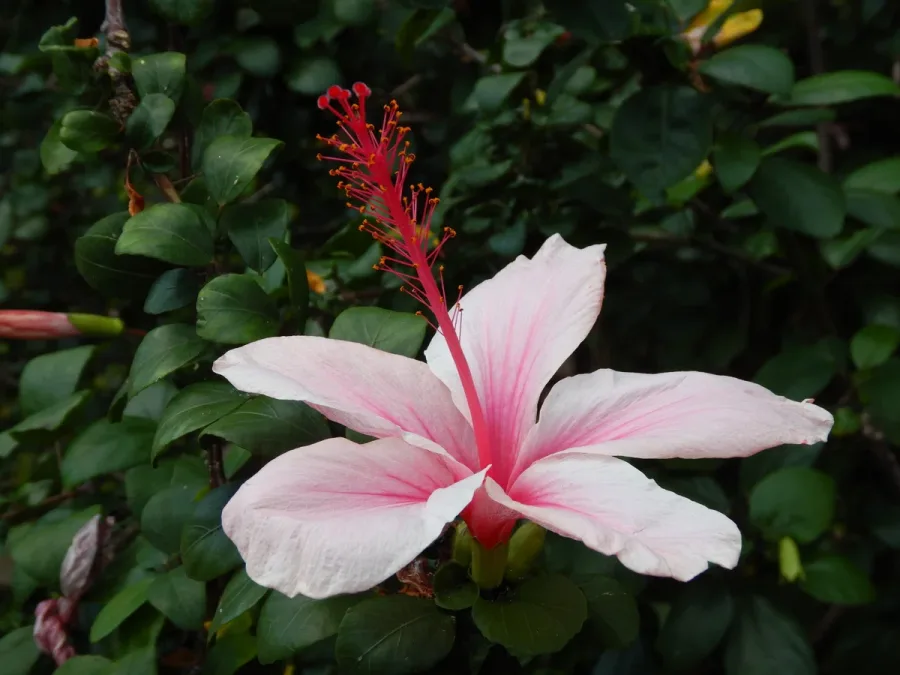
Malvaceae family. Endemic to Oahu.
Native to the wet forests of the Waianae and Koolau mountain ranges.
The petals are white or pale pink,
and are generally slender compared to the Kauai species.
The staminal column protruding from the center of the flower is deep red or pink.
It has little fragrance.
Malvaceae family. Endemic to the Hawaiian Islands.
The petals are red.
It was chosen as the first state flower of Hawaii in 1923, but because correct identification was difficult, it was later replaced by the Maʻo hau hele.
Since high-quality charcoal could be made from the trunk, it was planted within Polynesian settlements along with Kokiʻo keʻokeʻo. The flower juice was taken to improve blood circulation, the liquid from crushed leaves was used as a laxative, and the flower juice and seeds were used for nutritional recovery.
Malvaceae family. A Hawaiian endemic species distributed across the Pacific Islands. It is a shrub reaching 1m in height. The leaves are bright, oval or heart-shaped, 2-5 cm long, and alternate. The leaf margins have sharp or rounded serrations. The flowers are yellow-orange and 3 cm in diameter. There are 5 petals. The petals are one-day flowers that change from bright yellow to orange.
Because red and yellow are the colors symbolizing the Hawaiian monarchy, birds with feathers of these colors were captured. When the birds became extinct, the royal family began making leis using ʻilima flowers. Princess Emma, the queen of Kamehameha IV, loved ʻilima leis, so they became a special item that only the royal family could use.
Designated as the flower of Oahu in 1923.
A Hawaiian endemic species of the genus Gardenia in the Rubiaceae family. It was once commonly seen on Molokai and Maui, but a 1999 survey confirmed only 19 individuals in the Hawaiian Islands, and it was designated as an endangered species. It was believed that good things would happen when the scent of this flower drifted by.
Polyscias racemosa / False 'ohe / PōkalakalaAraliaceae family. A Hawaiian endemic species native to Kauai.
On October 22, when I saw it at Queen Kapiolani Garden,
on the leafless branches,
the fruits were hanging down like a ponytail.
From red button-like buds,
it is said that yellow flowers bloom.
The large leaves are said to fall during the flowering period.
Thymelaeaceae family. An endemic Hawaiian species, native to Kauai, Oahu, Molokai, and Maui. Popular as a garden plant. It produces small, tubular yellow flowers that emit a musky scent in the evening. The fruit changes from yellow to red. The roots, bark, leaves, and stems are toxic and were used to catch fish by releasing them into the sea or rivers.
Hawaiian Myrtle / Metrosideros polymorpha / ʻŌhiʻaMyrtaceae family. An endemic Hawaiian species.
It is one of the first plants to sprout and take root alongside ferns
on the black plains left behind by lava flows.
Its flame-red flowers are considered sacred as the incarnation of Pele, the goddess of fire.
The tree height varies from 20 cm to 30 m depending on the growing environment,
and the flower colors range from red and pink to orange and yellow.
Fabaceae family. An endemic Hawaiian species. It produces spherical, pale yellow flowers. Young branches have small leaves and large crescent-shaped leaves; the small leaves are the true compound leaves, while the crescent-shaped leaves are flattened petioles with degenerated leaf blades. It produces legumes. The wood has a beautiful luster and is used for high-end furniture, musical instruments, tableware, and crafts. In Hawaii, it was once used for canoes and surfboards, but its numbers were greatly reduced by over-harvesting, and its collection is now prohibited.
In Waikiki, it is planted at the entrance of the Halekulani. The introductory article on the Halekulani website is as follows.
Native species
Jamaican feverplant / Tribulus cistoides / Jamaican feverplant / NohuZygophyllaceae family. Native to tropical and subtropical regions. A prostrate to ascending perennial herb with stems reaching several meters. Leaves are compound and opposite, with oblong to elliptical leaflets 3–10 cm long. Each leaf has 5–10 pairs of leaflets, 7–28 mm long and 2.5–12 mm wide, with pointed or rounded tips and entire margins. Flowers have 5 slightly unequal lanceolate sepals, 7–14 mm long and 2–5 mm wide; the corolla consists of 5 lemon-yellow to bright yellow triangular to obovate petals, 11–26 mm long and 6–15 mm wide. Stamens are arranged in two whorls of 5, with the outer whorl slightly longer than the inner, and anthers are heart-shaped to arrowhead-shaped. The fruit is 8–15 mm long, with mericarps that have dorsal ridges and a nodular surface.
Beach naupaka / Scaevola taccada / Beach naupaka / Naupaka kahakai (Sea Naupaka)Goodeniaceae family. Native to tropical and subtropical regions of the Pacific. Leaves are long-obovate, and flowers are semi-circular. Legend has it that a couple in love were separated by their parents and took their own lives; the woman turned into the sea naupaka and the man into the mountain naupaka. It is said that if you join both flowers together, it will rain tears of joy.
Pandanus tectorius / thatch screwpine / HalaPandanaceae family. Native to the South Pacific. Aerial roots emerging from the base of the trunk spread out like octopus tentacles, and the leaves are folded near the center. It is a dioecious plant, meaning male plants that produce flowers with only stamens and female plants that produce flowers with only pistils are separate individuals. Male flowers are 2–3 cm long, fragrant, and wrapped in thin white bracts. Female plants produce cone-like fruits wrapped in bracts. The fruit is spherical, 10–12 cm in diameter, and is a multiple fruit consisting of numerous polygonal segments, resembling a pineapple. The long, slender leaves were used in lauhala (hala leaf) weaving to make mats, hats, pillows, baskets, bags, and fans. The long, slender leaves of the hala (lauhala) are durable and flexible. Skilled weavers dry the leaves, remove the thorny edges and midrib, and soften them to create beautiful baskets, hats, mats, clothing, and many other practical items. The pineapple-like multiple fruit, 20 cm in diameter, is used to make fragrant orange or red leis. Additionally, the ends of the dried fruit can be beaten until soft and used as a brush.
Sapindaceae family. Native species. Widely found in warm regions, mainly in Australia. It blooms with small yellow-green flowers in spring and autumn, and after flowering, it produces fan-shaped fruits with 3 to 4 wings. The fruit is initially green, then turns yellow-green, then red, and finally dark brown; it was used for red dye and leis. The wood was used for building materials and spears.
Beach Vitex / Vitex rotundifolia / PōhinahinaLamiaceae family. Native to Asia and the Pacific Islands. A shrub that spreads along the ground. The leaves are opposite, simple, elliptical to broadly ovate, with entire margins. It bears conical inflorescences at the tips of the branches, blooming with blue-purple flowers. The corolla is funnel-shaped, 5-lobed and bilabiate, with the lower lobe larger than the others.
‘Ūlei / Osteomeles anthyllidifolia / ‘ūleiRosaceae family. Native to the Hawaiian Islands, Cook Islands, Tonga, Pitcairn Island, Rapa Iti, Taiwan, and the Ryukyu Islands of Japan. An upright or spreading shrub reaching 3m in height. The compound leaves are alternate on the branches and divided into 15 to 25 leaflets. The leaflets are small and oblong, 1.5cm long and 0.7cm wide. White flowers with five petals, 7–11mm long, bloom in clusters of 3 to 6 at the tips of the branches. The fruit turns white when ripe, is 1.0cm in diameter, and contains yellow seeds 1.5mm in diameter.
Beach Morning Glory / Ipomoea pes-caprae subsp. brasiliensis / Beach Morning Glory / PōhuehueConvolvulaceae family. Pōhuehue is distributed in the tropics, and in Hawaii, the seeds drifted ashore on ocean currents.
The flower colors are white, pink, lavender, etc., with a purple center.
It blooms all year round.
The leaves are shaped like a sumo referee's fan (gunbai).
The roots were decocted and used for blood purification and as an antidote, and
the leaves were used to treat sprains.
Boraginaceae family. Native to the coasts of tropical regions from the Indian Ocean to the Pacific. An evergreen shrub that reaches 5m in height, with branches spreading like an umbrella up to 6m wide. The bark is pale grayish-brown with many vertical fissures. The leaves are obovate and pale green, densely covered with fine silver hairs on both sides, giving them a velvet-like texture. The flowers form conical inflorescences, but the small white flowers gradually unfurl as they bloom. The fruit is small, opaque, and thick-fleshed. In Polynesian legend, it is considered one of the first things created in this world.
Palapalai / Microlepia strigosa / PalapalaiA native Hawaiian fern. Family Dennstaedtiaceae. Also called Palai 'ula (red stem). Because of its fragrance, it is used for decorations on hula stages, leis worn on the head or neck, and kupe'e worn on the wrists or ankles. It is said that the goddess Hi'iaka, the youngest sister of Pele, as well as 'Ikapolio and Pele, wore it as a loincloth.
Bird's-nest fern / Asplenium nidus / Bird's-nest fern / 'ĒkahaA native Hawaiian fern. Family Aspleniaceae. Its long, glossy leaves grow in a shape resembling a bird's nest, storing water in the sponge-like rhizome in the center. The young leaves are edible. In Hawaii, due to the shape of the leaves, it is called the canoe paddle of the demigod Maui and was used for decorations on hula altars and in ceremonies for felling trees for canoes.
Sword fern / Nephrolepis cordifolia / Sword fern / KupukupuA native Hawaiian fern. Family Nephrolepidaceae. Native to Japan, tropical regions of the Pacific, and New Zealand.
It is one of the first plants to sprout along with 'ōhi'a and 'ōhelo after lava flows and hardens. The fronds are 50–80 cm long and are characterized by not spreading out at the ends. The English name comes from its thin, tall shape, which resembles a sword. "Kupu" means to sprout in the Hawaiian language.