The ecosystem of Taumoeba, revealed toward the end of the story, is one of the most impressive elements of "Project Hail Mary." There are organisms that prey on Astrophage, keeping its proliferation in check through a natural balance. This ecosystem becomes the key to saving Earth. Although fictional, it is an ecologically fascinating setting.
Discovery of the Astrophage predator
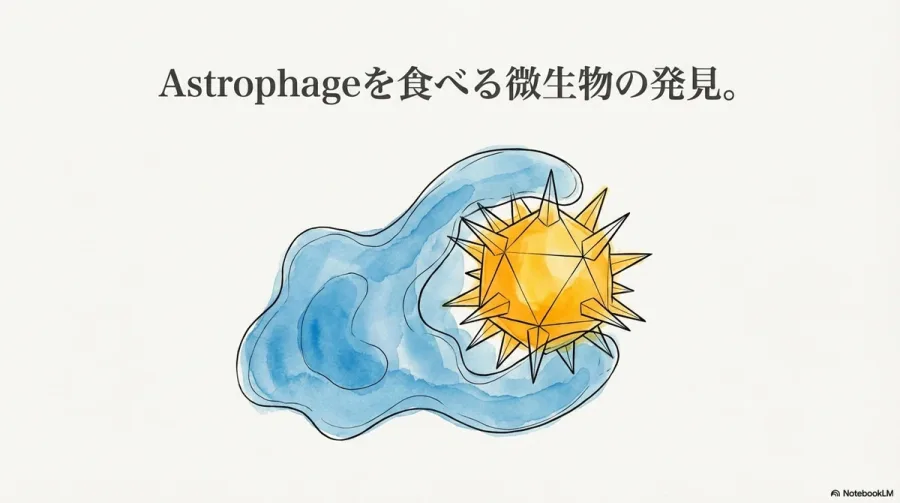
What Grace and Rocky discovered is that there are microorganisms on Taumoeba that eat Astrophage.
This discovery reflects the fundamental principles of ecology. No organism exists in isolation. There is always a predator or a parasite. This maintains the balance of the ecosystem.
Even on Earth, when a specific organism is about to multiply explosively, an organism that eats it appears. Or, a disease spreads. This is nature's regulatory mechanism.
If Astrophage originated near Taumoeba, a predator for Astrophage must have evolved there. Grace and Rocky's reasoning is ecologically sound.
Why are there no predators on Earth?
Then, why are there no Astrophage predators on Earth or other stars?
This can also be explained ecologically. Astrophage only recently reached the solar system. Earth's organisms have not had time to evolve the ability to eat Astrophage.
Evolution takes time. It requires many generations of natural selection to be able to utilize a new food source. If only a few decades have passed since Astrophage came to Earth, Earth's organisms cannot adapt.
On the other hand, Astrophage has existed on Taumoeba for a long time. The predators that evolved there acquired the ability to prey on Astrophage over millions or even hundreds of millions of years.
Ecosystem balance
On Taumoeba, a balance is established between Astrophage and its predators.
When Astrophage increases too much, the predators also increase. When the predators increase, the Astrophage decreases. When the Astrophage decreases, the predators also decrease. This cycle stabilizes the population of both.
This is a fundamental concept in ecology known as the 'predator-prey model.' It can be described by a mathematical model called the Lotka-Volterra equations.
The Taumoeba ecosystem is a perfect example of this theory. Weir has a deep understanding of ecology.
Application to Earth
Grace's great discovery is that if we bring Taumoeba back to Earth, we can solve the Astrophage problem.
This is a method called 'biological control.' You introduce a natural enemy to eradicate a pest. It is commonly used in agriculture and forestry.
However, biological control also carries risks. The introduced organism may have unexpected effects. Ecosystems are complex, and it is impossible to predict every interaction.
In Grace's case, the risk is relatively small. The Astrophage predator likely eats nothing but Astrophage. Once it consumes all the Astrophage, the predator will also die out. The long-term impact on Earth's ecosystem will likely be limited.
The environment of Taumoeba
The novel does not describe in detail what kind of environment Taumoeba has. However, we can make some inferences.
First, since it is a moon of Eridani, it receives light (or thermal radiation) from Eridani. It also receives light from the Eridani sun (40 Eridani).
The fact that Astrophage is abundant suggests that Taumoeba likely has an atmosphere rich in carbon dioxide. Astrophage gathers on planets with high carbon dioxide levels.
And there is a high probability that liquid water (or another solvent) exists. This is because life requires a liquid medium.
Biology of the predator
The novel does not go into detail about what kind of creature the Astrophage predator is. However, we can imagine it.
It is likely a microorganism. Since Astrophage itself is a 10-micron microorganism, the creature that eats it might be of a similar size.
Even on Earth, predation among microorganisms is common. Protozoa eat bacteria. One bacterium parasitizes another. The microbial world is as complex as the world of large organisms.
The Astrophage predator is likely adapted to the unique properties of Astrophage. It probably possesses the ability to safely digest high-energy Astrophage.
Significance in the story
The setting of the Taumoeba ecosystem is a crucial element that supports the climax of the story.
First, it provides a scientific solution. It is a solution based on real science—ecology—rather than magic or super-technology.
Second, it celebrates the wisdom of nature. It is not technology created by humanity, but a solution that nature evolved over millions of years that ultimately saves the Earth.
And it is the result of the cooperation between Grace and Rocky. The two of them hypothesize, experiment, and verify. This depiction of the scientific process gives the story its persuasiveness.
Implications for real-world astrobiology
Is it possible that an ecosystem like that of Taumoeba actually exists?
Wherever there is life, there is always an ecosystem. Life cannot exist as a single species alone. Therefore, if there is life elsewhere in the universe, there must be an ecosystem there.
When searching for extraterrestrial life, we should perhaps look not just for a single organism, but for traces of an ecosystem. For example, we might be able to infer interactions between organisms from patterns in atmospheric composition fluctuations.
Conclusion: The universality of ecosystems
What 'Project Hail Mary' demonstrates is that the principles of ecosystems might be universal.
Whether on Earth or on Taumoeba, the relationship between predator and prey exists. This may be a fundamental property of life.
The wonderful thing about Weir is that he placed this ecological insight at the core of the story. It is not flashy battles or explosions, but quiet scientific discovery that saves the Earth. This is the true thrill of hard science fiction.
I am looking forward to seeing how Taumoeba is depicted in next year's movie. Visualizing an alien ecosystem is a challenge, but if successful, it should make for an impressive scene.