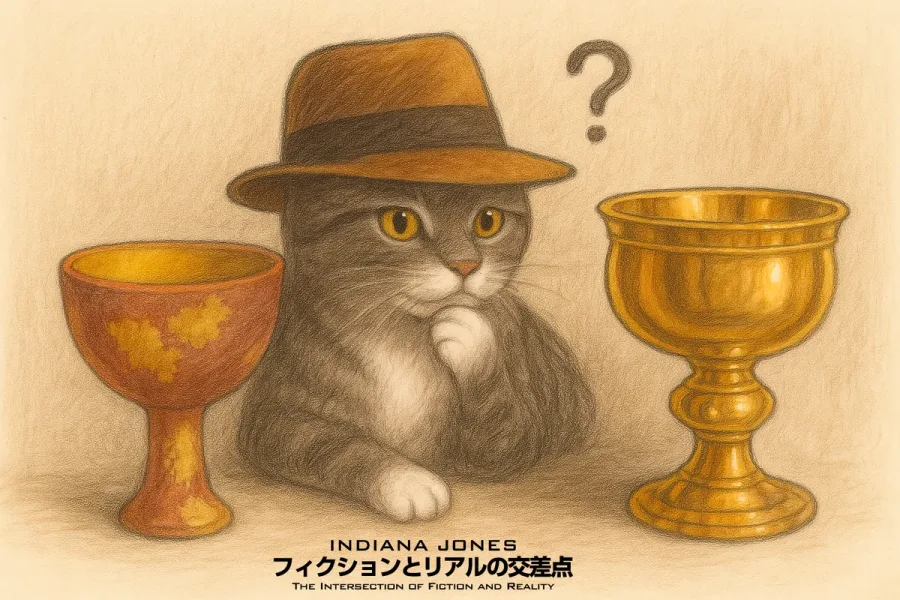
I felt it necessary to first confirm the image of the "Holy Grail" as presented in the "story." This is because therein lies the core of the "mystery" and "symbolism" told throughout the narrative.
In the final scene, Indiana Jones reaches the "Chamber of the Grail" and is asked to choose the "true Grail" while surrounded by a multitude of cups. Among them, it is the simple, unadorned cup, looking like earthenware, that is considered the true Grail. Indy's words—"That's the cup of a carpenter"—reveal its meaning⁽¹⁾. This depiction seems to present a philosophy that does not get caught up in the splendor of outward appearance, but rather places value on the symbolism of origin and purpose. If one views the Holy Grail as an "embodiment of faith," perhaps it contains a paradoxical value system that suggests it should be humble in its very existence.
Such an image is by no means derived solely from fiction. In the "Grail legends" that developed after the Middle Ages, alongside magnificent grails decorated with gold and jewels, there certainly exists a lineage that speaks of the cup as a simple piece of pottery⁽²⁾.
—To begin with, what is the "Holy Grail"?—
Generally, the legend that it is "the cup said to have received the blood of Jesus Christ, who was crucified" is widely known, but that image is not fixed. Rather, its interpretation and shape have fluctuated depending on the era and culture. The figure of the "Holy Grail" told through works of art presupposes such ambiguity and diversity of symbolism.
To what layers of tradition and imagination did the "story" connect to create this depiction? Exploring that is the starting point of this record for me.
I have long held a vague impression of the word "Holy Grail." Is it merely a vessel, or is it a hidden treasure? While it is a sacred relic derived from Christian faith, the way it is spoken of is not necessarily uniform.
The root of that ambiguity lies, after all, in the "Grail legend" that unfolded in the Middle Ages. What I arrived at during my investigation was the epic poem "Perceval, the Story of the Grail"⁽³⁾ by the late 12th-century poet Chrétien de Troyes. Chrétien was a troubadour poet who served in the courts of northern France and is known as the person who laid the foundation for chivalric literature. His work is known for skillfully interweaving the Christian values of the time, Celtic traditions, and the philosophy of courtly love, and it is thought that this concept of the "Grail" also contained such multiple cultural elements.
The "Grail" that appears here is not depicted as a vessel that received the blood of Christ on the cross, but rather as a mysterious sacred tool or even a pagan symbol⁽⁴⁾. Its purpose and essence are not clearly stated; it performs functions such as healing the king and carrying miraculous offerings, but what specific power it possesses remains ambiguous.
Furthermore, it seems that along with the elements of a Christian relic, pagan symbols such as the "cauldron of plenty" or "magic vessel" found in Celtic mythology are also superimposed upon it. These are generic expressions for the "sacred cauldron" in the Celtic world; for example, "The Cauldron of Dagda" is said to never be empty and is spoken of as a symbol of abundance that provides food inexhaustibly. Also, "Brân the Blessed’s Cauldron" is said to have the power to resurrect the war dead, but a restriction is imposed that those resurrected cannot speak. These cauldrons occupy a special place in mythology as vessels symbolizing life, rebirth, and spiritual power, and it is possible that they formed the foundation for the image of the Grail as a "vessel that brings miracles."
So, through what process did this "Grail" reach its current image as the "Holy Grail"? I believe that this transition is the key to deciphering the intersection of story and faith. The word "Grail" (Graal) originally derived from the Latin "gradalis," meaning "a large platter for serving food in stages" or "a flat vessel." In the early Middle Ages, this word contained no sacred meaning at all and remained strictly for use as everyday tableware.
However, at the end of the 12th century, as the poet Chrétien de Troyes wrote "Perceval, the Story of the Grail," this "Grail" suddenly appeared as the central symbol of the story. According to Chrétien's description, it was a "mysterious vessel shining with gold" and appeared as a container for the food that heals the king, but it was not explicitly stated to be a Christian relic; rather, it was depicted as an ambiguous and mysterious existence.
At this stage, the "Grail" was not yet the "Holy Grail." However, this ambiguity invited the development of the story. In the early 13th century, Robert de Boron⁽⁵⁾ gave this vessel the religious meaning of "the cup of Christ's Last Supper," and the Grail was redefined as the "Holy Grail" for the first time. In Boron's story, this cup is a sacred relic that received the blood shed during the crucifixion of Christ, and its guardian is Joseph of Arimathea⁽⁶⁾. With this, theological and salvific symbolism came to be superimposed on the word "Grail."
Through such reconstruction, the "Grail" was sublimated from mere tableware into a "sacred symbol to be sought." In the Arthurian legends, the Knights of the Round Table began to go on quests for the Holy Grail, and it changed into a story embodying the symbolic fusion of chivalry and faith. A vessel that only the "chosen one" can obtain—it was not merely a relic, but an object of trial and the culmination of spiritual growth.
Thus, the word "Grail" transformed from a platter on a table into a vessel symbolizing the salvation of the soul at the intersection of story and faith. In other words, the object we call the "Holy Grail" has layers upon layers of early ambiguity, the evolution of tradition, and interpretations of faith, and its substance is not monolithic. It is no exaggeration to say that "there are as many Holy Grails as there are stories told."
Even so, what is common to every tradition is its positioning as a "sacred vessel that only the chosen can reach." In that respect, the fact that Indiana Jones in the "story" approached this cup as one "to be tested" also seems to align with the essence of the tradition.
—In stories surrounding the "Holy Grail," the "chosen one" is always tested.—
It is not merely a structural device in the story, but also a place of trial that exposes the "standards of value" rooted in faith and philosophy. In the scene where Indy chooses the cup—in the "Chamber of the Grail," the vessels lined up before him range from ornate jeweled cups to simple pottery. From among them, he chooses the simplest cup. It is a judgment based on the belief that it is the "cup of a carpenter," and it is considered to have been the "correct choice" as a result.
This depiction skillfully embodies the motif of "choice and trial" at the heart of the Grail legend.
The "sacred vessels" in Celtic mythology actually have a very similar structure. For example, the "Cauldron of Rebirth" (the Cauldron of Cádry)⁽⁸⁾ and the "Cauldron of Murias," counted among the "Four Treasures"⁽⁹⁾, have the power to resurrect the dead, but it was said that the results changed depending on the heart of the person using that power. It is not the vessel itself, but how one handles and understands it that is questioned. This idea seems to be secretly incorporated into the lineage of the "Holy Grail."
On the other hand, the Cathars⁽¹⁰⁾, who flourished in southern France in the 12th and 13th centuries, viewed the material world as corrupt and considered only pure spirituality to be the truth. In that philosophy, the Holy Grail was sometimes interpreted not as a "vessel with form," but as a "vessel of the spirit"⁽¹¹⁾. In other words, what one should choose is not the "visible cup," but the "invisible truth."
When viewed from such diverse perspectives, Indy's choice should perhaps be grasped not merely as a formula of "simple appearance = correct answer," but as an intersection of faith, judgment, intelligence, and intuition behind it.
And what must not be forgotten is the point that Indy did not choose based solely on his own intuition. He moved forward while understanding the procedures of the Grail quest and the meaning of the trials, using the notes in the diary left by his father, Henry, as a clue. In other words, "choice" is never an act performed solely by individual intuition, but one built upon records, knowledge, faith, and family bonds passed down from the past.
—It is not guaranteed that those who reach the Holy Grail will win the trial.—
In the story, Indy, having found the true Holy Grail, uses it to save the life of his father, Henry. However, the "line that must not be crossed" that occurred afterward—the act of Elsa, an archaeologist who was cooperating with the Nazis, trying to take the Grail out of the sanctuary—results in collapse and loss⁽¹²⁾.
As a "cup that saves lives" and at the same time a "symbol of the limits that must not be crossed," I felt an important duality there. It seems that a clear ethical message is embedded in this setting of "limits." The problem is not the acquisition of power itself, but the will to possess that power privately, or the arrogance of trying to take hold of something sacred. That is what is shown in the story as an "act to be judged."
The Holy Grail is something that should only be obtained by a "righteous will," and it is something that "functions" momentarily rather than being held.
This structure leads to the principle often seen in mythology and religion that "contact is permitted, but possession is not."
For example, in the Arthurian legends, those qualified to see the Grail are limited, and it is not permitted for secular people to possess its power. Indy experiences that lesson firsthand.
And at the end of the story, when the cup he lets go of disappears into the rocky crevice, it was as if it were saying that the existence of the "Holy Grail" did not belong to this world from the beginning.
The "Holy Grail" depicted by fiction is reconstructed as a symbol of human desire and faith, while using the "real view of the Grail" that has continued to transform in myth and history as a foundation.
The cup vanishes, and life remains.
The power is lost, and the bond remains.
When asked "What did you get?" Indy's father answers quietly—"Illumination."Perhaps that was another "truth" found beyond the Holy Grail.
I would like to record this as a cross-section of the "quest for truth" that is repeated across eras, through the "story of a certain seeker" named Indiana Jones.
(Excerpt from Exploration Record 03-01)
List of Annotations(¹) This is a carpenter's cup: Jesus Christ is depicted in the New Testament as the son of Joseph, a carpenter of Nazareth, and his status as the "son of a carpenter" influenced later symbolic interpretations.
(²) A lineage speaking of the cup as a simple piece of pottery: For instance, in medieval Christian mysticism, there are examples of the Holy Grail being depicted as a symbol of humility, where simple vessels of pottery or wood were considered the "true cup" rather than those made of luxurious metal.
(³) The epic poem "Perceval, the Story of the Grail": A story written by the French poet Chrétien de Troyes at the end of the 12th century, in which the word "Grail" appeared for the first time.
(⁴) A sacred tool or a pagan symbol: Alongside the Christian interpretation of the "cup of the Last Supper," there are theories pointing to its connection with the vessel of fertility or the cauldron of rebirth in Celtic mythology.
(⁵) Robert de Boron: A French poet of the early 13th century whose work depicts the Holy Grail as the vessel that received the blood of Christ, with Joseph of Arimathea appearing as its guardian.
(⁶) Joseph of Arimathea: The person said to have taken down and buried the body of Christ. In the legend of the Holy Grail, there is a tradition that he caught the blood of Christ in the cup.
(⁷) The Knights of the Round Table set out on a quest for the Holy Grail: In the Arthurian cycle, the Holy Grail is set as a sacred goal, and knights such as Galahad and Percival take on the adventure of the quest.
(⁸) The Cauldron of Rebirth (Cauldron of Dagda): A magical cauldron appearing in Celtic mythology. It has the power to revive those who have died once, but it is depicted as a trial that questions the "state of the heart" rather than a complete resurrection.
(⁹) The Cauldron of Murias: A magical vessel said to have been brought by Murias, one of the four cities appearing in the Irish myth "The Four Treasures," symbolizing a "power that is never satisfied."
(¹⁰) Cathars: A heretical Christian movement that spread in southern France during the 12th and 13th centuries, which viewed the material world as evil and emphasized spirituality.
(¹¹) Interpretation as a vessel of the spirit: A symbolic understanding that views the Holy Grail not as a physical cup, but as a receptacle for faith or the soul, seen in Cathar thought and mysticism.
(¹²) Elsa Schneider: An Austrian female archaeologist who collaborates with the Nazis. In "The Last Crusade," she briefly travels with Indy but meets a tragic end due to her ambition to obtain the Holy Grail itself.
※ The contents written in this note are all based on my personal perspective and interests. They do not deny the intentions of the creators or the feelings of individual fans regarding the films, characters, or works, nor is there any intention to impose anything on anyone.