On Monday, June 1, 2026, one of Japan Post's cross-border e-commerce shipping services changed. The shipping method previously known as "International e-Packet Light" has been renamed to "International Air Packet", and at the same time, the supported area has expanded from the previous 138 countries and regions to all countries and regions worldwide where international mail can be sent.
This might be news you'd want to skip over, thinking, "It's just a name change, right?" However, for sellers selling low-unit-price, lightweight products overseas, this change is the perfect time to review your shipping settings and profit margins. The fact that you can send to more countries means you can go after orders from regions you had previously given up on. And the timing of the name change is a natural trigger to reorganize your shipping policies.
In this article, after accurately grasping the basics of "what is the difference between International Air Packet and International e-Packet Light" and "how much are the rates" based on official information, I will explain specific ways for low-unit-price sellers to turn this shipping update into sales.
What is International Air Packet? What has changed from International e-Packet Light?
First, the conclusion. There are only two major changes as of June 2026.
Name change: "International e-Packet Light" → "International Air Packet"
Expansion of service area: Previous 138 countries/regions → All countries/regions worldwide where international mail can be sent
And here is the point that will reassure sellers. The rates and service content (specs) themselves have not changed after the name change. If you have been using International e-Packet Light, the usability is basically the same. You can just understand it as having more destination countries available.
POINT: The origin of the name "Air"
The "Air" in "International Air Packet" is a combination of "AIR" for airmail handling and the acronym for the international specific record tracking service, "Acceptance Identification Recorded." In other words, the name itself describes the service content: "small packages sent by air that can be tracked."
Basic service specs (as of June 2026)I will organize the specifications of International Air Packet, focusing on the items necessary for practical work.
Classification: Small packet handled as airmail
Tracking: Tracking function included (however, tracking may not be provided depending on the situation in the destination country)
Weight limit: Up to 2kg
Size: Length + width + thickness = within 90cm (maximum length 60cm). For rolls, length + 2x diameter = within 104cm (maximum length 90cm). Minimum size is 14.8cm x 10.5cm
How to send: Print a dedicated label using the International Mail My Page online shipping tool and submit it at the post office counter using a dedicated pouch (handwritten labels are not accepted)
Regarding delivery days, there is no official statement from Japan Post on "how many days it will take to arrive." Since the time until arrival varies depending on the circumstances of the destination country/region, it is honest to tell customers that "it depends on the country/region."
Also, there is no explicit limit stated for compensation, and valuables such as cash and jewelry cannot be sent. If you are handling high-priced items, please consider using a courier (private delivery service) as described later.
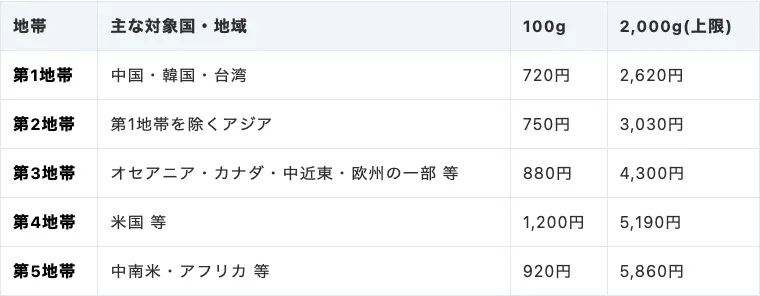
International Air Packet rate list (as of June 2026, by zone)
Rates are set by dividing the world into five zones, and all include the 370 yen fee for the International Registered Mail tracking service. The table below shows the rates for each zone at 100g and the 2,000g maximum.
What you notice when looking at the table is that the lighter the package, the smaller the rate difference between zones, and the heavier it gets, the wider the gap becomes. For example, at 100g, the difference between Zone 1 and Zone 4 is 480 yen, but at 2,000g, it widens to 2,570 yen. This is why it is said that "the lower the unit price and weight of the product, the better it suits this service."
Note: Always check the latest official information for rates
The above rates are as of June 2026. Since postal rates are subject to change, please be sure to check the latest rates on the official Japan Post website when actually setting or estimating shipping costs.
Significance for low-unit-price/lightweight product sellers: How to use it alongside couriers
So, how can you utilize this International Air Packet in practice? The key is "differentiating usage from couriers (private delivery services like DHL/FedEx)". Both have clearly defined areas of expertise.
A common mistake many sellers make is "sending all orders using the same shipping method." If you send even light products via courier, you will lose money on shipping, and conversely, if you send high-value or heavy items using a method with minimal coverage, you will face significant losses in the event of a problem.
Therefore, it is effective to create a rule to assign shipping methods based on "weight" and "unit price" for each product. For example, even a simple criterion like this works well.
2kg or less & low to medium unit price → International Air Packet (aiming for low cost with tracking)
Over 2kg or high unit price requiring extensive coverage → Courier
With the service area now expanded worldwide, you can now accept small orders from regions you previously turned down because they "weren't in the supported countries" using International Air Packet. Being able to recapture small-lot overseas orders that were previously missed—this is the practical benefit of this update.
Turning shipping updates into sales: How to think about free shipping and profit calculation
The name change and expansion of supported areas are perfect excuses to review your shipping policy. One thing you should especially consider is "how you present shipping costs." Overseas shoppers tend to abandon their carts the moment they see high shipping costs—this is a universal challenge in cross-border e-commerce.
This is why many sellers adopt "shipping-included pricing (free shipping display)". This is a method of incorporating shipping costs into the product price and displaying it as "free shipping." However, if you introduce this carelessly, it will eat into your profits, so be sure to calculate in the following order.
POINT: 4 steps to determine shipping-included pricing
Identify the zones of your main sales destinations (e.g., if most sales are to the US → use Zone 4 as the standard)
Check shipping costs based on the actual weight of the product (deduct zone-based rates using the weight including packaging materials)
Add up cost + shipping + sales commission + target profit (this is your minimum selling price)
Verify if you can compete with market prices at that price point (if it's too high, reconsider weight reduction or product selection)
This is where the aforementioned rate characteristic—that the lighter it is, the smaller the zone difference—comes into play. If you can pack products as lightly and thinly as possible, the fluctuation in shipping costs across multiple zones becomes smaller, making it easier to offer the same terms worldwide with a single shipping-included price. Price design becomes simpler, and operational effort is reduced.
On the other hand, if you offer "free shipping" uniformly even for products in weight ranges with large regional price differences, you risk running a deficit every time an order comes in from a distant region like Zone 5. For heavy products, you need to make decisions such as using different policies depending on the weight of the product, such as displaying shipping costs separately by zone or excluding certain regions.
Another thing not to be forgotten is the operational effort. International Air Packet requires printing dedicated labels from the International Mail My Page and submitting them at the counter using a dedicated pouch. As orders increase, the workload of label issuance, packaging, and submission cannot be ignored. Even if you can optimize shipping costs, it is meaningless if your shipping operations cannot keep up.
Summary: Now is the Chance to Organize Your Shipping Rules
Let's look back at the changes in June 2026 simply one more time.
"International e-Packet Light" has been renamed to "International Air Packet"
The supported area has expanded from 138 countries/regions to worldwide
Rates and specifications remain unchanged, making it compatible with lightweight, low-unit-price products
It is a great opportunity to review how to use it alongside couriers and to design shipping-inclusive pricing
Now that the number of countries you can ship to has increased, it is the perfect time to pick up small-lot orders you have been missing out on and to rebuild your profit margins by reviewing your shipping settings. Once you properly establish your shipping rules, they become a "system" that will continue to be effective from then on.
▼ Cross-Border E-commerce Operation Agency Service "Sekahan"
An operation agency service that realizes overseas sales of Japanese products with zero specialized personnel or capital investment. The US Amazon market is more than 15 times larger than Japan's — won't you take a step into the overseas market with us?
▼ "Sekahan - Amazon JPY Converter" for free market research on overseas Amazon
#InternationalAirPacket #InternationalePacketLight #OverseasShipping #ShippingSettings #JapanPost #LowUnitPriceProducts #ShippingPolicy