Why did a circus elephant escape into the city? The questions left behind by the 1994 Tyke the Elephant rampage
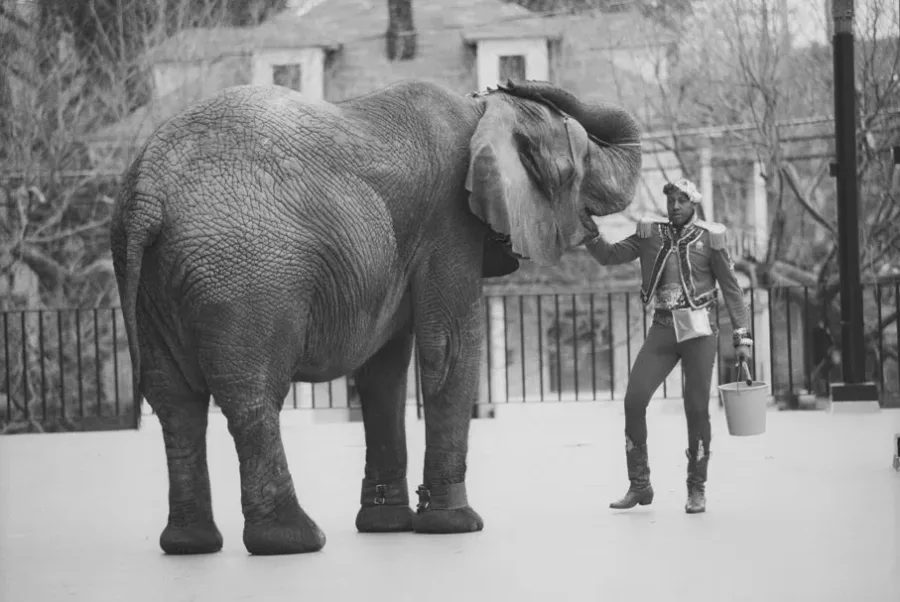
August 20, 1994, Honolulu, Hawaii.
At a circus venue bustling with families, an elephant suddenly began to rampage.
The elephant's name was Tyke.
She was a female African elephant born in Mozambique in southeastern Africa who had been brought to the United States at a young age. In 1994, Tyke was around 20 years old. She was an elephant who had performed on the circus stage for many years, following human instructions to put on shows.
To the audience, circus elephants appear to be "trained, safe animals."
Despite their massive size, they walk on cue, form lines, and perform tricks with their trunks. Because of this, many people likely form the impression that elephants are "intelligent, gentle, and domesticated animals."
However, that is merely how they appear from the human perspective.
Elephants are massive wild animals weighing several tons.
Once they break free from human control, it is difficult to stop them with simple fences or doors.
And in the Tyke incident, that danger became reality in the worst possible way.
The tragedy that began in front of the audience
That day, Tyke was performing in the "Circus International" show held at the Neal S. Blaisdell Center in Honolulu.
However, in the middle of the show, Tyke suddenly lost control.
The first person attacked was Dallas Beckwith, who was taking care of the elephant.
Tyke knocked him down and attempted to attack him further.
37-year-old trainer Allen Campbell stepped in to stop her.
However, Campbell was also attacked by Tyke and died in front of the audience. Beckwith was also seriously injured. The venue was instantly engulfed in terror and chaos, and several audience members were also injured while trying to escape.
But the incident did not end there.
After escaping the arena, Tyke bolted straight into the streets of Honolulu.
A multi-ton African elephant ran down the road, crashing into cars and chasing pedestrians.
Police vehicles gave chase, and a corner of the city turned into a scene for stopping a massive wild animal.
This bizarre spectacle was also captured on video.
In 2024, looking back on the 30th anniversary of the incident, Hawaiian news reports stated that Tyke ran around the streets of the Kakaako district and that police responded for approximately one hour. Ultimately, the police fired 87 shots at Tyke.
Normally, one might think of this as an 'accident caused by an elephant that suddenly turned violent.'
However, that is not the reason why the Tyke incident continues to be discussed more than 30 years later.
What became clear later was the fact that this rampage was not entirely 'sudden.'
From Mozambique to the Circus
Tyke is believed to have been born in Mozambique around 1973.
The 2015 documentary 'Tyke Elephant Outlaw,' introduced by the Animal Welfare Institute, tells the story of how young Tyke was separated from her family and transported to the United States. The company that subsequently owned Tyke was Hawthorne Corporation, based in Illinois.
In the United States at that time, there was a business of owning large animals such as elephants and leasing them to circuses across the country.
Tyke would go on to live a life of traveling to various locations and performing in shows.
However, at least according to the testimony of some former trainers, Tyke was never an easy elephant to handle, even from a young age.
In August 1994, immediately after the incident, the Los Angeles Times reported the testimony of Bryan McMillan, who had experience training Tyke about 15 years prior.
He stated that although he tried to teach the then-young Tyke tricks to perform in a nightclub for about three months, Tyke disliked the training and tried to escape.
McMillan ultimately decided that Tyke was not suitable for training. Furthermore, after the incident, he said, 'I wouldn't work with an elephant of this nature. It's too dangerous.'
The important point here is not to simply label Tyke as an 'elephant born violent.'
It is the fact that those involved at the time may have recognized her 'unmanageability' from a very early stage.
Nevertheless, Tyke was not removed from the circus world.
Transported, trained, performing on stage, and then moving on to another city.
That kind of life continued for about 20 years.
And in 1993, about a year before the Honolulu incident, a series of events occurred that more clearly demonstrated her dangerous nature.
Multiple anomalies that had already occurred
As reported by the Los Angeles Times immediately after the incident, Tyke had a history of multiple behavioral problems, and in 1993, an accident occurred in North Dakota where she broke a trainer's ribs.
Also, in Pennsylvania, an incident occurred before a performance where Tyke broke a door significantly and escaped outside.
At the time, the U.S. Department of Agriculture had received information about 'three or four' past incidents involving Tyke, but stated that they had not been able to confirm all of them at that stage.
Hawaii News Now in 2024 also looked back, noting that before the Honolulu incident, Tyke had caused problems such as escapes in Pennsylvania, North Dakota, and Canada, resulting in damages and injuries.
In other words, if you look only at the rampage on August 20, 1994, it looks like an 'unpredictable accident'.
But if you look back in time, there were multiple warnings before that.
Resisting human instructions.
Trying to escape.
Destroying equipment.
Injuring people.
Even so, Tyke continued to perform in shows.
Why was an elephant showing signs of danger not removed from the stage?
And on August 20, 1994, what happened to Tyke?
What awaits next is the rampage that began while hundreds of spectators watched, and the unusual chase that engulfed the streets of Honolulu.
On August 20, 1994, a routine show turned into a tragedy.
August 20, 1994.
A large crowd had gathered at the Neal S. Blaisdell Center in Honolulu, Hawaii.
The event taking place was a performance of 'Circus International'.
For families and children, it was supposed to be a fun weekend event.
One of the elephants standing on that stage was Tyke.
Although Tyke had exhibited multiple behavioral problems in the previous year, she was brought out in front of the audience again that day.
And in the middle of the show, that massive body suddenly broke free from human control.
The first person Tyke attacked was Dallas Beckwith, who was taking care of the elephant.
Beckwith was knocked down.
Trainer Allen Campbell rushed in to try and stop Tyke.
However, it was impossible for human strength to stop an African elephant weighing several tons.
Tyke attacked Campbell.
Campbell, who was 37 years old, died from the injuries he sustained at that time.
In front of the eyes of the audience who had come to see a fun circus, a human life was taken.
The venue fell into a panic.
Screams echoed, and the audience began to flee all at once.
According to an article published by Hawaii News Now in 2024, marking 30 years since the incident, Campbell was killed by Tyke, and over a dozen people, including Beckwith, were injured.
However, Tyke did not stop there.
It escaped the arena and headed outside the building.
From that moment on, the incident was no longer just an accident inside a circus venue.
A multi-ton elephant in the streets of Honolulu
Having escaped the venue, Tyke bolted straight into the city streets.
Running down the road, weaving between cars, while people fled in panic.
An agitated African elephant had suddenly appeared in an ordinary city.
Police officers trying to stop Tyke.
Citizens fleeing.
And police cars chasing Tyke.
This bizarre scene was recorded by television cameras and the cameras of citizens.
One of the reasons why this incident leaves such a strong impression to this day is likely the existence of this footage.
Tyke was not simply running away.
There were scenes of her chasing people on the street, and the danger of further harm to the general public continued.
Meanwhile, it was an extremely difficult situation for the police as well.
The opponent was not a criminal.
It was a massive wild animal weighing several tons.
While one might consider having a few police officers subdue a human, that would not work on an elephant.
Even if they blocked its path with police cars, there was a possibility it would break through.
And, one person had already died.
“If things continue like this, there may be more victims.”
Immediate decisions were required at the scene.
The question of “Why didn't they just use a tranquilizer gun?” is often raised.
However, sedatives for large animals do not take effect the moment they are fired, as they do in movies. Because it takes time for the effects to appear depending on the individual's condition and dosage, it is not an easy option in an emergency situation where an agitated giant animal is moving through a city.
And so, the police ultimately chose to use live ammunition.
87 Bullets
The police officers fired at Tyke.
However, the elephant's massive body did not stop easily.
According to Hawaii News Now in 2024, a total of 87 bullets were fired by police officers at Tyke.
Despite being struck by a large number of bullets, Tyke did not fall immediately.
Eventually, Tyke collapsed on the street.
The final moments captured on video spread around the world as a scene that symbolized the incident.
There is a very complex composition here.
One person, Allen Campbell, was killed by Tyke.
There were also injuries.
Ordinary citizens were put in danger in the city.
The police have a responsibility to protect the lives of citizens.
On the other hand, many people who saw the footage also felt something else.
“Why was this elephant driven to this point?”
That is the question.
Simply explaining the incident as,
"a violent elephant went on a rampage and was shot to death"
leaves some parts that just don't sit right.
This is because there were signs of danger from Tyke even before the incident.
Even so, she was brought to Honolulu and continued to perform in shows in front of an audience.
That fact significantly changed the discussion after the incident.
"Why did they keep putting her in the show?"
After the incident, attention turned to Tyke's past.
She was not the first elephant to cause problems in Honolulu.
In the previous year, there had been incidents where she injured people and broke through facilities to get outside.
Furthermore, people who knew Tyke from a young age testified that she was a difficult elephant to handle.
In other words, for those involved, Tyke's temperament and past problems were not completely unknown.
This gives rise to one major question.
If incidents indicating danger were being repeated, why was Tyke not retired from the show?
Why was she brought to a place with hundreds of spectators?
And, in the first place, was it right for humans to think they could "completely control" a multi-ton wild animal?
The discussion surrounding the Tyke incident gradually shifted from the personality of one elephant to the circus system itself.
Was she a "violent elephant," or...
There is a point that must be noted in order to understand the Tyke incident.
There is no definitive answer to date as to why Tyke went on a rampage.
After the incident, the environment in which Tyke had been kept for many years was called into question, particularly from the standpoint of animal welfare.
Wild elephants are inherently highly social animals.
Female African elephants, in particular, live in herds centered around their mothers, sisters, and other relatives.
They travel over wide areas and live while communicating with their companions.
However, it is difficult to recreate the same environment in a traveling circus.
They move from performance site to performance site, are managed in limited spaces, and perform tricks according to human instructions.
Animal welfare organizations have pointed out the possibility that the stress caused by such long-term confinement, travel, and training influenced Tyke's behavior.
The Animal Welfare Institute later introduced the Tyke incident as an event that symbolizes the treatment of elephants in circuses.
https://awionline.org/awi-quarterly/spring-2016/tyke-elephant-outlaw/
On the other hand, there is also testimony from people who actually had experience handling Tyke that she herself was particularly difficult to handle from a young age.
Therefore,
"Everything was caused by the captive environment"
cannot be concluded either.
Was it stress caused by the environment?
Was it largely due to Tyke's own individual differences or temperament?
Or was it the result of both factors combined?
Since Tyke herself cannot explain it in words, it is nearly impossible to prove the final answer.
However, regardless of which was the cause, there is one unchanging fact.
Even before the incident, Tyke had shown signs of escaping human control on multiple occasions.
And despite those warnings, she was still standing in front of an audience on August 20, 1994.
After the incident, what people began to ask was,
Why did the elephant go on a rampage?
It was not just that.
Why did they continue to use an elephant that had the potential to go on a rampage?
This was a question directed more at the human side.
It is this perspective that would transform the Tyke incident from a mere animal accident into an event that shook the entire circus industry.
From the issue of a 'dangerous elephant' to 'human responsibility'
Immediately after the incident on August 20, 1994, for many people, Tyke was a 'dangerous elephant that killed a person and went on a rampage through the city.'
In fact, one trainer died and many people were injured.
Regarding the police shooting Tyke, there is no doubt that the situation on the ground at the time was extremely urgent, as it was necessary to protect the lives of citizens.
However, as the details of the incident became clear, public perception gradually began to change.
The problem was,
Why did Tyke go on a rampage?
It was not just that.
Why did humans continue to put Tyke in shows when there were signs of danger?
This is the question.
Incidents of escape and injuring people had occurred even before the previous year.
There was also testimony that she had been difficult to handle since she was young.
Even so, Tyke did not retire and continued to tour various circuses.
What if Tyke had been removed from the show in 1993?
What if the past behavioral problems had been taken more seriously as a warning?
Could the tragedy in Honolulu have been prevented?
After the incident, this question would remain heavily on everyone's minds.
Wild elephants versus circus elephants: their vastly different lives
The Tyke incident brought attention to the living conditions of elephants in circuses.
Elephants are known to be highly social animals.
Wild African elephants, especially females, form herds centered on kinship and live with their families for long periods.
They also travel over wide areas, searching for food and water to survive.
Tyke was also originally an animal meant to live in such an environment.
However, Tyke's life changed drastically after she was captured as a calf and transported to the United States.
What awaited her was a life in a traveling circus.
Moving with every performance.
Being managed in a confined space.
Being taught tricks by humans.
And repeating predetermined movements in front of an audience.
Animal welfare organizations such as the Animal Welfare Institute have strongly argued that this lifestyle may have caused Tyke long-term stress.
The methods used to restrain and train elephants were a particular subject of debate.
At the time, circuses used various management methods to make large elephants follow human instructions.
One of these was the 'ankus,' a tool commonly known as a bullhook.
It is a tool with a hook-shaped tip that has been used to guide and direct elephants.
Regarding such training, intense debate has continued for many years between the circus industry and animal welfare organizations.
And the Tyke incident would become a symbolic event in that debate.
Had Tyke reached her 'limit'?
From an animal welfare perspective, the behavior Tyke displayed in Honolulu was not an abnormal behavior that occurred suddenly one day.
Being taken from the wild at a young age.
Being separated from her original herd.
Repeatedly traveling over long periods.
Having periods of being restrained.
Being trained to follow human commands.
And having repeatedly escaped or displayed aggressive behavior even before the incident.
When viewing these as a sequence of events,
'Could it be that Tyke reached her limit after years of accumulated stress?'
This interpretation arises.
The documentary "Tyke Elephant Outlaw," produced later, also highlighted this issue significantly.
Released in 2015, this work looks back on Tyke's entire life, not only through footage from the time of the incident but also through interviews with former trainers and witnesses.
A review in The Hollywood Reporter also notes that this film portrays Tyke's rampage not as an isolated event, but as connected to her long life in the circus.
Because of this, some people today talk about Tyke not as:
"A ferocious elephant that went on a rampage"
but rather as:
"An elephant driven into a corner by humans that finally resisted."
However, this interpretation also requires caution.
It is impossible to scientifically reconstruct Tyke's psychological state and identify a single cause for her actions on August 20, 1994.
What did Tyke herself feel?
What was the final trigger?
There is no evidence left that can definitively answer these questions.
Testimony that she was "difficult to handle from the start"
On the other hand, trainers who actually worked with Tyke have offered a different perspective.
From a young age, Tyke disliked following orders and had a tendency to try to escape training.
In other words, this is the view that:
"Her personality did not suddenly change due to circus life; she was an extremely difficult individual to handle from the beginning."
This is the perspective.
This is the view.
The Los Angeles Times published testimony from Brian McMillan, who once trained Tyke, immediately after the incident.
He tried to train Tyke, but it did not go as planned, and he eventually gave up on the training.
After the incident, he also stated that he would not work with an elephant like Tyke.
If we place importance on such testimony,
the conclusion is that
"Tyke's behavior cannot be explained solely by the captive environment."
The individual's personality.
Past experiences.
Captive environment.
Training.
Long-term stress.
And the situation on the day of the incident.
In reality, it is possible that multiple factors overlapped.
That is why, regarding the Tyke incident,
"abuse was the cause"
or
"it was a naturally violent elephant"
we should be cautious about dismissing it with a single word.
However, even if opinions on the cause differ, there is one problem that remains unchanged.
The very premise that they can be "completely controlled"
The Tyke incident really called into question more than just the elephant's temperament.
It was about human risk management.
If Tyke's rampage was caused by long-term stress, then the problem lay with the humans who created that environment.
Conversely, if Tyke was an extremely difficult individual by nature, then the decision to keep putting such an elephant in front of an audience becomes the issue.
In other words, whichever theory you adopt,
you cannot escape the question,
"Then why did they keep putting Tyke in the show?"
Moreover, Tyke was not a small animal.
She was an African elephant weighing several tons.
Even if she usually followed the trainer's instructions, once control was lost, she could not be easily stopped by human strength.
On August 20, 1994, hundreds of spectators witnessed that reality.
Not the trainer's experience.
Not the training.
Not the venue's facilities.
Not the police patrol cars.
None of them could safely restrain Tyke.
In the end, the situation could only be stopped by the extreme measure of firing 87 bullets.
"If humans train them, giant wild animals can be safely managed."
The glamorous stage of the circus was built upon that premise.
The Tyke incident confronted the world with the fact that its premises were by no means absolute.
Social values regarding circuses begin to change
After the incident, Tyke's name began to be mentioned repeatedly within the animal welfare movement.
In particular, the pros and cons of using large wild animals, such as elephants, in traveling shows for entertainment purposes began to be questioned.
The Tyke incident was not the only thing that brought about subsequent changes.
The debate surrounding circus animals had long-standing movements regarding breeding environments, safety, and animal welfare, and the values of society as a whole gradually changed.
However, the footage of a giant elephant running through the streets of Honolulu left a strong impression of the issue on the general public as well.
What lies behind the 'cute elephant show'?
And what happens the moment that animal stops obeying human commands?
The Tyke incident showed both of these things in a way that anyone could understand.
And as the years passed since the incident, its influence also led to concrete regulatory movements.
Even more than 20 years after Tyke's death, her name continued to be mentioned in Hawaii in debates over entertainment using wild animals.
The incident, which began with the rampage of one elephant, eventually turned into an even larger question:
'Should wild animals be used for entertainment in the first place?'
That is what it turned into.
The death of one elephant forced a rethink of the nature of the circus
On August 20, 1994, when Tyke collapsed on the streets of Honolulu, the incident itself ended.
However, the story surrounding Tyke did not end there.
In fact, as time has passed since the incident,
"Why did Tyke continue to perform in shows until that day?"
"Is it truly safe to use large wild animals for entertainment purposes?"
These questions have increasingly come into focus.
And Tyke has become a symbolic figure when considering the use of animals in circuses.
Of course, it was not just the Tyke incident that changed American circus culture.
Debates surrounding animal welfare had existed for some time, and societal values continued to shift over many years thereafter.
Even so, the shock that the Tyke incident gave to people was immense.
This is because,
"What happens when humans can no longer completely control a giant wild animal?"
Many people witnessed this danger through the footage.
Regulations on wild animal shows in Hawaii
Especially in Hawaii, where the incident took place, the memory of Tyke has remained for a long time.
Even more than 20 years after the incident, Tyke's name has repeatedly appeared in discussions regarding the pros and cons of using wild animals for entertainment purposes.
Then, in 2018, the state of Hawaii significantly strengthened regulations against using highly dangerous wild animals such as elephants, tigers, lions, and bears for entertainment purposes like circuses and carnivals.
In 2024, looking back on the 30 years since the incident, Hawaii News Now also reported that after the Tyke incident, the way of thinking about the use of wild animals in circuses in Hawaii changed, and currently, it is not permitted to bring such animals into the state for entertainment purposes.
In a sense, that was one of the most concrete social changes left behind by the Tyke incident.
A tragedy that occurred 30 years ago at a circus venue watched by hundreds of spectators.
That memory, over many years, has influenced systems and societal values.
A film that brought the incident to the world once again
Another reason why the Tyke incident is still talked about today is the existence of footage.
On the day of the 1994 incident, Tyke's rampage at the venue and her run through the streets of Honolulu were recorded on video.
This was not an era like today, where everyone carries a smartphone and instantly posts events to social media.
Even so, footage of the incident remained and became widely known through television news and other media.
Then, about 20 years after the incident, a documentary was produced based on that footage and the testimonies of those involved.
This was the 2015 release, "Tyke Elephant Outlaw."
In addition to the footage from the day of the incident, the work uses testimonies from people who knew Tyke, former trainers, and those involved in animal welfare activities to depict
"what happened on August 20, 1994"
not only,
"why it reached that point"
as well.
In a review at the time, The Hollywood Reporter introduced this work as one that raises questions about the treatment of elephants in circuses and the human use of wild animals for entertainment through the Tyke incident.
With the arrival of the documentary, Tyke's existence became known to generations who did not know about the incident at the time.
On the other hand, this work has a strong perspective on animal welfare.
Therefore, one should be cautious about concluding that the interpretation presented by the work is the definitive "cause of Tyke's rampage."
This is because multiple viewpoints regarding the incident still exist today.
Was Tyke a "perpetrator" or a "victim"?
When looking back at the Tyke incident, a very difficult problem remains.
It is the question of how we should categorize Tyke.
Looking only at the events of August 20, 1994, Tyke undoubtedly caused serious harm to humans.
The trainer, Allen Campbell, lost his life.
There were people who were injured, including Dallas Beckwith.
The audience, who had come to the venue to have a good time, were also suddenly put in mortal danger.
One cannot ignore the existence of the victims and simply tell the story as a 'sad tale of an elephant'.
However, if one looks back at Tyke's own life, a different picture emerges.
A wild elephant born in Africa was taken from its home at a young age and brought to America.
After that, it traveled to various places as a circus elephant for over 20 years.
And despite having exhibited problematic behavior in the past, it continued to perform in shows.
In the end, it ran out into the streets of Honolulu and met its end after being struck by a hail of bullets.
Knowing that life,
'Wasn't Tyke herself also a victim of the circumstances that led to this incident?'
It is understandable that such a perspective would arise.
However, if we decide that one side or the other is the 'villain' here, we lose sight of the essence of this incident.
What we should really be asking is not 'who is to blame'.
It is difficult to set a clear villain in the Tyke incident.
Allen Campbell, who died trying to stop Tyke.
The staff member who was seriously injured.
The audience who fled in terror.
The citizens who encountered Tyke in the city.
The police officers who opened fire to prevent further harm.
And finally, Tyke, who collapsed on the street.
Looking at each of them individually, it cannot be fully explained by a simple composition of 'perpetrator and victim'.
That is precisely why what we should consider from this incident is
'Who was at fault'
not just that.
What is more important is
'Why did this situation come to be?'
is the question.
There were signs indicating danger.
People had been injured in the past.
Escapes had also occurred.
Even so, the show continued.
Looking back at this sequence of events, it is clear that Tyke did not suddenly turn into a 'different elephant' on August 20, 1994.
The tragedy in Honolulu occurred after a series of warnings had piled up.
A question that remains even after more than 30 years
In August 2024, marking 30 years since the incident, the Tyke case was reported on once again in Honolulu.
Even after 30 years have passed, this event has not completely become a thing of the past.
This is because many of the issues left behind by the Tyke incident still resonate with human society today.
To what extent can humans control wild animals?
To what extent is there justification for using animals for entertainment?
When safety and economic viability collide, which should be prioritized?
And above all,
"To what extent can we take the warnings that appeared before an accident seriously?"
This is the question.
This is not just a story about elephants or circuses.
Looking back at the history of major accidents, there are many cases where small anomalies, incidents, and warnings from the field existed before the disaster.
However, as long as a major accident has not occurred,
"It has been fine until now"
"It will probably be fine this time too"
These thoughts tend to prevail.
One can see such aspects in the Tyke incident as well.
Even though problems had occurred in the past, the performances continued.
And finally, a situation occurred that could not be stopped by human hands.
What Tyke ultimately confronted us with
An elephant performing tricks on a circus stage.
For a long time, it was a symbol of entertainment that families could enjoy.
However, for that glamorous stage to exist,
the premise that "a massive wild animal continues to follow human instructions"
was necessary.
The Tyke incident showed the world what happens the moment that premise collapses.
That is why this incident
cannot be fully explained by the single sentence,
"an elephant suddenly went on a rampage and attacked people."
It is a tragedy in which one person named Allen Campbell lost his life, and a serious accident in which injured people and audience members were caught up.
At the same time, it is the story of an elephant brought from the wild into human society, who lived in the world of shows for over 20 years.
What was Tyke feeling on August 20, 1994?
Why did she suddenly completely reject human instructions?
We can no longer know the answer to that.
However, records show that there were signs of trouble many times before the incident.
That is precisely why the greatest lesson the Tyke incident left us with
might not be the simple one that
"elephants are dangerous animals."
It is to stop and not ignore the signs when they appear to warn of danger.
And to question whether what humans think is "under control" is truly under control.
August 20, 1994.
The elephant that bolted from a circus venue in Honolulu into the city continues to leave behind a heavy question about the relationship between humans and wild animals, even more than 30 years later.