For those looking to buy a Mac, a major dilemma right now is
“Should I wait for the M6?”
the question of.
Looking at the currently reported information on the M6, there are quite a few reasons to want to wait.
The first 2nm generation of Apple Silicon
Reports of memory bandwidth increasing from 153GB/s to approximately 200GB/s
Testing up to 12-core GPUs
Enhanced AI-related features
If that were all, it would seem to end with
“I’ll skip the M5 and wait for the M6.”
that.
However, the Apple Silicon roadmap is a bit unusual this time.
According to Mark Gurman of Bloomberg, Apple plans to launch the standard M6 and then skip the M6 Pro, M6 Max, and M6 Ultra, moving directly to the M7 generationinstead.
Moreover, the reason reported for this is AI.
Should you buy the M5 now?
Should you wait for the M6?
Or should you wait until the M7?
When you organize the latest information, deciding when to buy a Mac has become more difficult than expected.
When will the M6 Mac be released?
According to current reliable information, the first Mac to feature the M6 is expected to be the 14-inch MacBook Pro, arriving in late 2026.
The current M5 MacBook Pro was released in October 2025, so this is an update after about one year.
On the other hand, the M6 MacBook Air is expected to arrive in the first half of 2027.
For those eyeing a MacBook Air, this is important.
It is not so close that you can say, 'The M6 is coming soon, so I'll wait a little,' as you would need to wait for several months.
Moreover, there is currently no credible information suggesting that a major design change will occur with the M6 MacBook Air.
The transition to OLED is also seen as being further off.
In other words, the biggest reason to wait for the M6 Air will likely not be the design or OLED, but
the new M6 chip itself
it seems.
The M6 doesn't seem like it will just be a 'slightly faster M5'
So, is the M6 a chip worth waiting for?
Looking only at the information currently available, I think it has the potential to be a quite interesting generation.
The first 2nm Apple Silicon
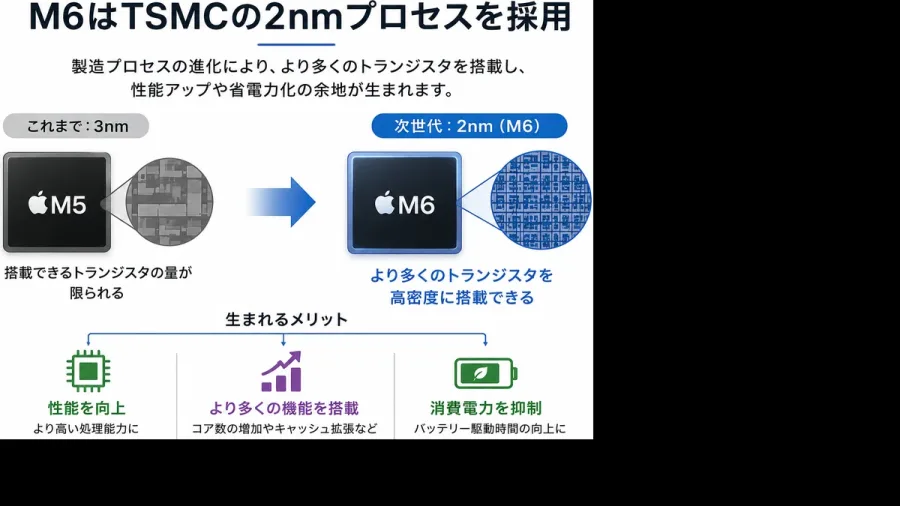
First, the big one is the shift to 2nm.
The M6 is expected to be the first M-series chip to adopt TSMC's 2nm generation.
If the manufacturing process evolves, it creates room to pack more transistors into the same area or to improve the balance between performance and power consumption.
However,
2nm does not equal blazing fast
.
The actual performance will change depending on where Apple allocates that headroom: CPU, GPU, AI, or power efficiency.
And what is interesting this time is that specific enhancement information other than 2nm is also emerging.
Memory bandwidth: 153GB/s → approx. 200GB/s?
The memory bandwidth of the current M5 is 153GB/s.
This is an official Apple figure.
On the other hand, according to Mark Gurman of Bloomberg, it may be increased to approximately 200GB/s in the M6.
That is an increase of about 31%.
Chip memory bandwidth M5 153GB/s (official) M6 approx. 200GB/s (reported) M7 approx. 240GB/s (reported)
So, why increase the memory bandwidth this much?
One important application is AI.
To simplify significantly when running an LLM locally,
Memory capacity
→ how large a model can be deployed in memory
Memory bandwidth
→ how fast that data can be read and written
are the differences.
Therefore, just because the M6 reaches 200GB/s does not mean that a 16GB Mac will suddenly be able to handle huge AI models.
However, in AI processing where memory bandwidth is prone to becoming a bottleneck, increasing bandwidth is a key performance improvement factor.
GPU also testing up to 12 cores
Enhancements are also being reported for the GPU.
The M5 has a maximum of 10 GPU cores, but it is said that Apple is testing configurations with up to 12 GPU cores for the M6.
In terms of simple core count, that is a 20% increase.
Furthermore, reports indicate a redesign of the GPU itself, as well as enhancements to the Neural Engine and video processing capabilities.
Summarizing the current information,
2nm process
+ approx. 31% increase in memory bandwidth
+ testing of up to 12-core GPU
+ AI-related enhancements
is what it comes down to.
Looking at this, the M6 might not just be
“just a slightly faster M5”
after all.
Even I would say that if it's just this much,
“If you're not in a hurry, wouldn't it be fine to wait for the M6?”
I think.
However, this is where the story gets strange.
No M6 Pro, Max, or Ultra?
Since the M1, Apple Silicon has basically been expanded into higher-end chips.
The current generation also follows the flow of
M5 → M5 Pro / Max → M5 Ultra (projected release)
as well.
Normally, the next step would likely be
M6 → M6 Pro → M6 Max → M6 Ultra
as well.
However, according to Bloomberg, while Apple will release a standard M6, it is reportedly planning to skip the M6 Pro, M6 Max, and M6 Ultra and move directly to the next M7 generation.
In other words,
M5 family
↓
M6 only
↓
M7 family
This results in a very irregular roadmap.
So, why would they end the M6 here?
The reason Apple is rushing the M7 is "AI"
Let's look at the currently reported roadmap.
Next-gen chip October 2025 M5 March 2026 M5 Pro / M5 Max Late 2026 M6 Early 2027 M7 Late 2027 M7 Pro / M7 Max 2028 M7 Ultra
What I want to highlight is the short interval between the M6 and M7.
According to Gurman, Apple is planning significant enhancements to Neural Processing for the M7 family.
As a result of prioritizing those improvements, it is believed that they decided to accelerate the M7 itself rather than releasing the M6 Pro/Max in sequence.
In short,
they are skipping the M6 Pro/Max to bring AI performance to market sooner.
If this report is accurate, it means that the priority of AI in Apple Silicon development has become quite high.
M5 → M7: Memory bandwidth increase of about 57%?
The memory bandwidth mentioned earlier seems to symbolize this.
M5: 153GB/s
↓
M6: approx. 200GB/s
↓
M7: approx. 240GB/s
If the reports are correct, that is an increase of about 57% from the M5 to the M7.
Of course, the figures for the M6 and M7 have not been officially announced by Apple.
However,
Rapid expansion of memory bandwidth
+
Significant enhancement of Neural Processing
When you combine this information, it appears that the evolution of Apple Silicon is expanding beyond just
“how fast to make the Mac”
and into
“how much AI can be run within the Mac.”
Will the M6 end up being a “bridge generation”?
From here on is my own analysis.
First, I want to emphasize that
it is not because the M6 is weak. In fact, it is the opposite.
Transition to 2nm.
Memory bandwidth of approximately 200GB/s.
GPU enhancements.
Viewed on its own, the M6 has the potential to be a very attractive chip.
The problem is that
the subsequent M7 is coming too soon.
If you simplify the reported roadmap, it looks like this:
M6 release
↓
No Pro / Max / Ultra models
↓
M7 follows shortly after
↓
Significant AI enhancements in M7
↓
Rollout of M7 Pro / Max / Ultra
Looking at it this way, the M6 starts to look like a bridge to the next full-scale Apple Silicon generation.
And there is one more thing that concerns me.
Did rising memory costs also influence the decision?
This is my own speculation, not a report.
The direct reason for the early M7 release reported by Bloomberg is AI, and
"Apple did not explain that they skipped the M6 Pro/Max because memory is expensive"
is not the case.
However, considering the current market environment, I don't think it's completely unrelated.
If we organize the flow,
memory prices rise
↓
costs for Pro/Max models with large memory capacities increase
↓
upward pressure on product prices
↓
plus the M7 is waiting right behind
↓
the benefits of launching a short-lived M6 Pro/Max decrease
is a plausible scenario.
In that case,
continuing to sell the M5 Pro/Max while concentrating development resources on the next big thing, the M7,
is a decision that has a certain degree of rationality.
Especially now, there is upward pressure not only on DRAM but also on NAND flash, which means SSD prices as well.
Since high-performance Macs are more susceptible to the impact of large memory and storage configurations, this must be a difficult time for Apple as well.
However, I repeat,
it has not been confirmed that rising memory costs are the reason for skipping the M6 Pro/Max.
This is just one hypothesis based on the market environment.
So, should you just wait for the M7?
Having read this far,
"If you're going to wait for the M6, why not just wait for the M7?"
That is the question.
The M7 is particularly intriguing for those who want to use local AI in earnest.
If the reports are true,
it will have a memory bandwidth of approximately 240GB/s.
Furthermore, AI processing itself will be significantly enhanced.
And it is planned to be rolled out to the M7 Pro, Max, and Ultra as well.
However, there is a major problem.
The M7 has not been announced yet.
The release date, performance, and the 240GB/s figure are all based on reports at this time.
There is also a possibility that Apple's plans could change.
And once you start waiting for future Macs,
"If you wait for the M7, the M8 will be on the horizon"
could become the reality.
You will never be able to buy the Mac you need.
Furthermore, there is no guarantee that "waiting will make it cheaper."
Another difficult aspect this time is price.
Normally, when a new Mac is approaching,
the new model is better → buy the new model
it's subtle → buy the older, cheaper model
is a strategy you can use.
However, there are currently issues with component prices and supply, particularly regarding memory and storage.
Apple has also raised Mac prices, and they have mentioned the impact of supply constraints on costs during earnings calls.
In other words,
“if the M6 comes out, I can buy the M5 for less”
is not necessarily true.
The M6 itself could potentially be more expensive.
Therefore, this time,
waiting for a new model equals a better deal
is not necessarily the standard logic that will apply.
Ultimately, which one should you choose: M5, M6, or M7?
Here is how I would think about it at this moment.
Choice: Who it's forBuy M5You need a Mac now. Focus is on photo editing, programming, and general video editingWait for M6You can wait a few months. Focus is on GPU, local AI, and long-term useWait for M7You can wait until 2027. AI performance is the top priority
People who should buy the M5 now
If you need a Mac now, I don't think there is any reason to avoid the M5.
For photo editing, general programming, and video editing, the M5 is already quite fast.
Is there really any benefit to waiting months for a Mac you need just for a future chip?
It would be better to think about this calmly.
People waiting for the M6
This is the most difficult decision to make.
The first 2nm chip.
Memory bandwidth is reported to be around 200GB/s.
Enhanced GPU.
The M6 itself has the potential to be a very interesting generation.
Especially if you plan to use a MacBook Air for a long time, I think it is worth waiting.
However, it is expected that the M6 MacBook Pro will appear before the M6 MacBook Air.
Therefore,
First, check the actual performance of the M6 MacBook Pro.
↓
Decide whether to wait for the M6 Air based on those results.
I think this is a very rational approach.
People who should wait for the M7
This is limited.
Those who can wait until 2027.
And,
Those who prioritize AI performance above all else.
These are the people who meet these two criteria.
If the reports that Apple is rushing to the M7 even by skipping the M6 Pro/Max are correct, it is worth checking the M7 for local AI use cases.
In the end, should you wait for the M6?
My thinking at this point is simple.
If you need a Mac now, get the M5.
If you can wait a few months, first check the actual performance of the M6 MacBook Pro.
If you prioritize local AI above all else, wait for further news on the M7.
The M6 itself has the potential to be a very interesting generation due to the shift to 2nm, increased memory bandwidth, and GPU enhancements.
The problem is not that the M6 is weak.
It is that the M7, which is said to follow shortly after, is far too intriguing.
If reports are correct that Apple is rushing the M7 to the point of skipping the M6 Pro/Max, then for future Apple Silicon,
more than just "how many percent faster the CPU has become,"
it may be that
"how much AI processing can be handled within the Mac"
will become the important factor.
Therefore, right now,
rather than deciding "I will absolutely wait until the M6 comes out,"
I think it is most rational to
make a decision after seeing the first M6 MacBook Pro that appears.
Personally, I think this is the most reasonable approach.
*Excluding information already announced by Apple, such as the 153GB/s of the M5, the specifications, release dates, and product roadmaps for the M6/M7 include unannounced information from sources such as Bloomberg. This is subject to change until Apple's official announcement.
Click here for the YouTube version
In this article, I focused on purchase decisions, but in the video, I explain the M6's 2nm transition, GPU, memory bandwidth, and the reasons for the accelerated M7 release in detail with diagrams.