Hello, this is Papao.
Yesterday, my daughter and I watched the live-action version of 'Moana'.
You know how live-action adaptations can be a bit hit-or-miss, and it's disappointing when the story is weirdly altered, but this one basically followed the original, so I was able to enjoy it with peace of mind.
To be honest, it was dubbed, so in that sense, it was safe.
So.
This introduction of Moana,
"I am Moana of Motunui!"
Did you know that an island called"Motunui"actually exists?
An island called "Motu Nui" actually exists
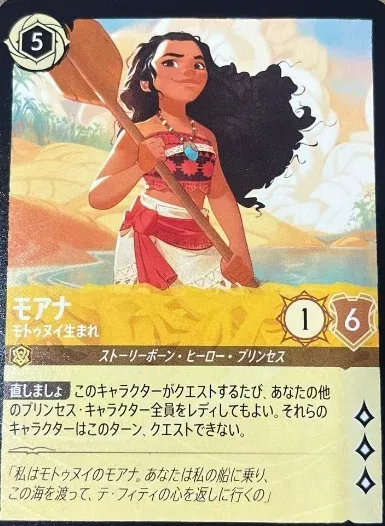
Moana's home is an island called "Motunui" in the story.
While this Motunui itself is a fictional island in the story, there is a real small island in the South Pacific with the same name,"Motu Nui."
The real Motu Nui doesn't seem to be inhabited by people today, but this Motu Nui is related to a certain place.
The name of that place is,
Point Nemo.
What is Point Nemo?
Simply put, Point Nemo is,
the point in the ocean farthest from any land on Earth.
It is officially called the "Oceanic Pole of Inaccessibility."
It is approximately 2,688 km away from the nearest land.
Moreover, one of the closest landmasses is the aforementioned Motu Nui.
Other locations include Ducie Island in the Pitcairn Islands and Maher Island near Antarctica, and Point Nemo is roughly equidistant from all three directions.
In other words,
no matter which way you go, there is no proper land for over 2,600 km.
Incredible.
A "desert of the sea"
What makes the area around Point Nemo incredible is not just its distance from land.
This area is located within a massive circular current called the South Pacific Gyre and is known as one of the most nutrient-poor marine regions in the world.
Phytoplankton, which serve as the starting point for marine life, require nutrients such as nitrogen and phosphorus.
However, this sea area is subject to a combination of conditions:
it is too far from land for nutrients to easily enter from rivers or other sources,
it is difficult for nutrient-rich water to rise from the deep sea,
and there is very little nitrogen in the surface layer.
These conditions overlap.
Research has confirmed that the center of the South Pacific Gyre is particularly oligotrophic, even by global standards, and that the amount of phytoplankton is extremely low.
In short,
there are no islands.
There are no people.
There are few nutrients.
There is little life.
Truly a "desert of the sea."
Te Fiti should have just built an island around here.
Because there is nothing there, spaceships fall into it.
Because it is Point Nemo, there are almost no people or ships in the surrounding area.
That is why Point Nemo is,
just right as a place to drop spacecraft that have reached the end of their lives.
Therefore, controllable spacecraft are sometimes re-entered over the South Pacific, and this sea area is called the "spacecraft cemetery."
NOAA also introduces examples of spacecraft being dropped around Point Nemo.
I suddenly thought about this while watching the movie this time.
In the world of Moana, Te Ka throws lava toward the sea.
At the real Point Nemo, humans drop giant artificial objects from space.
...I wonder why, but this disposal of large spacecraftstarts to look like Te Ka's lava throwing.
I haven't looked into it properly, so I don't think the "legendary sea" in Moana is Point Nemo, but still,
"Does Motunui really exist?"
Starting from that one question,
looking up the name of the island,
going to the place furthest from land in the world,
talking about ocean currents and plankton,
and in the end, you can even reach space development.
Actually, I knew about Point Nemo first, and one of the closest lands to Point Nemo was Motunui—wait, isn't Motunui from Moana? That was the order for me, but this kind of "looking up things you're curious about" is quite interesting, isn't it?
If you haven't decided on your summer vacation independent research project yet,
looking up places that appeared in movies or anime and connecting them to real-world geography or science,
that kind of independent research might be surprisingly interesting.
I also introduce how to create an independent research project below, so if you take a look at that as well, you might be able to nail your project and welcome the new semester with peace of mind.
I hope this article leads to a "I did it!" moment for everyone!
Do you have any discoveries where you thought, "Wait, this actually existed!?"
If you'd like, please let me know in the comments section.
May tomorrow be another great day for you.