Introduction
In 2026, the focus of AI agent discussions shifted from 'which model is smarter' to 'how agents connect with other systems and agents.' Two events in the last six months symbolize this shift. On March 12, 2026, the A2A (Agent2Agent) protocol released v1.0. It is an open protocol for AI agents from different companies to collaborate, and v1.0 is positioned as a production-ready standard.
Then, on August 27, 2026, A2A joined the Agentic AI Foundation (AAIF) under the Linux Foundation as a Growth Stage Project. MCP, goose, and AGENTS.md are listed as sister projects within the AAIF. Peripheral technologies for agents are moving from being proprietary to a single company to becoming a common foundation for the industry.
This article is not a technical specification guide, but rather a discussion on something more structural. Once agents can connect with each other, 'agency' will inevitably become an issue. Immediately after the standard for 'how to talk' is established, the question that arises is, 'Who is this agent authorized by, and what are they entrusted to do?'
News: A2A moves from 'concept' to 'implementation'
A2A is a protocol designed from the start to connect agents across organizational boundaries. The March 12 v1.0 release includes Signed Agent Cards, security flow updates, multi-tenancy, support for multiple transports, and backward compatibility with v0.3. What is noteworthy is that v1.0 was released not as an 'experimental specification' but as a 'production-ready standard'.
The organizational structure is also moving. The Technical Steering Committee includes AWS, Cisco, Google, IBM Research, Microsoft, Salesforce, SAP, and ServiceNow. By the time of the AAIF joining in August, over 150 organizations had expressed support, with the lineup expanding across cloud, business applications, and agent frameworks. What is important is not the number, but the fact that these three layers are coming on board simultaneously.
The blog post announcing the AAIF participation describes the world that A2A will realize: 'Agents publish an "Agent Card" that describes their capabilities and how to connect to them. Other independent agents read that card to determine how to interact and entrust tasks to each other without human intervention.' This future is already close at hand.
Differences from MCP, and the Agent Card
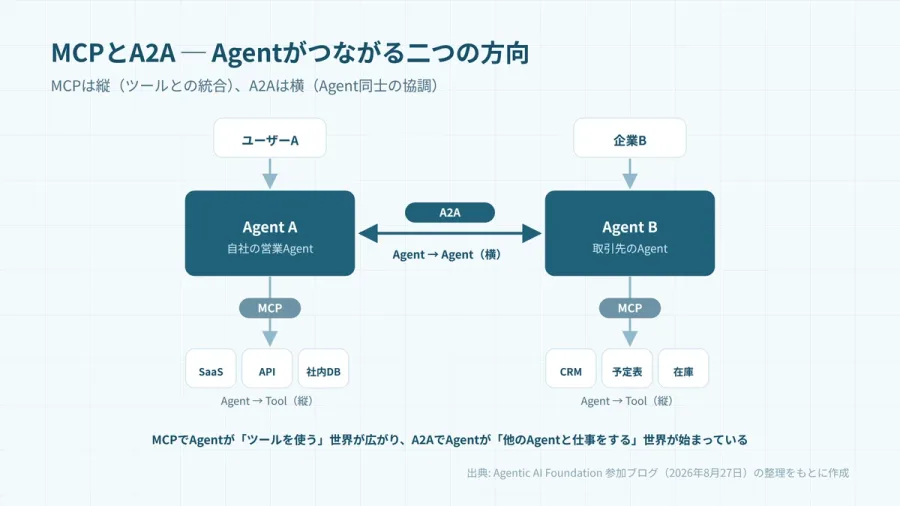
A2A is often confused with MCP (Model Context Protocol), but their roles are distinct. MCP connects agents to tools. It is a connection protocol for agents to use external tools (SaaS, APIs, databases, internal systems). A2A connects agents to other agents. The counterpart is not a tool, but another agent with its own intent and judgment. The AAIF blog summarizes this as: MCP is vertical (integration with tools), A2A is horizontal (collaboration between agents).
The component in that horizontal interaction that is directly related to the theme of this article is the Agent Card. It is a JSON document that an agent publishes about itself, describing who it is (name, provider), what it can do (skills / capabilities), where to connect (endpoint), and which authentication method to use, allowing other agents to mechanically determine how to connect. The Signed Agent Card in v1.0 uses JWS signatures to verify that the card was issued by the provider as declared. In other words, the mechanisms for 'where an agent is and what it can do' are now quite well-established.
However, this raises the next question
Here are the questions that the current set of tools answers:
A2A: How to talk (transport, task exchange, negotiation procedures)
Agent Card: What kind of agent it is (capabilities, connection destination, authentication method)
OAuth / OIDC: Whether it is a party allowed to connect to that service (access rights)
However, none of these answer the following question.
?: This agent, from whom and what kind of actions have been delegated to it? (The source and scope of the delegation)
A2A defines communication etiquette, Agent Cards declare capabilities, and OAuth passes access rights. None of these are mechanisms for conveying to the other party 'which human's agent this is, and what scope of agency it is acting under.' We will look at how this question specifically manifests in the next section.
While the A2A specification includes In-Task Authorization, the method for expressing delegation is left to the implementer. This is not a flaw, but a difference in scope, and that layer must be filled by someone.
'The Agent itself' and 'the permissions the Agent holds' are different
Suppose one agent contacts another with the following:
'I would like to coordinate next week's meeting on behalf of Mr. Tanaka.'
The recipient can verify the Agent Card. The signature is correct, the provider is known, and it can be confirmed that it possesses the skill for scheduling. Even so, the things one really wants to verify are mostly not written on the Card.
Is it truly acting on behalf of Mr. Tanaka, and has it been granted the authority to coordinate the schedule?
Is it just looking at the calendar, or is it allowed to finalize the appointment?
Is that authority still valid? (Has it not already been revoked?)
All of these are questions of 'what the agent has been entrusted with,' not 'who the agent is,' and a Signed Agent Card only guarantees the latter. Even if the same software from the same provider is running, the scope of what it is entrusted with varies from time to time. In other words, an agent's identity alone is not enough. It becomes important to be able to understand 'from whom, what, and to what extent the agent has been entrusted.'
This problem itself is not new. A secretary coordinates the president's schedule, and a representative negotiates on behalf of a company. There were ways to verify this (business cards and titles, letters of attorney, a phone call just in case), but all of these were mechanisms based on the premise of humans reading and making judgments. What is needed is to express the same agency relationship in a form that machines can verify with each other. Otherwise, the world that A2A aims for, where tasks are delegated without human intervention, cannot be realized.
As A2A becomes more widespread, this problem will become even more important.
Within the same company, it can be managed quite well with existing mechanisms. You can separate accounts for agents using internal accounts, IAM, OAuth, and ACLs, restrict permissions, and keep logs. As a structure, it is a solvable problem. On the other hand, what A2A is aiming for is coordination that crosses company and service boundaries.
The users on the left and right belong to different organizations. From the perspective of Agent B, Agent A is a system of another company, and it cannot reference internal IAM or User A's account. Even so, Agent B needs to be able to judge that Agent A 'has been granted authority by User A for this action.' If it cannot, the only two choices are to entrust nothing or to entrust without verifying.
Here, the following elements suddenly become important.
Identity: Who is that agent?
Delegation: From whom has the authority been entrusted?
Authorization: What and to what extent is it allowed to do?
Trust: Why can that claim be believed?
Audit: Can the operation be traced back to whose authority it was performed under?
Within the same organization, many of these five elements were covered by the assumption that 'we are in the same company.' The moment you cross that boundary, that assumption disappears.
While traditional Digital Identity has been built around 'who you are,' Agent Identity must also handle who it is acting for (Principal), what it is authorized to do (scope and conditions), and who granted that authority (chain of delegation).
Agent Identity = Identity + Delegation + Authority
Identity is just the first of the three-part set. If you connect agents without the other two, you are left with a state across boundaries where 'the identity can be verified, but the authority is self-declared.'
About VESS AIDENTITY
We at VESS Labs are developing VESS AIDENTITY with this Agent-to-Agent world in mind. We handle agent identity and the delegation of authority from humans and organizations to agents. In one sentence, our goal is this:
To enable agents to verify not just 'who this agent is,' but 'as whose agent is this one acting, and what has it been entrusted to do?'
If A2A handles the 'how to talk' layer, AIDENTITY handles the layer that makes the claims exchanged on top of it trustworthy—that is, the Identity / Delegation layer.
How exactly should that delegation be expressed? Is an extension of existing OAuth sufficient, or do we need proofs that can be carried across organizations? This is an area currently attracting significant attention.
Try it for free
VESS AIDENTITY is currently offering Early Access. You can try connecting to business tools, setting permissions, approval flows, and operation logs for free right now.
https://aidentity.vesslabs.ai/
Conclusion
With A2A v1.0 and joining the AAIF, the standards for 'how agents converse' have begun to take shape. The next question is not about conversation etiquette. When an agent is actually entrusted with work, there is one thing the other party wants to verify: Who has entrusted this agent with what? As AI agents evolve into entities that 'work externally as proxies for humans and companies,' the importance of Identity and Delegation will only increase.
Perhaps the next thing needed after agents can talk to each other is for agents to be able to trust each other.
VESS Labs, Inc.
A Japanese startup providing decentralized identity technologies such as DID (Decentralized Identifiers) / VC (Verifiable Credentials), as well as execution control and authority management layers for AI agents.
VESS AIDENTITY: https://aidentity.vesslabs.ai/
HP: https://vess.id
Contact: info@vess.id
References
A2A Protocol "A2A Protocol Ships v1.0: Production-Ready Standard for Agent-to-Agent Communication" (March 12, 2026) https://a2a-protocol.org/dev/blog/2026/03/12/a2a-protocol-ships-v10-production-ready-standard-for-agent-to-agent-communication/
A2A Protocol "A New Chapter for A2A: Joining the Agentic AI Foundation" (August 27, 2026) https://a2a-protocol.org/latest/blog/2026/08/27/a-new-chapter-for-a2a-joining-the-agentic-ai-foundation/
A2A Protocol Specification https://a2a-protocol.org/latest/specification/
VESS Labs "Should AI Agent Authorization be Solved with OAuth or DID/VC? Thinking from the Latest Internet-Draft" https://note.com/vesslabs
VESS Labs "AI Agents Will Also Need 'Employee ID Cards'." https://note.com/vesslabs/n/n6a1ff277dbdf
VESS AIDENTITY https://app.vesslabs.ai/