After staying for three days and two nights in Midosuji-Hommachi, Osaka, during the Golden Week training camp, I happened to find a bargain Teenage Engineering EP-133 K.O. II "the champ edition" at a DTM specialty store in Horie called SMITHS. Since I got my hands on it, I'll start by talking about it before even making a sound.
The EP-133 K.O. II's,"extraordinary perfection as an object."
The box itself was already a work of art.
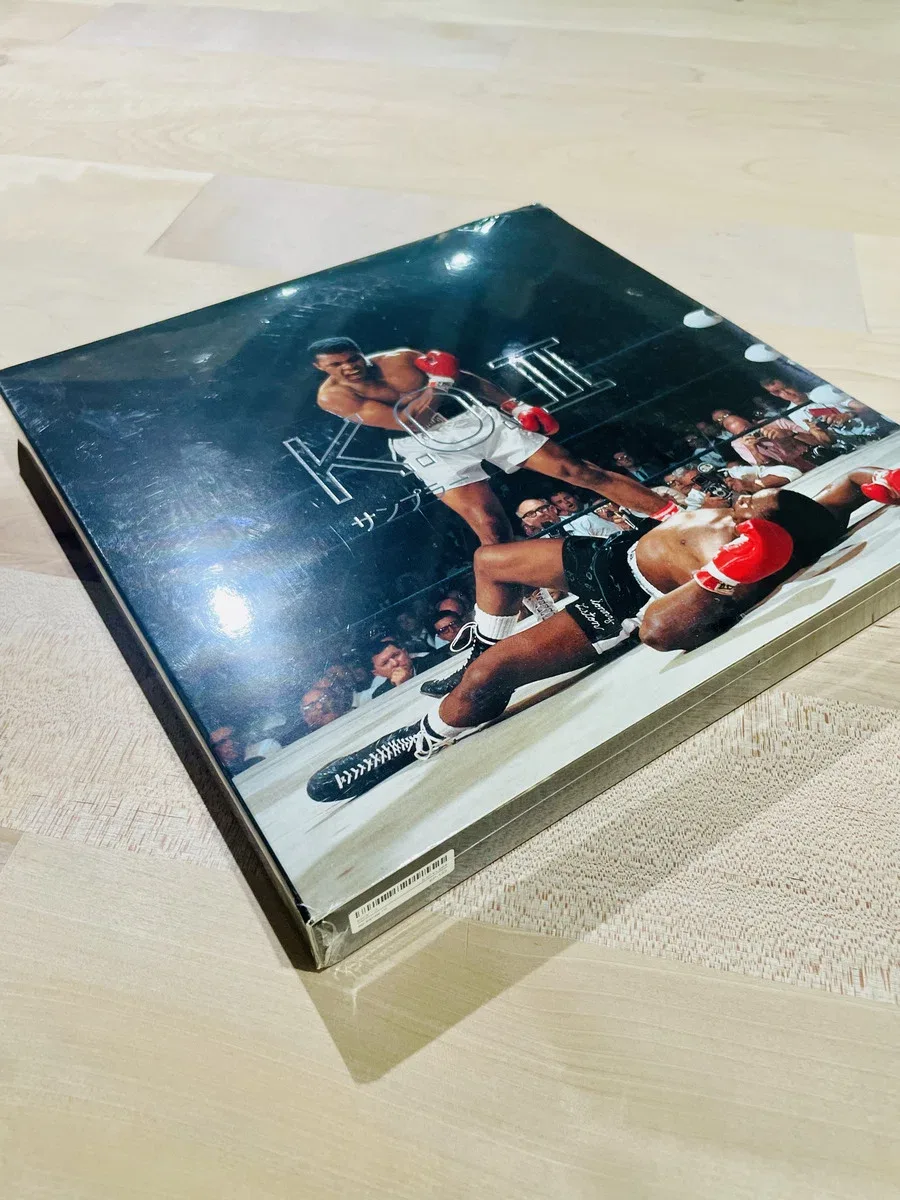
It's the exact same product as the Teenage Engineering EP-133 K.O. II, but this is a limited edition with different packaging, and since that actually made it eligible for a discount, I grabbed it immediately. Oh, the thrill.
A square box the size of an LP record. On the front is that moment etched into boxing history—Muhammad Ali's roar of victory as he looks down at his fallen opponent. The letters "K.O. II" overlap as if melting into the ring ropes. Below that, in katakana, it says "Sampler."
This strange temperature difference. This cultural collision. This sense of incongruity. A violent graphic design that only Teenage Engineering could pull off. These people are truly out there.
The back is also great. From an angle looking straight down at the ring, two boxers are in opposite corners of the canvas (one is down). Spectators surround all four sides. In the bottom right corner, in small print: "TEENAGE ENGINEERING AB / TEXTILGATAN 31 / 11230 STOCKHOLM / SWEDEN".
The Stockholm headquarters address is added to the boxing photo. A mystery. This sense of incongruity is exactly the brand's mysterious presence.
It makes you hesitate to peel off the shrink wrap,
the box alone could be interior decor.
The courage of a white chassis
When you open the lid, the unit appears, nestled in a paper tray.
It's white.
It's refreshingly white.
When it comes to musical instruments, especially samplers and drum machines, black is usually the standard. An anonymous matte black that sinks into the stage lighting.
The EP-133 completely ignores that convention, choosing a clean white that looks like office equipment—or, more accurately, like a Braun calculator.
And because of this white, the orange really pops.
The SAMPLE button. The RECORD button. The base of the GAIN knob. These three orange points on the white canvas precisely point out, "Touch here." A color scheme that serves as a textbook example of how to implement UI design physically.
A little bit of seriousness about the tactile feel of the buttons
If you're someone who types on a keyboard, you could talk all night about key switches. The buttons on the EP-133 offer a similar experience.
The number keys (0-9) are dark gray, with just the right amount of depth and a satisfying click. The group keys (A/B/C/D) are white and have a slightly shallower stroke.
The function keys (SOUND, MAIN, TEMPO, etc.) are even smaller, as if to prevent accidental presses, telling your fingertips, "Press here with intention."
And then there's the volume knob. The small white dial gives a light, tactile click every time you turn it. You could play with just this sensation for five minutes.
The modesty of the display
Before you turn it on, the display looks like a smoky mirror. It faintly reflects the surrounding scenery without making any statement.
When you turn it on, small dot-matrix icons light up one by one.
Group display, pad display, BPM, waveforms—everything is drawn in minimalist pixel art. It's not OLED or Retina, but this "deliberately coarse" display creates a sense of intimacy, like a Game Boy in the palm of your hand.
In the upper right of the display is a mesh speaker grille. Sound comes directly from here. This "self-contained feeling" is irresistible. You don't need to connect cables; just put in batteries, and you can sample and play right there on the spot.
The accessories are all cute
Everything that comes out of the box has its own personality.First, the "Quick Start Guide." It's the Japanese version of the quick start guide, and the cover features an illustration of the K.O. II unit and the familiar round-faced character from Teenage Engineering.
Opening it up, it's beautiful. Printed in two colors, orange and black, it's designed to get you to the "joy of making sound" in the shortest distance possible, covering RECORD → PLAY → SELECT SOUND → KEYS → SAMPLE → USING THE FADER → INPUT.
I feel like I can trust a product that makes me "want to read" the manual.
Cards with QR codes. Links to the "FULL GUIDE," precautions, and warranty information. They are all unified in card size, like a set of trading cards.
And the sticker sheet. MUTE button-style icons, piano keys, dynamite, umbrellas, cacti, pointing fingers—a lineup of motifs with unknown purposes.
It doesn't say "stick them on," and it doesn't say "don't stick them on." It just feels like they're there. That sense of distance.
The story behind the name "the champ edition"
The contents are the same as the standard EP-133. It doesn't have more features, nor does it contain exclusive sounds. The only difference is the packaging.
But, actually, it's not "only" that.
Teenage Engineering designs the very experience of "buying things." From the moment you hold the box, peel off the shrink wrap, open the lid, lift the unit from the tray, and check each accessory one by one—that sequence itself is already a musical experience.
The name "the champ edition" doesn't just refer to the boxing photos. It's a message that you, the one holding this, are the champ.
Well, maybe that's it. Probably.I haven't even talked about a single sound yet.
I've written this much, and I haven't written a single character about the sound of the EP-133 K.O. II.
64MB of sample memory. Built-in microphone. Real-time effects via fader. Pattern sequencer. I'll write about the long, long story of playing with it from here on out another time.
For now, today, I'm just looking at this box, this white, and this orange.
That alone is enough to make it a happy Saturday.
Aside: Why this is in my hands
Actually, this wasn't the purpose of my shop visit today.I went out to buy Teenage Engineering's new product, the EP-136 K.O. Sidekick—that $179 new machine that packs a 2-channel mixer, effects, and audio interface into the palm of your hand.
Second day of release. Already sold out.
Since it sold out on the day of its release in March, it has been on backorder for two months (only display units were in the store). It seems they finally restocked recently, but it's apparently almost impossible to get. Even if they have them, they sell out immediately, I was told.
Then what about Casio's SXC-1? It was gone in an instant as soon as pre-orders started.When it will be in stock is still undecided, and the clerk commented that you might be able to get it by ordering directly online rather than in-store.
What about Roland's SP-404MK II? Out of stock. Arrival date undecided.In other words, in Japan in May 2026, if you try to buy a sampler, a strange situation is occurring where products from domestic manufacturers are all unavailable, and products from a Swedish company are the easiest to buy.
I've wanted the K.O. II for a while, so this is definitely not a compromise. But what is this "inability to buy"?
Why a sampler in 2026?
Maybe it's the impact of the memory chip shortage. But what's even more intriguing is why, in the first place, so many people want hardware samplers right now.
Akai MPC Sample, sold out on the day of release.
Casio SXC-1, reservations gone in an instant.
Teenage Engineering is expanding the EP series one after another.
At Superbooth 2026, a new generation of granular samplers was announced, and it seems like everyone at NAMM is talking about "budget samplers."
Sound on Sound even writes that the hardware sampler market is more active than ever.
If you install the Koala app, your iPhone becomes a capable sampler. I also understand the argument that AI can do everything. In an instant, you can create a track where Aphex Twin dub-mixes gamelan and medieval church music. It's an era where you can generate high-level music just by entering a prompt.
But I think this is a different story.Because a smartphone can "do anything," you can't focus on anything.
Notifications arrive. Social media calls. Slack pings. The very fact that there are infinite choices on the other side of the screen becomes noise in the moment of creation.
But the generated music hasn't passed through your own body. Your body isn't involved in the process in terms of sensory experience. The pressure of your finger pressing a button, the speed at which you slide a fader, the reflexes that decide "this is it!" at the moment of sampling—music without that physicality becomes something distant, even to the person who made it.
What a hardware sampler provides is freedom in the form of "constraints."There's only 64MB. The screen is small. What you can do is limited.
But that's exactly why everything that happens inside that box becomes "your own choice."
That tactile feel cannot be reproduced in principle by smartphones or AI, which have infinite possibilities. Moreover, that time is, in a sense, unique and enjoyable. Time takes on a specific meaning.
Perhaps this isn't even a "rebound." I think it's a fundamental desire that was there all along, whose contours only became clear after smartphones and AI covered our daily lives.
I want to catch sounds with my own hands, rearrange them with my own fingers, and verify them with my own ears. There is a simple, earnest desire for just that.
That alone makes for a perfectly happy Saturday.
I turn on the K.O. II.
The display glows faintly. The built-in microphone is waiting for the air in the room.
The roar of motorcycles heard from outside the window, the low hum of the air conditioner, the clatter of fingers typing on a keyboard, the bubbling sound of brewing coffee—this world is overflowing with material waiting to be sampled.
Let's press the RECORD button.........and just as I was about to conclude, it turns out there's a vinyl record inside the box! What is this? Whoa, I was caught off guard; I guess that's one benefit of shopping without doing research.
When I get home, I'll put it on my old turntable and listen. Exciting.
Product Name: EP-133 K.O. II Sampler / Sequencer / Composer
Manufacturer: Teenage Engineering (Stockholm, Sweden)
Price: $329 (Standard Edition) / Domestic official price approx. 48,000–53,000 yen (tax included, varies by retailer)
the champ edition: Same price range as the standard edition. Includes a 10-inch vinyl record + limited edition Muhammad Ali artwork box. Limited production; out of stock at some retailers.
Item Details Sample Memory 64 MB (*Increased to 128 MB for new lots from January 2026. 64 MB version officially discontinued) Sample Slots Max 999 Sampling Frequency 48 kHz / 16-bit Polyphony Stereo 6 voices / Mono 12 voices (Expanded to 16 mono / 12 stereo in v2.0) Sequencer 4 groups × 99 patterns, 1–99 bars/pattern Effects 6 Master FX + 12 Punch-in FX I/O Stereo I/O (3.5mm), SYNC I/O, MIDI I/O, USB-C Built-in Mic Yes Built-in Speaker Yes Power 4x AAA batteries / USB-C Dimensions 240 × 176 × 16 mm Weight Approx. 365 g (excluding batteries)
Key new features in Firmware v2.0 "Champions" (Released April 2025, free) Resampling (sound/pattern), Song Mode (chaining scenes for song structure), sidechain, polyphony expansion, MIDI enhancements, hands-free sampling
Review SummaryMusicRadar: Intuitive and fun sampling workflow. Not the most powerful, but creativity thrives within constraints.
Sound on Sound: A true evolution of the PO-33. Praises the intimacy of the Game Boy-like display and the satisfying feel of the mechanical keys.
Gearnews: Phenomenal for a TE product at €349. "A musical toy in the best sense." The fader issues from the initial batch have been resolved.
Amazon.co.jp User: "Fast operation and responsive," "Battery life is surprisingly long," "Very fun and carefree when you accept its limitations."
Those who want to make beats easily without a DAW
Those who want to sample anywhere using the built-in mic and speaker
Those who prioritize portable size and battery operation
Those who resonate with Teenage Engineering's design philosophy
Memory capacity is quite low by modern standards (64 MB or 128 MB)
Arrangement features are inferior to competitors (MPC, SP-404MKII, etc.)
Punch-in FX cannot be recorded or sequenced
The edit screen is minimal and not suited for deep sound design
Official Store: teenage.engineering/store/ep-133 — $329. Direct shipping to Japan available.
Domestic Authorized Distributor: Handled by Media Integration (minet.jp). Available at various musical instrument stores (Rock oN, Kurosawa Gakki, Musicland KEY, etc.). Stock for the champ edition is low to sold out at some stores.
Amazon.co.jp: Both the standard edition and champ edition are listed (be aware of price fluctuations).
Akai MPC Sample ($399): Sold out immediately upon release in March. Finally back in stock recently after a 2-month backorder.
Roland SP-404MKII (around 50,000 yen range): A classic. Stock is unstable at some stores.
Casio SXC-1 (39,930 yen): Japan-first release on May 28th. Pre-orders sold out instantly; international release TBD.
Teenage Engineering EP-136 K.O. Sidekick ($179): The best mixer companion for the K.O. II. Released May 7th. Already reports of it being sold out.
Postscript: What is that vinyl, anyway? (A follow-up story)
And then, I listened to the vinyl. I put it on the turntable and dropped the needle.The moment Side A started, I was surprised. Industrial, post-punk, synthwave—the gritty texture of analog synths, repeating sequences, hard-edged noise that cuts through the space. And the quality is exceptionally high. This is not "sampler bonus record" quality. There is plenty of negative space, intentionally left open to make it easy to sample. What is this?
I looked it up and found the answer.This vinyl is distributed in connection with Dark Entries Records. Dark Entries is a label founded in 2009 by Josh Cheon in San Francisco, a cult entity that continues to unearth out-of-print and unreleased recordings of 80s industrial, post-punk, new wave, Hi-NRG, and more. It holds catalogs of artists such as Patrick Cowley (a giant of cybernetic disco known as the producer of Sylvester's "You Make Me Feel (Mighty Real)"), Severed Heads, Units, X-Ray Pop, and Rubella Ballet.
In other words, when TE made a "bonus sample collection," they didn't just prepare random material; they curated sounds from a legitimate archive of underground electronic music.
The "can you laugh, can you love" mix on Side A is the very aesthetic of Dark Entries, and the one-shots and loop materials on Side B are an homage to the origins of sampling culture—the act of picking up sounds from vinyl.
As the Juno Daily review pointed out, this follows in the lineage of Ultimate Breaks & Beats and battle tool records.
You play it on a turntable and sample it from there using the K.O. II's built-in microphone. Instead of streaming digital files via USB, you pick up the vibrations of the air from a physical disc. It is in that detour that the essence of the act of sampling lies.
The record is also sold separately for $29 (TE official store). You can get it even if you don't buy the champ edition.
10-inch, 45rpm, 170g. This wasn't a "bonus," it was an independent work. I hadn't expected that, so it was a truly pleasant surprise. It's new, fun, and delightful that a manufacturer can distribute something like this.