I finally went on a pilgrimage to the sacred sites of Osamu Dazai in Mitaka, a place I had been meaning to visit for a long time because it is so close, but never quite managed to get to.
I have visited every spot I could find, so I hope this will be helpful for those who are planning to visit as well.
By the way, as the writer of this piece, I am not very good at dealing with the moments when my mind goes blank while walking, so I created something for this trip.
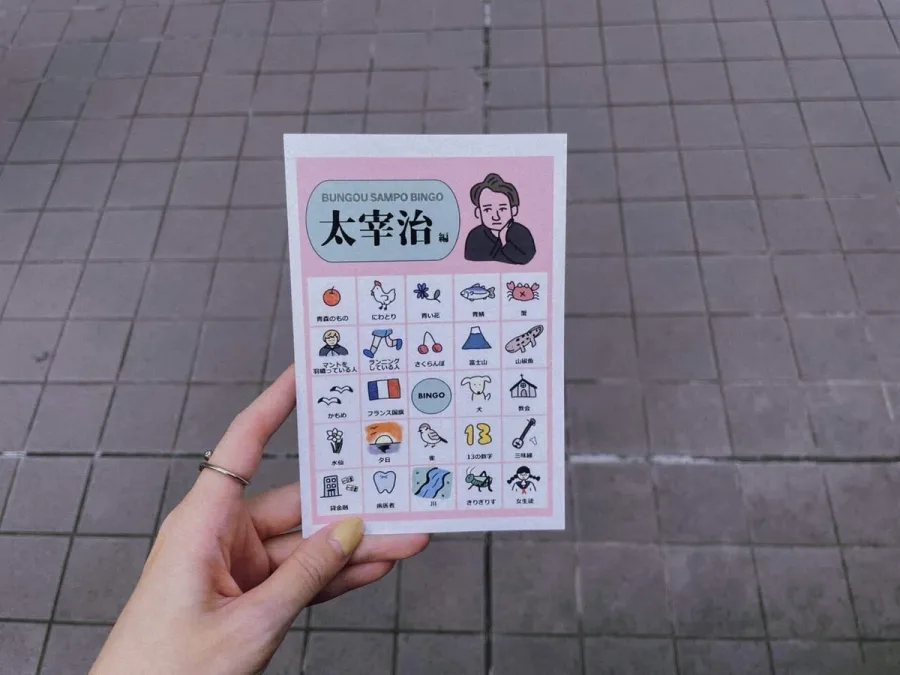
It's Literary Master Bingo!!!!
I created a bingo card with elements related to Dazai, so I will use this to enjoy the empty moments during my walk.
(I truly envy those who can enjoy those empty moments.)
I made the bingo content so that it can be enjoyed anywhere, not just in Mitaka, so please feel free to use it if you want to feel Dazai's presence while walking in your own neighborhood.
▼ Please download the bingo data here
* If you want to make it into a card, I recommend printing it in [postcard size].
I printed mine using the Seven-Eleven postcard print service.
In that case, if you selectprint slightly smallerit will finish without cutting off the edges.
* Although this is an original illustration, I have removed the Dazai illustration from the downloadable version due to concerns about portrait rights and copyright.
Instead, I have inserted some lovely illustrations by Loose Drawing. ️
I have summarized the episodes for each bingo element here!
Please zoom in to take a look if you are interested.
I will post my bingo results at the end!
Let's compete!
Walking Route
Here is the route for this walk.
I started from around Mitaka Station and went clockwise.
I wanted to visit every single Dazai-related spot, so the route ended up being nearly 20,000 steps.
If you think that sounds too tough, please feel free to pick and choose the spots that interest you.
By the way, although I am a fan of Dazai, I am not an expert or a particularly avid reader.
I majored in modern Japanese literature in college, but my research theme was Ango Sakaguchi.
They lived in the same era and were both called members of the Buraiha (Decadent School), but please forgive me if I lack knowledge regarding Dazai.
1. Osamu Dazai Exhibition Room
There is a building called CORAL right off the south exit deck of JR Mitaka Station.
I headed first to the Osamu Dazai Exhibition Room inside the Mitaka City Art Gallery located there.
There was a sign on the way to the 5th floor by escalator after entering CORAL.
I also took photos of several panels related to Dazai on the wall of the soba restaurant 'Kashiwaya' behind it.
The 'Mitaka Beauty Salon,' where Tomie Yamazaki—who drowned with Dazai—worked, was located next to the 'Kashiwaya' of that time, and it is said that Dazai even came to the landlady of 'Kashiwaya' to ask for money. (As expected of the greatest debtor among novelists!)
There was also a map of the area in front of the station from around 1940, when Dazai was in Mitaka, and it makes my imagination run wild wondering if he went to the bakery here.
There were no escalators from here, so I headed further up the stairs and found a heavy, bordeaux-colored door.
The door was shut tight, so I panicked, thinking,
Could it be closed today!?
But when I pushed down on the doorknob, it opened normally.
What a relief.
The entrance to the Osamu Dazai Exhibition Room is designed like this, with a partial reconstruction of the house where he lived in Mitaka based on historical documents.
The exhibition I visited this time was roughly divided into the following four sections.
In 1️⃣, postcards and the desk lamp Osamu Dazai used to love, which are owned by Mitaka City, were on display.
In addition to that, the highlight this time was the first public display of thehandwritten manuscript of 'Sparrow'!
Since I visited during Phase II of the special exhibition, the latter half of the pages of 'Sparrow' were on display, and I was able to see Dazai's brushwork and traces of his revisions up close.
This manuscript was discovered by Mitaka City in 2024 at a used bookstore in Tokyo that owned it, and the city purchased it for 8.8 million yen, as the complete handwritten manuscript without any missing parts is considered to have high documentary value.
Ninety percent of Dazai's manuscripts were donated to the Museum of Modern Japanese Literature by his wife, Michiko Tsushima, so it seems quite rare for one to be discovered at a used bookstore.
Previously, on 'Kaiun! Nandemo Kanteidan' (Fortune Appraisal), a postcard that the deceased son's father-in-law had exchanged with Dazai, as he was a fan, was brought out, but it is unlikely that a handwritten manuscript will just pop up again so easily.
I viewed it with a sense of gratitude, thinking that because Mitaka City purchased it, we are able to see it like this.
The special exhibition in 2️⃣ was the 'Osamu Dazai Materials Exhibition Phase II: Exchanges,' which mainly featured materials from people who had interactions with Dazai.
Among them, what left an impression on me was a postcard fromHidemitsu Tanaka.
Speaking of Hidemitsu Tanaka, he studied under Osamu Dazai, and after Dazai's suicide, he could not bear the shock and committed suicide by drinking 300 sleeping pills and a sho-chu (a liter of distilled spirit) before cutting his wrists in front of Dazai's grave, as if to follow him.
However, in a letter he addressed to his friend Tasuku Sato that was on display, he wrote, 'I can no longer tolerate that man's genius-ism,' and knowing that despite his complex feelings toward Dazai, Dazai was a light for him to live by, I felt the sadness of his death even more deeply.
In 3️⃣, Paintings and Calligraphy by Osamu Dazai, the oil paintings and calligraphy he created were on display.
Despite the eccentric use of color, the paintings had an aura where the whole was in harmony, and they were charming, with a vividness and boldness that reminded me of Henri Matisse's 'Woman with a Hat'.
I was surprised that his talent was not limited to writing.
Since photography was allowed in 4️⃣, the recreation of Osamu Dazai's study and reception room, I took a few pictures.
It is a tatami room, and you can take off your shoes and step up only here.
Dazai's iconic 'double-breasted' coat is hung up, and
manuscript paper is placed in the drawer of the desk at the bottom right of the photo, so it seems you can also experience writing as if you were Dazai.
A passage from 'Cherry' is also displayed in the room, and I could imagine Dazai packing his bags and leaving from this very desk.
At the entrance, there is a stand where you can stamp a commemorative seal of your visit, and the staff kindly handed me a pamphlet and told me I should definitely stamp it here.
When I tried to take a picture of the exterior, the security guard outside even removed the rope used for lining up so that it would be easier to take photos; everyone was truly kind.
Everyone was so kind, and despite having such valuable materials, this facility is free to enter. I highly recommend it.
② Site of the Wakamatsuya Eel Restaurant
After leaving CORAL, where the Osamu Dazai Exhibition Room is located, you will find an information board for the "Former Site of Unagi Wakamatsuya" at the entrance to the outdoor bicycle parking area.
It seems that the "Unagi Wakamatsuya" food stall, which Dazai often used for meetings with his editors, was located here.
It is said that many writers, including Masuji Ibuse and Kazuo Dan, visited this place to see him.
The restaurant has since relocated to Kokubunji and is currently run by the third generation.
I would love to try the eel that Dazai ate.
3. Former Site of Tanabe Meat Shop / Dazai Alley
There was also an information board for the former site of the Tanabe Meat Shop, which Dazai rented to continue writing "The Setting Sun," and the location of the alley commonly known as "Dazai Alley," where his favorite small restaurant "Kikuya" was located.
I wandered around for a while unable to find this information board, but...
It was in a place like this!
It was posted above a trash can for a restaurant, so there was no way to know!
I couldn't help but laugh.
The Tanabe Meat Shop is also depicted as the setting for "The Criminal," and a passage from it is written on the information board.
Imagining the scene of Dazai walking through this area, I head to the next location.
4. Osamu Dazai Literary Salon (Former Site of Isemoto Liquor Store)
The former site of the Isemoto Liquor Store, which the Dazai family used to frequent, is now operating as a wonderful salon where you can read research books on Osamu Dazai and enjoy Dazai-related food and drinks on the spot.
When I went inside, research materials and books related to Osamu Dazai were placed all along the walls.
Looking closely, there were many books that were self-published research compiled into Japanese-style bindings, and I could deeply feel the passion of those who love Dazai.
There are also volunteer guides at the facility who explain the items in the building and the nearby pilgrimage sites, which made me even more interested in the places I was about to visit.
Other visitors were also talking, saying things like, "I'm not a Dazai fan, but I went to Aomori recently, so I was a little curious," or "I like Natsume Soseki, and I happened to see this, so I was curious," and it seemed to me that there were more people who had just dropped by rather than devoted readers on this day.
A model of the Dazai family's home in Mitaka, which was partially recreated in the Osamu Dazai Exhibition Room I visited earlier, was also on display.
Seeing it like this really gives you an idea of their daily life.
There were also plenty of Dazai goods such as clear files and keychains.
I bought a few, so I would like to introduce them!
I purchased these three items.
The first is a pencil engraved with a sentence from an Osamu Dazai novel.
They also had ones for "Villon's Wife" and "Run, Melos!," but I chose "The Setting Sun."
A famous sentence is engraved in gold, and it feels so auspicious that I feel like both love and revolution would succeed if I used this pencil.
It seems to be a collaboration item with Musashino Art University, and its simple elegance really stands out.
The second item is a postcard featuring a photo of Dazai taking a walk near his home in Mitaka.
His cheerful expression is so cute that I couldn't help but buy it.
I have a literary friend I exchange letters with, so I think I'll use this to send the next one.
The third item is a cookie with apple fiber from "Tsugaru".
The packaging is inspired by the first edition of "Tsugaru" published in 1944, and I bought it because it looked so cute.
Perhaps thanks to the apple fiber in the cookies, there is a pleasant scent of apple that brushes past my nose as I eat them.
The cookies themselves are quite orthodox and simple.
Personally, I think they might be even tastier with a bit more richness, so maybe adding some clotted cream would be nice.
5. Site of the Nogawa House / Site of the small restaurant "Chigusa"
There are also places associated with Dazai a short walk from the Dazai Osamu Literary Salon.
This information board marks the site of the Nogawa House, where Tomie Yamazaki, who committed suicide by drowning with Dazai, used to lodge.
It is said that Dazai also used a room on the north side of the second floor of the Nogawa House as his workspace starting around September 1947, when he became close with Tomie Yamazaki.
On June 13, 1948, the day Dazai died, he left behind works such as "Goodbye" (his unfinished final work) and headed from here with her toward the Tamagawa Aqueduct.
The Nagatsuka Funeral Home currently stands on this site.
Across from it is the site of the small restaurant "Chigusa," where Dazai also used the second floor as a workspace.
It seems Dazai used various places around Mitaka as workspaces; perhaps it was his nature to be unable to write in the same place.
I wondered if Dazai would have been happy if there were shared offices like we have today, but I also feel that having places to be in so many different locations is a testament to his charismatic personality.
6. Tamagawa Aqueduct Relief / Gyokuka Stone
Now, having returned toward the station, I have come along the Tamagawa Aqueduct.
I tried peering into the river, but the water flows slowly and quietly; it is so calm that it is hard to believe anyone would drown themselves here.
As you walk east along the river, there is a relief engraved with a passage from Dazai's "Beggarly Student".
It is a passage describing how the cherry blossoms, having turned to leaves, cover the Tamagawa Aqueduct from both sides, like a tunnel of green leaves.
It also notes that Dazai ended his life in this river in June 1948 at the age of 38.
Unlike today, the fact that it refers to the Tamagawa Aqueduct as "deep" fills me with sorrow as I imagine them struggling and growing cold.
There is also the following sentence in "Beggarly Student".
This shows that at the time, it was recognized as such a dangerous river.
A little further on, a "Gyokka-seki" (Jeweled Deer Stone) has been placed, and it is said that Osamu Dazai and Tomie Yamazaki committed suicide by drowning near the spot opposite this stone.
Although the exact place where they entered the water is still unclear, it is said that this stone, a specialty brought from Dazai's birthplace of Kanagi Town in Aomori Prefecture, was placed here—where their footwear was reportedly found neatly arranged—in response to fans' requests to "know the final place."
"Rather than letting the stone speak, I want to leave it to the imagination of the viewer."
It is said that nothing is engraved on the stone, making it an unmarked monument.
I put my hands together here and continue along the river.
The house of Yuzo Yamamoto, famous for "The Roadside Stone," is also along this street, but it was closed for renovations. What a pity.
Although the periods during which Osamu Dazai and Yuzo Yamamoto lived in Mitaka overlapped for about seven years, it is said that no records of them having any contact remain.
7. Crape Myrtle (Mitaka Koshintei)
Turning off the path along the river, you will find Mitaka Koshintei in the residential area.
Mitaka Koshintei is open as a Japanese-style cultural facility with tea rooms and the like, but in fact, the crape myrtle that was at Dazai's house has been transplanted here.
You can see it from outside the facility, and the tree poking its head out from the fence is that very crape myrtle.
There were still a few flowers left.
The small pink petals glowed fleetingly and were beautiful.
Dazai's former residence was opposite this facility, and it is written in "Osan" that the crape myrtle was planted in front of that entrance.
A staff member at the Osamu Dazai Literary Salon mentioned that this crape myrtle tree might be the only thing remaining in the city of Mitaka that Dazai actually saw.
We should be grateful to those who continue to preserve it.
Incidentally, the site nearby where Dazai's former residence is said to have stood is now just part of a residential neighborhood that looks no different from the surrounding area.
In the book 'Tokyo Hyakkei' (One Hundred Views of Tokyo) by Peace member Matayoshi, who is also famous as a Dazai fan, there is an anecdote about how he later discovered that the apartment he first lived in after moving to Tokyo was coincidentally built on that very site.
⑧ Inokashira Park / Matsumoto Kundō Memorial Monument
Heading further east, I arrived at Inokashira Park.
This is a place depicted in many of Dazai's works, such as 'Villon's Wife' and 'Kōson Sensei Genkōroku'.
It was cool that day, and there were many families having picnics.
Following the riverside in the park, I found a stone monument.
This is the Matsumoto Kundō Memorial Monument.
It is a memorial to Teacher Matsumoto Kundō, who died while trying to save a child who had fallen into the Tamagawa Aqueduct—the same incident mentioned in the excerpt I shared earlier when introducing the relief for 'Beggar Student'.
This monument was built to honor this brave act for future generations.
While the act of protecting a child should be praised, water accidents often result in deaths during rescue attempts, so it would be good if knowledge on how to perform rescues were more widely disseminated.
In a split-second situation, I feel like my instinct to just save them would take over...
The characters carved into the stone monument are quite shallow, so it looks like nothing is written on it in photos, but when you look closely, it is densely engraved with text.
Given the season, spider lilies were blooming along the river, and I prayed for the repose of Teacher Matsumoto Kundō's soul.
Next to the park is the Ghibli Museum, Mitaka, and I could even catch a glimpse of the Giant Warrior.
⑨ Renjakuyu Bathhouse Site
After passing through the south side of Inokashira Park, you will find the site of Renjakuyu, the public bathhouse that the Dazai family used to frequent.
Dazai's 'December 8th' also depicts a scene where his wife takes their eldest daughter to the bathhouse.
It is a story from the day the Pacific War began; after cherishing the cuteness of his child in the bath, he had to walk home in the pitch-black night, carrying his sleeping daughter, due to the blackout regulations for the war.
Currently, a Honda Cars dealership operates at this location.
It is hard to imagine that this area was once in total darkness.
⑩ KANNON COFFEE
This place is unrelated to Dazai, but my legs were feeling like lead from exhaustion, so I had lunch at this lovely cafe I found on the map.
The interior had large glass windows covering one side, letting in sunlight that made it feel pleasant, spacious, and calm.
The panini was also delicious, with the salty flavor of the mentaiko and cheese pairing perfectly with the chewy bread.
Many people were ordering desserts, so I would like to try something sweet next time I visit.
⑪ Coffee Matsui Shoten
I had just finished a latte so I couldn't stop by, but I passed by Coffee Matsui Shoten, which sells items like 'Dazai COFFEE' inspired by the era in which Dazai lived, and took a photo.
The storefront had a catchphrase that read, 'Sorry for being too delicious.'
It is currently a cafe, but it is said that Dazai often came to shop at the original Matsui Shoten, which dealt in alcohol and tobacco.
I am curious about what their coffee tastes like.
⑫ Used Book Cafe Phosphorescence
Located a little under a 30-minute walk from Mitaka Station, there is a used book cafe opened by a Dazai fan.
I had wanted to visit someday, so I was happy to see the actual shop, but it was closed that day.
Sorry for my lack of research...
The shop had many posters related to Dazai displayed.
The shop name 'Phosphorescence' is taken from Dazai's novel of the same title.
In the novel, the word is used as the name of a flower, but no such flower actually exists; it seems to be a word that means 'phosphorescence' in Greek.
It is said that you can also order lattes with Dazai's face drawn on them at the shop.
I was looking forward to ordering that, so I will definitely go back to visit.
⑬ Osamu Dazai's Grave (Zenrin-ji Temple)
I walked back toward the station and arrived at Zenrin-ji Temple, where Dazai rests.
The main gate at the entrance to the parking lot bears the name 'Reisen-zan,' which is the 'sango' (a title prefixed to a temple's name).
I passed through this temple gate to enter.
As I proceeded to the back, I found a sign for the entrance to the graveyard.
It lists not only Osamu Dazai but also Ogai Mori, with both of their names inscribed.
Following the path further back, it becomes semi-underground, leading out toward the cemetery.
Once I reached the cemetery, I wandered around the grounds for a while because I couldn't easily find Dazai's grave, so I recommend that anyone visiting should check the approximate location beforehand.
I found Dazai's grave and offered a prayer.
Next to the grave, there was a request from the Tsushima family asking visitors to 'please take your offerings home with you,' so I left nothing and simply expressed my gratitude to Dazai in my heart.
The inscribed characters for 'Osamu Dazai' were written by Masuji Ibuse.
Michiko Tsushima, his wife, also rests next to Dazai's grave.
There was a tree with some kind of fruit growing in front of the grave, but I wonder what it is.
I tried looking it up, but I couldn't figure it out.
An image search suggests it might be a quince.
Opposite Dazai's grave is the grave of Ogai Mori.
The name 'Rintaro Mori' inscribed there is Ogai Mori's real name.
It is no coincidence that the graves of Osamu Dazai and Ogai Mori are close to each other.
There is a passage in Dazai's 'Hanafubuki' (Flower Blizzard) that mentions this.
It is said that Michiko, his wife, took these thoughts of Dazai to heart and had him buried here after his death.
I also offered a prayer to Ogai Mori and left Zenrin-ji Temple.
⑭ Book relief
Returning to the bustling Chuo-dori street at the south exit of Mitaka Station, there is a monument to Osamu Dazai and the literary critic Katsuichiro Kamei, with whom he was close.
The part shaped like a book is engraved with a portion of Dazai's 'The Setting Sun,' and below it is an interesting feature that includes 'Mitaka-mura Shimorenjaku' from 'Buraipa no Inori' (Prayer of the Decadent School), in which Kamei recorded his memories of Dazai.
It seems there are other monuments on this Chuo-dori street related to Rofu Miki, Saneatsu Mushanokoji, and Yuzo Yamamoto, who also had ties to Mitaka, so please try to find those as well.
⑮ Site of the Nakabachi House
Near Mitaka Station, in a place that is now an apartment building, stood the site of the Nakabachi house, which was one of Dazai's workplaces.
He returned to Mitaka from his evacuation life in November 1946, and it seems this place was rented to avoid visitors and focus on writing; it was located diagonally across from the Mitaka Station Post Office. It must have been a convenient location for his work as well. Works such as 'Villon's Wife' were written here. The story 'Morning,' in which a married 'I' and a young woman who admires him spend a night during a power outage, is said to be set in this room. They are not lovers, and there seems to be a level of trust where the woman's mother even asks 'I' for his opinion on her marriage prospects, but... Hearing that the actual room was the setting makes 'Morning' feel even more like a story that really happened, increasing its sense of reality. (Terrifying)
16. Mitaka Station Post Office
It is an unremarkable post office, but as mentioned earlier, it is said that Dazai used this post office to receive his manuscript fees and for other purposes.
The Mitaka Post Office appears in the essay 'Minanogawa and Uzaemon.' The Yokozuna Minanogawa also lived in Shimorenjaku, Mitaka, and Dazai humorously describes the scene when he saw him. It is a piece of writing that makes you chuckle because you can imagine what he looked like, even though you know nothing about Minanogawa. It is short, so if you haven't read it, please do.
17. Site of the Mitaka Pedestrian Overpass
Finally, I have come along the train tracks.
Dazai was very fond of the view from the pedestrian bridge that used to be in this area, and he often brought his disciples and editors here. The famous photo of Dazai wearing a cape was also taken here. However, the bridge was demolished due to aging starting in December 2023, and although construction is still ongoing, the bridge itself has vanished without a trace.
This location is planned to become a 'Pocket Space (tentative name)' to preserve the records and memories of the overpass, and Mitaka City has announced a crowdfunding campaign for its development. Although this has already ended, it is said that depending on the donation amount, one could receive items like paperweights made from parts of the overpass as a return gift.
It is a pity that I could not see the same view that Dazai loved, but I look forward to the day it is reborn as a new place of relaxation.
In closing
This has become quite long, but how was it? I recorded this so that those who were thinking of going, those who live too far away to visit easily, and those who have visited several times can all enjoy it. I would be happy if this has been of any help to you.
This is a bit of a trip down memory lane, but it was my high school modern literature teacher who taught me the appeal of Osamu Dazai. He was an eccentric teacher who would play a mysterious flute during thinking time in class or keep moving his hands in a squirmy way while explaining things, but he used to exchange letters with me, as I loved novels, to share our thoughts on books at the time. Since there were no book-loving friends around me, I still vividly remember how much I enjoyed those exchanges. Now that I am a working adult and busy every day, I understand it even more, and I cannot thank him enough for the time he set aside for me back then. My teacher, who adored Dazai, chose and introduced me to works he thought I would like, such as 'Otogizoshi' and 'Run, Melos!'. They were works that contained his own new interpretations of the stories, different from the Osamu Dazai we read in class, and I remember reading them avidly as they felt like a fresh perspective to me at the time.
I had heard that my teacher was also in Tokyo during his student days, so this walk made me feel nostalgic, wondering if perhaps he had also come to Mitaka.
Even today, many people visit Zenrin-ji Temple on O-to-ki (the anniversary of Dazai's death), and I am once again surprised that he left behind works that remain in so many people's hearts even more than 70 years after his death. The fact that there are still people seeking his novels today, even across generations, makes me feel that Dazai captured the fundamental suffering, loneliness, and beauty of human beings, which resonates with many people.
The streets of Mitaka, tracing the final days of such a Dazai. Although almost nothing from the time Dazai was alive remains in the city, by walking around while thinking of him like this, I feel I was able to learn just a little bit about what kind of feelings he had toward his life and his work in this place. In addition, I was able to recall the time I spent being saved by his works. I hope that Dazai is looking down from heaven and is happy to see that he is still so loved in Mitaka today.
Bingo results (bonus)
Here are my bingo results!
1 BINGO!!!
I looked, but as expected, there was no one in Mitaka wearing a cape.
I took photos of everything except people, so I'll post what I found.
This ended up being quite long, but thank you for reading.️