This time, it's an essay, or perhaps more of a casual reflection piece.
Suno credits are settled on a monthly basis and do not roll over.
Once a month passes, it simply resets to the "monthly credits" determined by your subscription, and any credits remaining from the day before are lost and wasted.
So, when your monthly credit settlement date (which is based on the day you first subscribed, so it's different for every user) approaches and you realize, "Oh, I'm definitely going to have credits left over," I think it's a good idea to do something you wouldn't normally do because it would be a waste of credits, but...
when you're actually in that situation, it's hard to think of anything.
In the first place, I don't usually hoard my credits and I use them for experimental things, so I don't really come up with things I want to do just because I have "leftover credits."
If I had to say, I think I could use them for things I occasionally plan on this Note, like "setting various style prompts for the same lyrics to generate music and compare them," but,
well,actually, I'm already doing things close to that (trying out various styles) in my daily generation activitiesanyway...
So that happens sometimes.
Because of that, I couldn't really think of a good idea, but the other day, I finally thought of one "challenge you can only do because you have leftover credits."
That is,
taking on the challenge of remaking a song from my repertoire that is difficult to remake
is what it is.
What this means is that among the songs generated with Suno, there are "remake-difficult songs", where no matter how many times you try, the lyrics get garbled, the melody line breaks, or it turns into a different song halfway through when you try to Cover or Remaster them.
When you listen closely to those songs, you can tell that there are parts in the original song where the pronunciation is hard to hear, or it contains a tricky melody line that isn't very common (which is often the charm of that song), and that's where the "remake fails."
It's also quite common for a major dissonance to occur during a Cover because of a part where the original song's chord progression is a bit rough.
When you generate many songs, sometimes a song appears that "sings the parts that usually fail well," but even in that case, it usually "fails in a different place," so as a whole, it almost always ends up being a failed remake.
When remaking, the "musical style you are aiming for after the remake" is almost always decided, so you can hardly change the parameters (other than slightly increasing or decreasing Audio Influence or Style Influence), so it becomes a task of "repeating the generation gacha until a 'miracle remake' is born that gets through all the frequent failure points."
By the way, a typical example of a song that somehow took shape after repeating this remake generation gacha is listed here.
https://suno.com/s/2klNpUdOUUVEnwCf
This song is,as I have written before, a remake of this song, which is the "first" one I ever made when I took on Suno.
This song has a special place in my heart because it was my first song, and even listening to it now, I think it's a very high-quality song (I can't believe it was the first song I ever made), but there is just one point: in the second verse, where it should sing "favorite song," it sings "fav-o-rite song" with an extra syllable, which is really a shame.
So, of course, I tried replacing it with Edit, and I tried remaking it with Cover many times, but it "absolutely won't fix it." Why?
Later, when I thought I wanted to put this song on music distribution services, I also thought I wanted to update the original Suno v4.5+ song to a v5 base (by the way, Remaster also always fails), and I thought I would have KIRARI cover it to reduce the slightly excessive kayokyoku (Japanese pop) and folk song feel of the original song.
And so, after repeating the gacha about 20 times.
The KIRARI version above is the one where the Cover succeeded at a level where I could just barely accept it.
The KIRARI version has a slightly different melody line, and there is the issue that the ending is a completely different song, but aside from that, I think it covers it reasonably well. KIRARI's singing voice also matches the lyrics well.
*In the end, I went ahead and released the original version too...
So, the 'remake gacha' for 'hard-to-remake songs' really requires generation at the level of 20 or 30 times, and since 'failed songs' become complete trash, I personally feel this is the best way to 'use up leftover credits'.
It's like, 'Let's take another shot at that song I had given up on remaking!'
I thought of another one.
Creating a new artist profile.
As I wrote in this article, in order to create a 'good artist profile,' it is important to actually generate the 'sample songs' incorporated into the profile (preferably generating 2-3 times to make 4-5 songs and looking at the average), compare the differences between the image and the actual generated songs, provide feedback to Gemini (download the generated songs and let Gemini listen to them as well), and refine the profile so that songs closer to the image are generated.
To do that, you use up quite a lot of credits.
Moreover, since the songs generated in that process are 'songs that are different from the image,' most of them are usually a waste.
Therefore, I think it's best to refine and create an artist profile when you have leftover credits before your billing date.
It seems Suno's cover art creation feature has been enhanced...
Suno's cover art creation feature, which was completely unusable, has been enhanced, and it seems the video generation feature in particular has been strengthened. Since this consumes a large amount of credits, it might become the primary way to use them when you have leftovers.
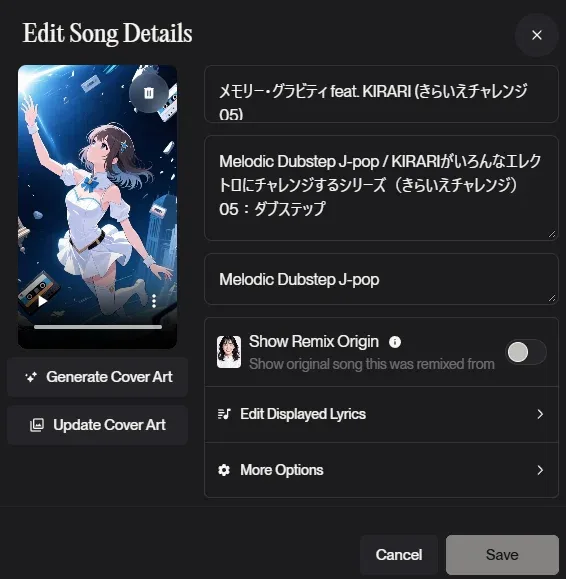
I tried using it. The image for 'Memory Gravity' from the Kirarie Chronicle seems easy to make into a video, so I'll use that.
I selected 'Generate Cover Art,' entered a light script in I2V, and clicked 'Generate.' A 5-second Basic model costs 50 credits. The Advance model costs twice as much, and even if the time is 10 seconds, it costs twice as much, so making a 10-second video with the Advance model consumes 200 credits at once. Credits really disappear like water.
After waiting for a while (I was made to wait several minutes even for a 5-second Basic video), two videos are generated. The quality is surprisingly not bad.
The cover image within Suno also becomes a video, and you can also use this video to create a Hook.
That said, my impression of the videos is still that they have 'a long way to go,' so I don't feel like getting serious about it. At this point, it's nothing more than 'playtime for when you have leftover credits.'
Making karaoke tracks.
This might also be quite interesting as a credit-consuming activity.
You make karaoke versions of your favorite songs using leftover credits!
To make a karaoke track, you need stem separation, but with the 10-credit version that only separates vocals and instruments, the backing chorus can end up in the vocal track, and you might end up cutting the chorus when you intended to cut the vocals, which can be very disappointing, so even when making karaoke tracks, it is better to use full stem separation. That will consume 50 credits, so if you're going to do it, it's best to do it when you have leftover credits before your billing date.
Since the use of separated stems is basically limited to adjusting volume, such as turning it up, down, or cutting it, you don't necessarily have to do it in Suno Studio; I think it's fine to just download the audio source and do it in a DAW.